
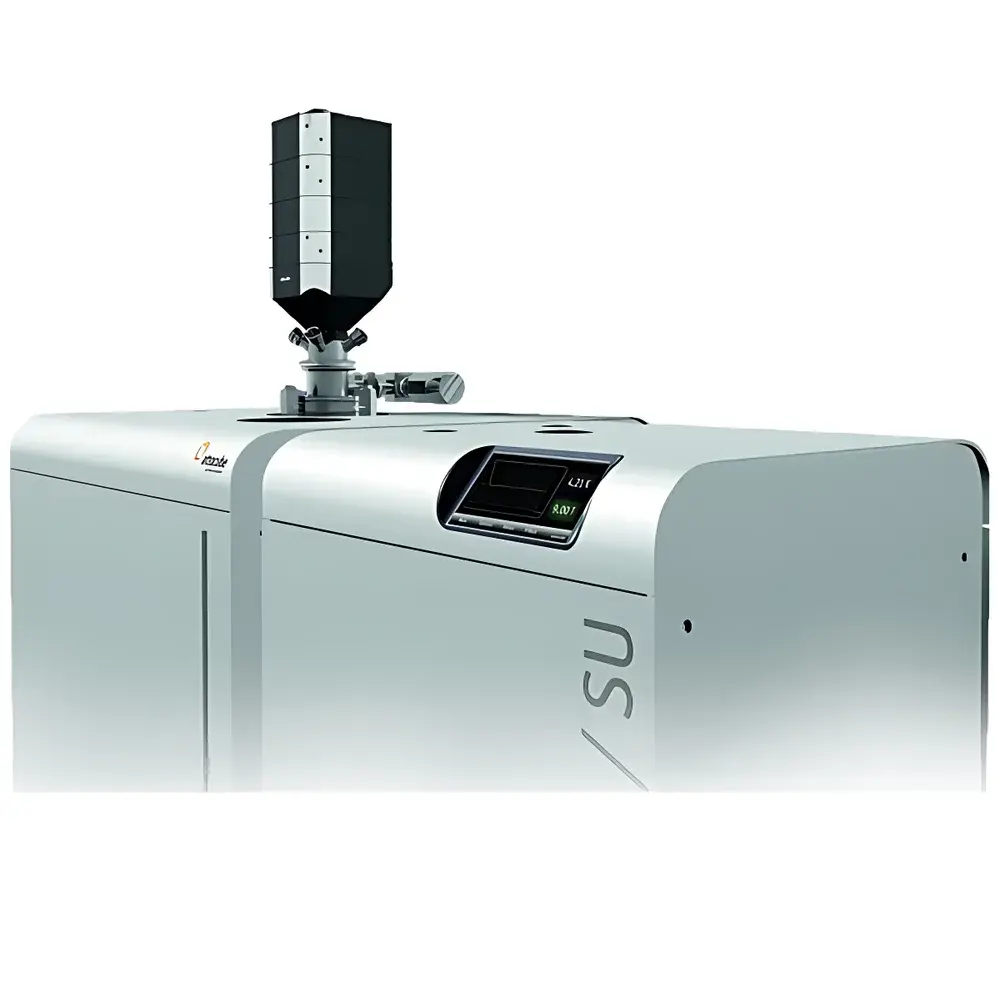
Attocube attoCSFM Cryogenic High-Magnetic-Field Optically Detected Magnetic Resonance Imaging System
| Brand | Attocube Systems AG |
|---|---|
| Origin | Germany |
| Model | attoCSFM |
| Operating Temperature Range | 1.5 K – 300 K |
| Magnetic Field Range | 0 – 15 T |
| Optical Spectral Range | 400 – 1600 nm |
| Objective Lens | Cryogenic Confocal Objective (NA = 0.82, Working Distance = 4 mm) |
| Scan Range | 30 × 30 µm (at 4 K) |
| Spatial Resolution | < 50 nm (lateral), < 5 nm (z-height control) |
| Magnetic Field Sensitivity | ≤ 3 nT/√Hz (100 s integration) |
| NV-center-based Diamond Nanosensor Integration | Yes |
| AFM Platform | Tuning-Fork-Based Non-Contact AFM |
| ESR Detection Method | Spin-Dependent Fluorescence via Confocal Microscopy |
| Drift Stability | < 10 nm over 1 h (room-temperature base stability reference) |
| Compliance | Designed for GLP/GMP-aligned lab environments |
Overview
The Attocube attoCSFM is a cryogenic, high-field optically detected magnetic resonance (ODMR) imaging system engineered for quantitative nanoscale magnetometry under extreme conditions—down to 1.5 K and up to 15 T. Unlike conventional magnetic imaging techniques such as magnetic force microscopy (MFM) or scanning Hall probe microscopy (SHPM), the attoCSFM combines quantum sensing with scanning probe architecture to deliver both sub-50 nm spatial resolution and nanotesla-level field sensitivity in a single measurement modality. Its core principle relies on the spin-dependent photoluminescence of nitrogen-vacancy (NV) centers embedded in a diamond nanocrystal mounted on a tuning-fork-based atomic force microscope (AFM) sensor. Under resonant microwave irradiation, the NV spin state transitions are optically probed via confocal fluorescence detection. The Zeeman splitting of the NV ground-state triplet directly encodes local magnetic field magnitude and orientation, enabling vectorial field mapping with calibration traceable to fundamental constants. This architecture eliminates the trade-off between resolution and quantification inherent in contact-mode MFM or low-resolution SHPM, establishing the attoCSFM as a benchmark platform for fundamental studies in quantum materials, superconductivity, and spintronics.
Key Features
- Integrated quantum sensor: Single NV-center diamond nanocrystal (< 100 nm size) mounted on a low-noise tuning-fork AFM probe for non-perturbative, non-contact magnetic field sensing.
- Cryogenic compatibility: Fully operational from 1.5 K to 300 K using closed-cycle or wet-dilution refrigerator integration; optimized thermal anchoring and vibration isolation.
- High-field capability: Compatible with superconducting magnets up to 15 T; includes active field homogeneity compensation and microwave delivery through cryogenic waveguides.
- Confocal optical access: Dedicated low-temperature objective (NA = 0.82, WD = 4 mm) supporting excitation and collection across 400–1600 nm—enabling simultaneous ODMR, Raman, and photoluminescence spectroscopy.
- Nanomechanical stability: Sub-10 nm thermal drift over 1 h (referenced to room-temperature base); real-time topographic feedback ensures precise height control during magnetic imaging.
- Modular architecture: Interchangeable AFM modes (non-contact, tapping, current-sensing), optional time-resolved fluorescence lifetime (TRPL) and pulsed ODMR extensions.
Sample Compatibility & Compliance
The attoCSFM accommodates a broad range of solid-state samples—including thin-film heterostructures, 2D materials (e.g., CrI₃, Fe₃GeTe₂), superconducting vortices, skyrmion lattices, and biological spin-labels—without requiring conductive coatings or vacuum-compatible metallization. Sample mounting follows standard cryogenic sample holders (e.g., OFHC copper stages with gold-plated contacts). All optical and microwave pathways are sealed and pressure-rated for UHV-compatible operation. From a regulatory standpoint, the system’s hardware design and software logging architecture support audit-ready workflows aligned with ISO/IEC 17025 requirements for calibration traceability and measurement uncertainty reporting. While not FDA-certified (as a research instrument), its data acquisition modules comply with 21 CFR Part 11 principles for electronic records and signatures when deployed in GLP-compliant laboratories.
Software & Data Management
Control and analysis are performed via the proprietary attoDRY Control Suite, a Python- and LabVIEW-integrated environment supporting synchronized acquisition of topography, ODMR spectra, microwave frequency sweeps, and fluorescence intensity maps. All raw data are stored in HDF5 format with embedded metadata (timestamp, temperature, field, laser power, microwave amplitude). Built-in tools include lock-in demodulation for ESR frequency tracking, vector field reconstruction algorithms (Bx, By, Bz), and spectral deconvolution for multi-NV ensemble analysis. Export options include ASCII, TIFF, and MATLAB-compatible structures. Audit trails record user actions, parameter changes, and calibration events—essential for reproducibility and compliance documentation.
Applications
- Quantitative vortex imaging in type-II superconductors (e.g., NbSe₂, FeTe₀.₅₅Se₀.₄₅) with simultaneous topographic and magnetic contrast.
- Nanoscale domain wall dynamics in antiferromagnetic insulators and synthetic antiferromagnets.
- Spin texture mapping in topological insulators (Bi₂Se₃, Sb₂Te₃) and magnetic Weyl semimetals.
- Characterization of spin-torque efficiency and stray fields in magnetic tunnel junctions for next-generation MRAM development.
- In situ spin-labeling studies of protein conformational changes at cryogenic temperatures.
- Calibration and validation of micromagnetic simulation models (e.g., MuMax³, OOMMF) using experimentally derived B-field distributions.
FAQ
What is the minimum detectable magnetic field gradient?
The system achieves ≤ 3 nT/√Hz sensitivity for homogeneous fields; gradient sensitivity depends on scan step size and integration time—typically ~100 nT/µm at 1 s integration per pixel.
Can the attoCSFM operate in ultra-high vacuum (UHV)?
Yes—the sample space and optical path are UHV-compatible (≤ 10⁻⁹ mbar), and all feedthroughs meet ConFlat flange standards.
Is NV-center alignment required before measurement?
No—diamond nanocrystals are pre-characterized for optimal (111) orientation; automated microwave polarization optimization is included in the startup routine.
How is microwave delivery implemented at cryogenic temperatures?
A low-loss, flexible coaxial line with cryogenic SMA connectors delivers microwaves to a miniature coplanar waveguide integrated near the NV sensor; impedance matching is maintained down to 1.5 K.
Does the system support pulsed ODMR sequences?
Yes—optional extension module enables π-pulse generation, T₁/T₂* mapping, and dynamical decoupling protocols (e.g., XY8, CPMG) for coherence time analysis.



