
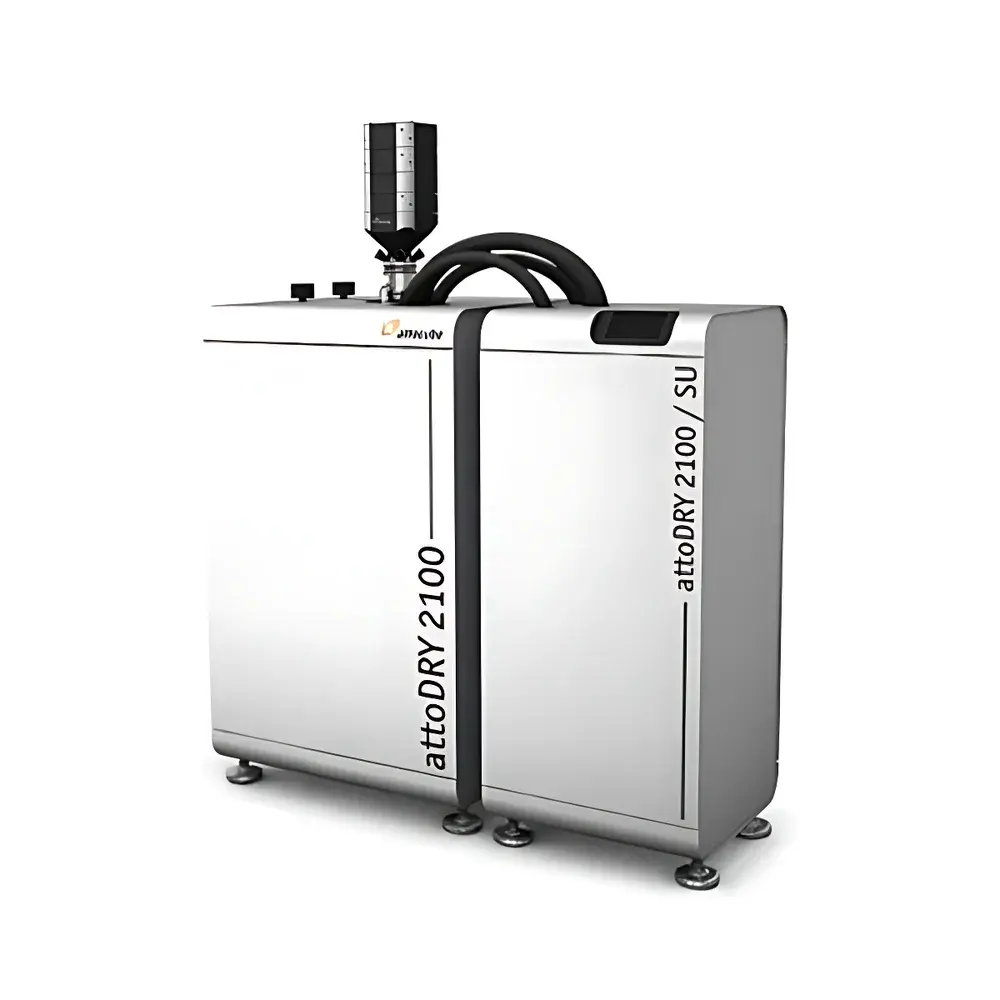
attocube attoDRY Series Cryogen-Free Low-Vibration Magnet and Cryostat Systems
| Brand | attocube Systems AG |
|---|---|
| Origin | Germany |
| Model | attoDRY800 / attoDRY1000 / attoDRY1100 / attoDRY2100 |
| Cooling Principle | Pulse-tube cryocooler |
| Base Temperature | 3.8 K (attoDRY800), 4 K (attoDRY1000/1100), 1.5–1.8 K (attoDRY2100) |
| Temperature Range | 1.5–320 K (model-dependent) |
| Temperature Stability | < ±5 mK (attoDRY2100), < ±10 mK (attoDRY1000/1100), < ±15 mK (attoDRY800) |
| Vertical Vibration Amplitude (Z-axis) | < 0.15 nm (attoDRY1000/1100/2100), < 5 nm peak-to-peak (attoDRY800) |
| Sample Chamber Diameter | 49.7 mm (attoDRY1000/1100/2100), 75 mm (attoDRY800) |
| Magnetic Field Options | Up to 9 T (superconducting), vector magnet configurations available |
| Optical Access | Integrated optical vacuum chamber with high-NA low-temperature objectives (NA ≥ 0.8) |
| Control Interface | Touchscreen-based automated temperature & field control (attoDRY1100/2100), manual control (attoDRY800/1000) |
| Refrigeration Power | >5 mW @ 5 K, >1000 mW @ 4.2 K (attoDRY1000/1100/2100) |
Overview
The attocube attoDRY Series represents a class of cryogen-free, low-vibration magnet-cryostat systems engineered for high-precision quantum transport, scanning probe microscopy (SPM), and quantum optical spectroscopy at millikelvin temperatures. Unlike conventional liquid-helium-based cryostats, the attoDRY platforms utilize closed-cycle pulse-tube refrigeration—eliminating dependency on liquid helium supply chains, associated safety protocols, and recurring operational costs. Each system integrates a mechanically decoupled cold head with an ultra-stiff optical or SPM-compatible sample stage, achieving sub-nanometer mechanical stability in the Z-direction. This architecture enables reproducible measurements under static or swept magnetic fields (up to 9 T), while maintaining thermal equilibrium across the sample region with exceptional temporal stability. The attoDRY platform is not merely a cooling device but a fully integrated experimental infrastructure—designed for compatibility with confocal microscopy (CFM), Raman spectroscopy, atomic force microscopy (AFM), magnetic force microscopy (MFM), scanning Hall probe microscopy (SHPM), cryogenic photoluminescence spectroscopy (CPS), and dual-axis rotation stages (atto3DR). Its modular vacuum chamber design supports custom optical paths, electrical feedthroughs, and multi-probe wiring—all without compromising vibration performance or thermal homogeneity.
Key Features
- Cryogen-free operation using high-reliability pulse-tube cryocoolers—no liquid helium handling, storage, or replenishment required.
- Ultra-low mechanical vibration: Z-axis displacement < 0.15 nm RMS (attoDRY1000/1100/2100); < 5 nm peak-to-peak (attoDRY800), enabling stable single-emitter photoluminescence and atomic-resolution SPM imaging.
- High-temperature stability: < ±5 mK (attoDRY2100), < ±10 mK (attoDRY1000/1100), and 24 h).
- Large, accessible sample space: 49.7 mm cylindrical bore (attoDRY1000/1100/2100); 75 mm diameter optical chamber (attoDRY800), accommodating complex multi-probe setups and high-NA cryogenic objectives (NA ≥ 0.81).
- Automated touchscreen interface for simultaneous temperature and magnetic field control (attoDRY1100/2100); manual PID tuning supported on all models.
- Modular vacuum architecture with customizable flange configurations (CF, KF, ISO-K), optical viewports, and electrical feedthroughs (DC, RF, microwave).
- Integrated cooling power optimization: >1000 mW at 4.2 K (attoDRY1000/1100/2100); 100 mW at 4.2 K (attoDRY800), sufficient for multi-channel electrical transport and cryogenic detector biasing.
Sample Compatibility & Compliance
The attoDRY systems are designed for direct integration into cleanroom-compatible, GLP-aligned laboratory environments. All models meet ISO 14644-1 Class 5 particulate requirements when operated under standard vacuum conditions (<1×10⁻⁶ mbar base pressure). Electrical feedthroughs comply with IEC 61000-4-2 (ESD immunity) and IEC 61000-4-3 (radiated RF immunity). Vacuum chambers are constructed from oxygen-free high-conductivity (OFHC) copper and 316L stainless steel, ensuring minimal outgassing and long-term UHV compatibility. The systems support full traceability of temperature setpoints and magnetic field profiles—enabling audit-ready data acquisition for ISO/IEC 17025-accredited laboratories. For regulated research domains—including medical device material characterization and quantum sensor development—the attoDRY platform supports optional 21 CFR Part 11-compliant electronic signature and audit trail modules via third-party DAQ software integration.
Software & Data Management
attoDRY systems ship with attoDRY Control Suite—a cross-platform (Windows/Linux) application supporting real-time monitoring of cold-head status, temperature gradients, compressor health, and magnetic field ramp rates. The suite provides programmable temperature ramps (0.01–10 K/min), field sweeps (0–9 T, 0.1 T/s max), and synchronized trigger outputs for external lock-in amplifiers, time-correlated single-photon counting (TCSPC) modules, or AFM controllers. Data export follows HDF5 format with embedded metadata (timestamps, calibration coefficients, hardware revision IDs), ensuring FAIR (Findable, Accessible, Interoperable, Reusable) compliance. Integration with LabVIEW, Python (via PyVISA), and MATLAB is natively supported. Optional add-ons include automated calibration logging, failure mode prediction (based on compressor cycle statistics), and remote diagnostics via encrypted TLS 1.3 tunnels.
Applications
The attoDRY platform serves as foundational infrastructure for studies requiring simultaneous low-temperature, high-field, and ultra-stable mechanical conditions. Key use cases include: quantum emitter spectroscopy in 2D semiconductors (e.g., WSe₂, WS₂ monolayers); valleytronic and spin-valley coupling measurements under magnetic field; nanoscale Hall effect mapping in topological insulators; magneto-transport in moiré superlattices; cryogenic photoluminescence lifetime imaging (PLIM); and scanning gate microscopy of edge states in quantum Hall systems. Published work using attoDRY systems spans *Nature Materials*, *Nature Nanotechnology*, *Physical Review Letters*, and *Nature Photonics*—demonstrating reproducibility across >130 academic and national lab installations worldwide, including institutions such as Max Planck Institutes, ETH Zurich, MIT, Stanford, and the Chinese Academy of Sciences.
FAQ
What cooling technology does the attoDRY series employ?
The attoDRY series uses high-efficiency pulse-tube cryocoolers—eliminating liquid helium dependence while delivering stable base temperatures from 1.5 K to 4 K depending on model.
Can the attoDRY systems be used for electrical transport measurements?
Yes. All models provide dedicated low-noise electrical feedthroughs (up to 48 channels) and support four-terminal DC, AC lock-in, and pulsed IV measurements down to sub-picoamp levels.
Is vacuum integrity maintained during magnetic field ramping?
Yes. Superconducting magnets are housed within a separate, thermally anchored vacuum enclosure; field ramping induces no measurable pressure rise or vibration coupling into the sample stage.
How is vibration isolation achieved in the Z-direction?
Through a multi-stage passive damping architecture: helium-filled bellows, tuned mass dampers, and kinematic mounting of the cold finger—validated by laser Doppler vibrometry per ISO 20816-1.
Are attoDRY systems compatible with third-party SPM controllers?
Yes. Standard analog/digital I/O interfaces (BNC, D-sub) enable seamless synchronization with commercial AFM, STM, and SHPM controllers—including those from Keysight, RHK, and Scienta Omicron.



