
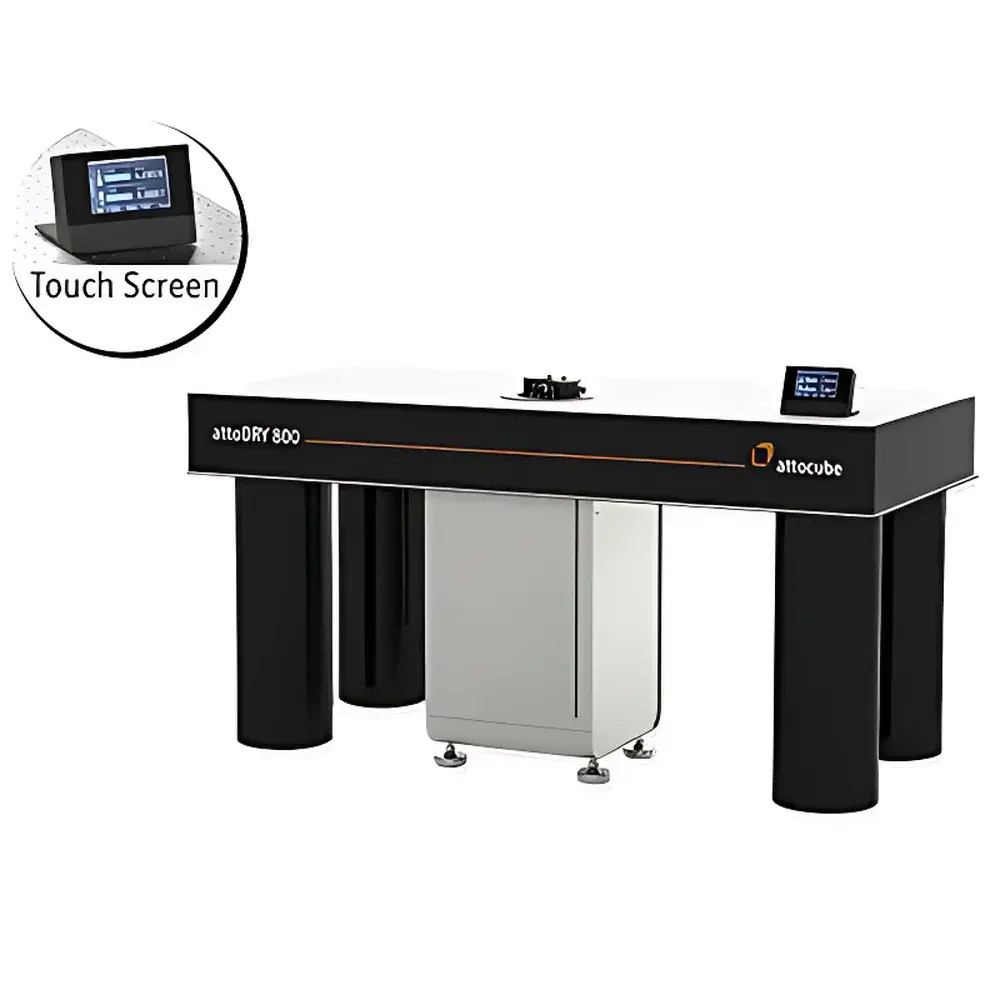
Attocube attoDRY800 Desktop Optical Cryogenic Thermostat
| Brand | Attocube Systems AG |
|---|---|
| Origin | Germany |
| Model | attoDRY800 |
| Instrument Type | Upright |
| Temperature Range | 3.8 K to 320 K |
| Temperature Stability | <15 mK |
| Vibration Level | <5 nm peak-to-peak (vertical, 1500 Hz bandwidth) |
| Sample Chamber Diameter | 75 mm |
| Base Pressure | <5×10⁻⁶ mbar |
| Leak Rate | <5×10⁻⁹ mbar·L/s |
| Cool-down Time (to 5 K) | <4.5 h |
| Cooling Power | >170 mW @ 5 K |
| Compressor Power | 3 kW |
| Cooling Method | Closed-cycle, helium-free |
| Dimensions (Optical Table Mounting) | 900 mm × 1800 mm × 305 mm (height of vibration isolation legs: 597 mm) |
Overview
The Attocube attoDRY800 Desktop Optical Cryogenic Thermostat is an engineered solution for high-precision optical experiments requiring ultra-stable thermal and mechanical environments at cryogenic temperatures. Based on closed-cycle pulse-tube refrigeration technology, it eliminates dependence on liquid helium while delivering continuous, autonomous operation from 3.8 K to 320 K. Its defining architecture integrates the cold head beneath a standard optical table—preserving full optical access to the sample region without obstruction. This spatially efficient design enables unimpeded beam paths from multiple directions (top, side, diagonal), supporting complex configurations such as confocal microscopy, micro-Raman spectroscopy, quantum dot photoluminescence, and two-photon interference experiments with remote emitters. The system achieves sub-5 nm peak-to-peak mechanical stability at the cold stage—measured directly via laser interferometry—making it suitable for applications where thermal drift or vibrational noise would otherwise degrade spectral resolution, spatial localization, or coherence fidelity.
Key Features
- Integrated cold-head placement beneath optical table surface, maximizing usable free-space optics area
- Ultra-low vibration performance: <5 nm peak-to-peak (vertical), <2 nm RMS (200 Hz–1500 Hz bandwidth)
- Full automation via embedded touchscreen and remote software control (temperature ramping, vacuum management, cooldown/heat-up sequencing)
- High-vacuum sample chamber (<5×10⁻⁶ mbar base pressure; leak rate <5×10⁻⁹ mbar·L/s) compatible with in-situ electrical and optical probing
- Modular vacuum shroud options: room-temperature objective, low-working-distance objective, high-vacuum objective, and cryogenic objective (NA up to 0.95)
- 36 standard user-accessible electrical feedthroughs (DC/AC/SMA/fiber); expandable per configuration
- Compatible with attocube’s low-temperature nanopositioners, rotation stages, tilt stages, and scanning probes
- Compressor options: water-cooled (standard) or air-cooled (optional); helium transfer line lengths configurable (6 m standard, 13 m or 20 m optional)
Sample Compatibility & Compliance
The attoDRY800 supports diverse sample geometries within its 75 mm diameter sample space. Sample exchange is performed by opening the vacuum shroud—no disassembly of cryogenic components required. The system accommodates standard optical mounts, fiber-coupled excitation/detection paths, and multi-probe electrical interfaces. It meets essential laboratory infrastructure requirements for ISO/IEC 17025-accredited testing environments, with traceable temperature calibration protocols and audit-ready operational logs. While not certified to FDA 21 CFR Part 11 by default, its software architecture supports integration into GLP/GMP-compliant workflows through external data acquisition systems that implement electronic signatures and audit trails. Vacuum integrity and thermal stability are verified per ASTM E1502 (Standard Guide for Calibration of Cryogenic Thermometers) and ISO 21360-1 (Vacuum technology — Calibration of vacuum gauges).
Software & Data Management
Control is executed via the proprietary attoDRY Control Suite—a cross-platform application supporting Windows, Linux, and macOS. It provides real-time monitoring of temperature, pressure, compressor status, and vibration metrics. All setpoints, ramps, and hold profiles are scriptable using Python APIs (PyAttocube), enabling synchronization with third-party instruments (e.g., spectrometers, lock-in amplifiers, time-correlated single-photon counting modules). Data export conforms to HDF5 and CSV formats, ensuring compatibility with MATLAB, Python (NumPy/Pandas), and LabVIEW. System logs—including vacuum pump cycles, temperature deviations, and compressor duty cycles—are timestamped and stored locally with optional network backup. Firmware updates are delivered over secure HTTPS channels with SHA-256 signature verification.
Applications
The attoDRY800 serves as a foundational platform for quantum optics, nanophotonics, and condensed matter research. Published use cases include: single-photon emission characterization of InGaN quantum dots across 5–200 K (Nanoscale, 2017); phase-transition mapping in monolayer 1T-TaS₂ via temperature-dependent Raman spectroscopy from 4–300 K (Adv. Mater., 2018); and mutual two-photon interference between spatially separated semiconductor quantum emitters housed in synchronized attoDRY800 units (TU Berlin). Additional validated configurations include low-temperature confocal microscopy (attoCFM I), micro-Raman imaging (attoRAMAN), and fiber-based optical probe stations with dual-side excitation/detection. Its mechanical stability enables diffraction-limited imaging, tip-enhanced Raman scattering (TERS), and cavity quantum electrodynamics (cQED) measurements requiring long integration times.
FAQ
Does the attoDRY800 require liquid helium or other cryogens?
No. It operates as a fully closed-cycle system using a pulse-tube cryocooler and integrated helium compressor—eliminating recurring helium procurement, handling, and boil-off losses.
What is the typical cooldown time to base temperature?
From ambient to 5 K takes less than 4.5 hours, including vacuum pumping and thermal equilibration.
Can the system be integrated with existing confocal or Raman microscopes?
Yes. Standard optical ports accommodate commercial objectives; custom vacuum shrouds and kinematic mounting solutions are available for OEM integration.
Is vibration performance validated independently?
Yes. Vibration spectra are measured in situ using calibrated laser Doppler vibrometry, with results published in technical white papers and peer-reviewed literature.
Are electrical feedthroughs customizable beyond the standard 36 lines?
Yes. Custom feedthrough panels with additional DC, RF, or fiber-optic channels can be designed and qualified for specific experimental requirements.



