
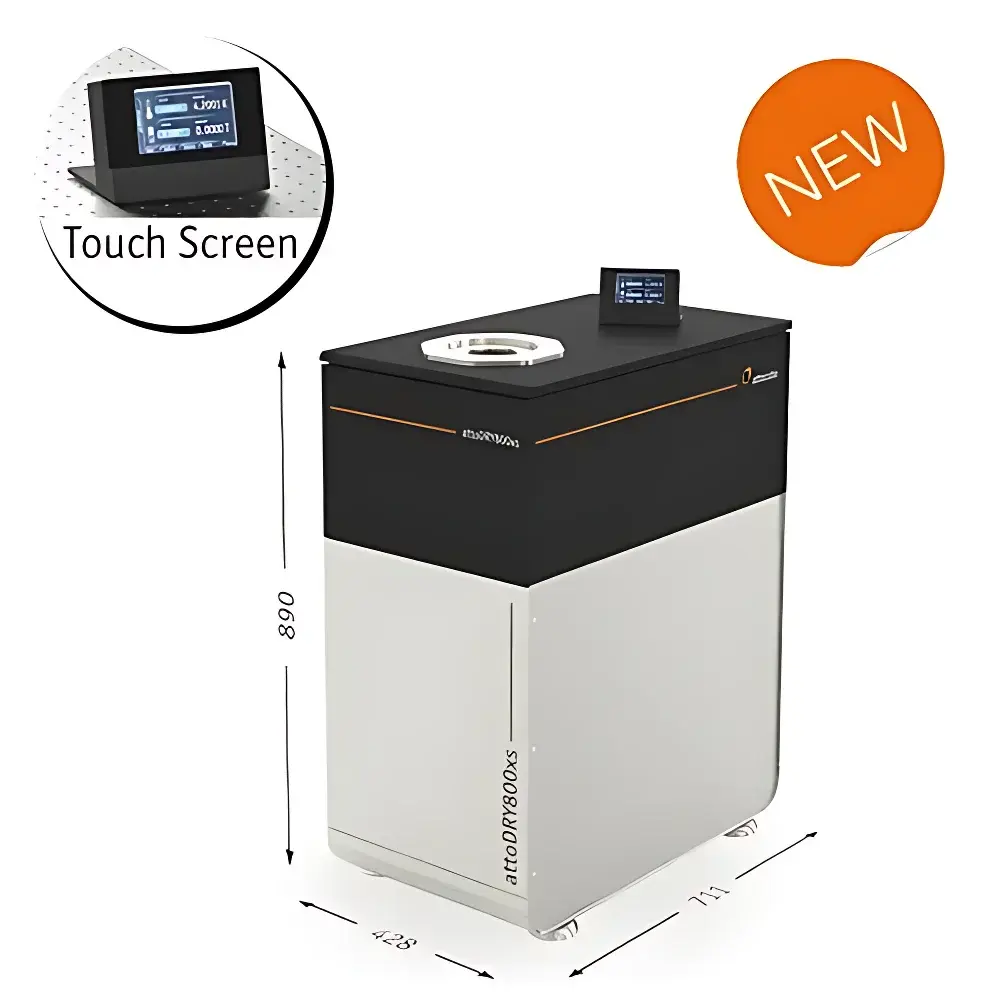
Attocube attoDRY800xs Standalone Optical Cryostat
| Brand | Attocube Systems AG |
|---|---|
| Origin | Germany |
| Model | attoDRY800xs |
| Instrument Type | Vertical |
| Temperature Range | 3.8 K to 300 K |
| External Dimensions | 17 in × 28 in (432 mm × 711 mm) |
| Cooling Method | Closed-cycle helium refrigeration, helium-free operation |
| Vibration Performance | Sub-microradian angular stability, <5 nm RMS vertical displacement below 10 Hz |
| Vacuum Enclosure | User-customizable, optically accessible, multi-port design |
| Integration Height | Compatible with standard optical table height (762 mm ± 10 mm) |
| Electrical Feedthroughs | 36 DC leads included |
| Optical Compatibility | Designed for low-temperature achromatic objectives (e.g., attoLFT series), ≥12 mm working distance, AR-coated viewports (250–1100 nm) |
Overview
The Attocube attoDRY800xs is a vertically integrated, standalone optical cryostat engineered for quantum optics, solid-state quantum emitters, single-photon source characterization, and nanoscale spectroscopy under cryogenic conditions. Unlike conventional bath-style or flow-cryostat systems requiring liquid cryogens or large footprint infrastructure, the attoDRY800xs implements a high-efficiency closed-cycle pulse-tube refrigerator coupled with a mechanically decoupled cold stage architecture. Its core measurement principle relies on thermally stabilized sample positioning within an ultra-low-vibration environment—achieving sub-5 nm RMS vertical displacement and sub-μrad rotational drift over extended acquisition windows. This enables diffraction-limited optical resolution and long-term spectral stability essential for resonant fluorescence, Hanbury Brown–Twiss interferometry, and coherent spin control experiments. The system operates across a continuous temperature range from 3.8 K (base temperature at minimum heat load) to 300 K, supporting both deep-cryogenic quantum state initialization and ambient-temperature alignment protocols without hardware reconfiguration.
Key Features
- Compact footprint: Occupies only 17 in × 28 in (432 mm × 711 mm) of benchtop space—designed for integration into space-constrained cleanrooms and shared optical laboratories.
- Optical-table-height compatibility: Cold stage mounting surface aligns precisely with ISO-standard optical tables (762 mm ± 10 mm), enabling direct mechanical coupling to translation stages, motorized goniometers, and fiber launch assemblies.
- Modular vacuum enclosure: Interchangeable, user-configurable vacuum shrouds with multi-angle optical access ports (up to 8 standard CF-35 or CF-63 flanges), anti-reflection coated fused silica viewports (250–1100 nm), and optional cold shielding layers.
- Integrated cryogenic achromat support: Engineered to accommodate Attocube’s attoLFT series low-temperature apochromatic objectives (NA ≥ 0.65, WD ≥ 12 mm) with minimal thermal gradient-induced aberration.
- Low-vibration cold stage: Patented mechanical isolation between compressor unit and cold head ensures <5 nm RMS positional noise below 10 Hz—validated via laser Doppler vibrometry per ISO 20816-1.
- Full remote operation suite: Embedded Ethernet interface supports TCP/IP-based temperature ramping, vacuum monitoring (Pirani + capacitance manometer), gas handling (He purge, N₂ backfill), and interlock management via LabVIEW, Python, or MATLAB APIs.
Sample Compatibility & Compliance
The attoDRY800xs accommodates samples up to 25 mm in diameter and 10 mm in thickness on its actively temperature-controlled copper cold finger. Standard sample holders include electrical contact plates with 36-pin DC feedthroughs (gold-plated phosphor bronze), piezo-driven XYZ nanopositioners (±15 µm range, <1 nm resolution), and interchangeable mounting fixtures for dielectric substrates, semiconductor heterostructures, or 2D material flakes. All vacuum components conform to UHV-compatible materials standards (ASTM F94-22), with outgassing rates <1×10⁻¹⁰ mbar·L/s·cm² after bakeout. The system meets CE marking requirements for electromagnetic compatibility (EN 61326-1) and safety (EN 61010-1). For GLP/GMP-aligned environments, audit-ready temperature logging (with NIST-traceable Pt-100 sensors) and electronic signature-capable control software are available as optional firmware modules compliant with FDA 21 CFR Part 11 Annex 11 guidelines.
Software & Data Management
Control is executed through the attoDRY Control Center—a platform-independent application supporting Windows, Linux, and macOS. It provides real-time visualization of temperature gradients across six calibrated sensor channels (cold finger, radiation shield, vacuum jacket, etc.), pressure trends, compressor status, and cooldown rate analytics. All operational parameters—including setpoint history, alarm logs, and thermal transient profiles—are exported in HDF5 format with embedded metadata (timestamp, operator ID, instrument serial number). The API layer exposes full SCPI command syntax and RESTful endpoints, enabling seamless integration into automated test sequences governed by Python-based experiment orchestration frameworks (e.g., QCoDeS, PycQED). Audit trails record every parameter change with user authentication and timestamped digital signatures—fully traceable for ISO/IEC 17025 laboratory accreditation.
Applications
- Quantum emitter spectroscopy: Resolved zero-phonon lines of SiV⁻, GeV⁻, and SnV⁻ centers in diamond at 4 K with linewidths <100 MHz.
- Cavity quantum electrodynamics: In-situ tuning of photonic crystal cavities and microdisk resonators via integrated piezo actuators while maintaining sub-wavelength cavity mode stability.
- Spin-photon interface characterization: Optically detected magnetic resonance (ODMR) of NV centers with simultaneous microwave delivery through coaxial lines and confocal excitation collection.
- Low-temperature Raman and PL mapping: Spatially resolved spectral acquisition across 2D TMD monolayers (MoS₂, WSe₂) with diffraction-limited spot size (<1 µm) maintained over 24-hour acquisitions.
- Hybrid quantum systems: Integration with superconducting microwave circuits via RF-tight vacuum feedthroughs and magnetic shielding options (µ-metal can upgrade).
FAQ
Does the attoDRY800xs require liquid cryogens?
No. It operates exclusively via a closed-cycle helium refrigeration system—no liquid nitrogen or liquid helium refills are needed.
Can I integrate my existing optical microscope objective?
Yes, provided it meets low-temperature mechanical and thermal contraction specifications; custom adapter rings and thermal compensation spacers are available upon request.
What is the base temperature under typical experimental load?
3.8 K is achieved with ≤50 mW total parasitic heat load on the cold finger; performance scales predictably with added wiring, optical elements, or RF cabling.
Is vibration isolation external to the system necessary?
Not required for most quantum optics applications; the built-in passive and active damping architecture meets ISO 20816-1 Class A criteria for precision optical instrumentation.
How is vacuum integrity maintained during thermal cycling?
All seals utilize metal gaskets (copper or indium) and undergo helium leak testing to <1×10⁻⁹ mbar·L/s prior to shipment; bakeout capability up to 120 °C is supported.



