Attocube IDS3010 Picometer-Accuracy Laser Interferometer
| Brand | Attocube Systems AG |
|---|---|
| Origin | Germany |
| Model | IDS3010 |
| Light Source | Single-frequency laser |
| Measurement Range | 0–5 m |
| Linear Measurement Accuracy | ±1 pm |
| Sampling Bandwidth | 10 MHz |
| Operating Environment | 10 mK, 1×10⁻¹⁰ mbar vacuum, up to 10 MGy radiation tolerance |
| Interface Options | HSSL, AquadB, CANopen, Profibus, EtherCAT |
| Probe Wavelengths | 650 nm (alignment), 1530 nm (measurement) |
| Probe Spot Sizes | 2 µm to 7.6 mm (depending on configuration) |
Overview
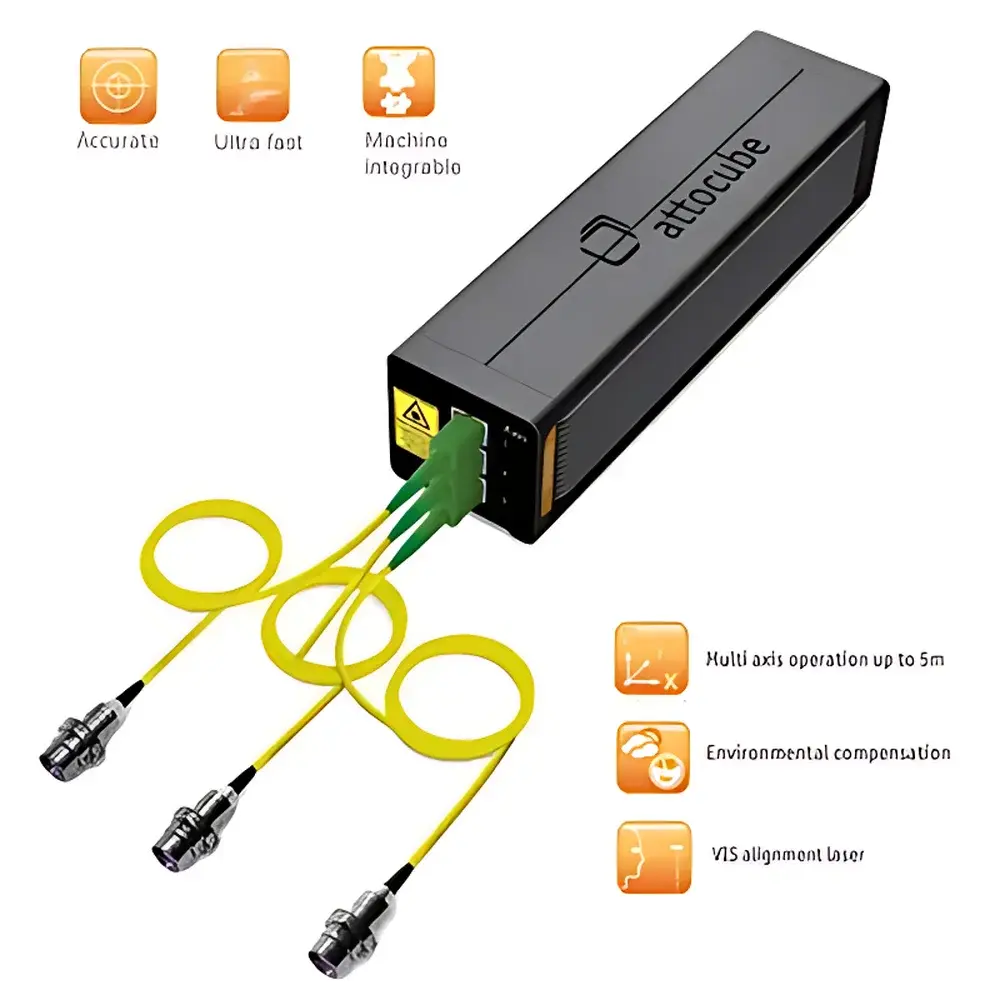
The Attocube IDS3010 is a compact, single-frequency laser interferometer engineered for picometer-level displacement metrology in demanding scientific and industrial environments. Based on the well-established Michelson interferometric principle with heterodyne or homodyne detection architecture, the IDS3010 delivers traceable linear position measurement with an absolute accuracy of ±1 pm over a 0–5 m range—certified by the Physikalisch-Technische Bundesanstalt (PTB), Germany’s national metrology institute. Its core optical design employs a stabilized 1530 nm infrared measurement beam paired with a visible 650 nm alignment laser, enabling rapid, intuitive setup without sacrificing fidelity. Unlike conventional interferometers, the IDS3010 integrates environmental compensation directly into its signal processing chain—automatically correcting for air refractive index variations due to temperature, pressure, and humidity—ensuring metrological integrity across diverse operational conditions, from ultra-high vacuum chambers (1×10⁻¹⁰ mbar) to high-radiation synchrotron beamlines (up to 10 MGy). With a physical footprint of only 50 × 55 × 195 mm, the IDS3010 is explicitly designed for OEM integration into motion control systems, nanofabrication tools, and next-generation photonics platforms where space, stability, and deterministic performance are non-negotiable.
Key Features
- Traceable picometer resolution: Certified ±1 pm linear accuracy (0–3 m range) by PTB; consistent with primary national standards.
- Ultra-compact form factor: 50 mm × 55 mm × 195 mm host unit enables seamless integration into vacuum chambers, cryostats, and machine tool enclosures.
- Industrial-grade real-time interfaces: Native support for HSSL, AquadB, CANopen, Profibus, and EtherCAT ensures plug-and-play compatibility with PLCs, motion controllers, and SCADA systems.
- 10 MHz sampling bandwidth: Enables high-fidelity dynamic measurements—including vibration analysis, fast-stage tracking, and transient thermal drift characterization.
- Radiation- and cryo-hardened probe options: Fiber-coupled probes operate continuously at 10 mK and withstand cumulative gamma doses up to 10 MGy—validated in DESY, CERN, and METAS facilities.
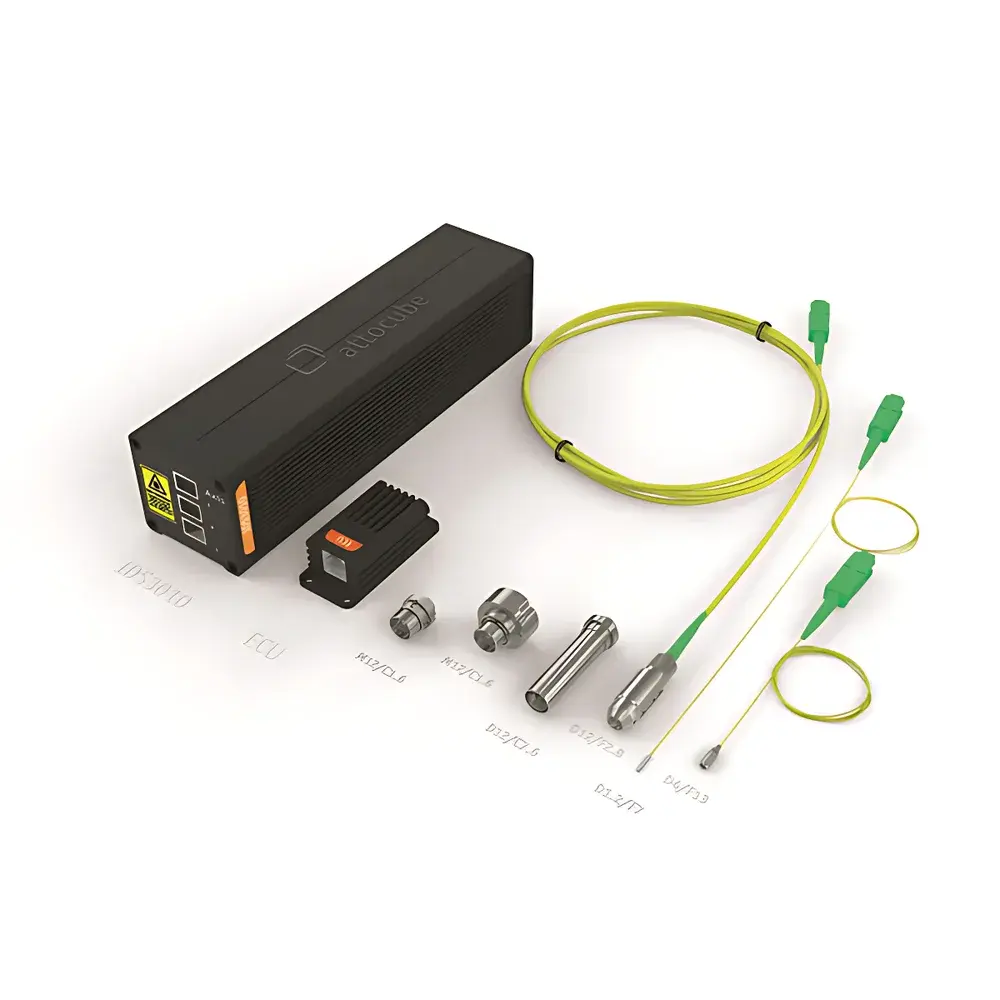
- Multi-probe modularity: Interchangeable collimated and focused probes (diameters 1.2–22 mm; spot sizes 2 µm–7.6 mm) allow optimization for surface reflectivity, working distance (5 mm–5 m), and geometric constraints.
Sample Compatibility & Compliance
The IDS3010 is compatible with reflective surfaces ranging from polished metals and dielectric mirrors to low-reflectivity semiconductor wafers and diffusive coatings—enabled by adaptive signal gain and phase-lock loop stabilization. Its optical path accommodates both retroreflector-based and plane-mirror configurations, supporting multi-axis setups via angular encoder integration. From a regulatory standpoint, the system adheres to ISO 230-2 (machine tool testing), ISO 5725 (accuracy and precision of measurement methods), and ASTM E2548 (standard guide for interferometric calibration of translation stages). When deployed in GxP-regulated environments (e.g., semiconductor metrology or medical device manufacturing), the IDS3010 supports audit-ready data logging with timestamped, tamper-evident records compliant with FDA 21 CFR Part 11 requirements when used with validated software configurations. All hardware meets CE/EMC Directive 2014/30/EU and RoHS 2011/65/EU specifications.
Software & Data Management
The IDS3010 ships with Attocube’s proprietary *InterferoControl* software suite—a deterministic, low-latency application framework built on real-time Linux kernels. It provides live FFT spectral analysis, dual-channel synchronous acquisition, and automated environmental compensation using integrated barometric, thermometric, and hygrometric sensors. Raw phase data is exported in HDF5 format with SI-traceable metadata (including NIST-traceable wavelength calibration coefficients), ensuring full reproducibility and third-party interoperability. For industrial deployment, the SDK supports Python, MATLAB, LabVIEW, and C/C++ APIs, enabling closed-loop feedback integration with PID controllers or model-predictive algorithms. Audit trails—including user actions, parameter changes, and calibration events—are stored with SHA-256 hashing and configurable retention policies, satisfying GLP/GMP documentation requirements.
Applications
The IDS3010 serves as a foundational metrology engine across disciplines requiring sub-nanometer positional certainty. In synchrotron radiation facilities (e.g., PETRA III at DESY), it stabilizes X-ray nanoprobes and corrects thermal drift in scanning fluorescence microscopes—enabling 40 nm spatial resolution with <45 nm long-term stability over 40-hour acquisitions. In semiconductor manufacturing, it validates bearing error motion (<5 µm peak-to-peak at 2160 rpm), calibrates μ-SLS 3D printers (NXP/Texas A&M), and verifies overlay accuracy in EUV lithography stages. In quantum engineering, it characterizes phononic topological insulators (Nature 555, 342–345, 2018) and measures photonic crystal cavity displacements under radiation pressure. Additional use cases include FMCW radar validation (224 GHz, ±0.4 µm uncertainty), industrial CT geometry metrology (70% versus traditional laser tracker methods.
FAQ
Is the IDS3010 suitable for ultra-high vacuum applications?
Yes. The fiber-coupled probe head and vacuum-compatible mounting flanges enable continuous operation down to 1×10⁻¹⁰ mbar, with no outgassing or thermal drift penalties.
Can the IDS3010 measure angular motion?
Not natively—but three-point planar displacement measurement (using three synchronized IDS3010 channels) enables full 3-DOF reconstruction of pitch, yaw, and axial displacement, as demonstrated in coherent telescope beam combining (CAS, China).
Does the system require external environmental sensors?
No. Integrated PT1000 temperature, capacitive humidity, and piezoresistive pressure sensors feed real-time corrections directly into the interferometric phase calculation.
What is the maximum achievable measurement speed?
At full 10 MHz bandwidth, the IDS3010 resolves displacements up to 2 m/s with sub-picometer jitter—verified in dynamic tests with air-bearing linear stages.
How is traceability maintained during long-term deployments?
Each unit includes a factory-calibrated wavelength reference and PTB-issued certificate. On-site verification is supported via cross-comparison against secondary standards or through in-situ cavity-length monitoring protocols per ISO/IEC 17025.