
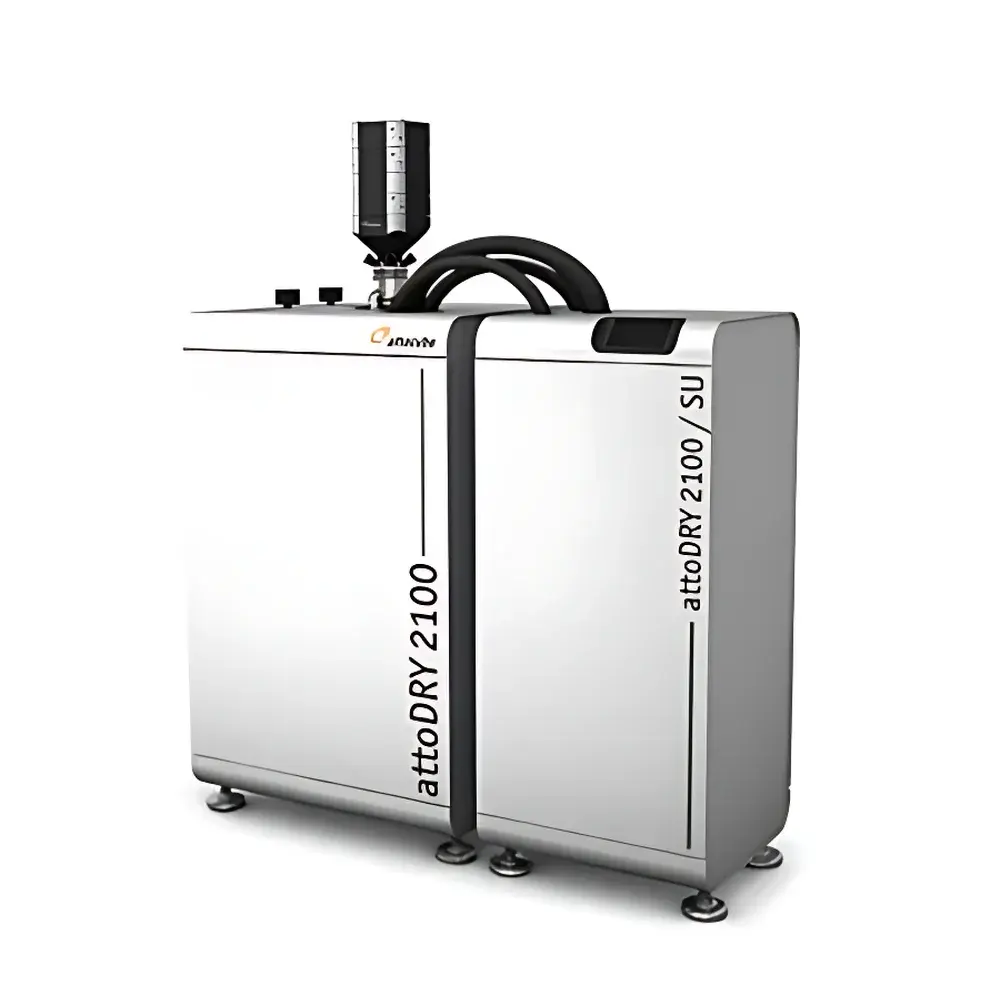
attoDRY Lab Cryogen-Free Low-Temperature High-Magnetic-Field Scanning Probe Microscope
| Brand | Attocube Systems AG |
|---|---|
| Origin | Germany |
| Model | attoDRY Lab |
| Instrument Type | Magnetic Force Microscope (MFM) |
| Positioning Noise | 0.12 nm RMS |
| Sample Stage Travel Range | 5 mm × 5 mm × 5 mm |
| Temperature Range | 1.5 K – 300 K (configurable) |
| Maximum Magnetic Field | 15 T |
| Cooling Time (to base temperature) | ~1–2 hours |
| Control Interface | Integrated touchscreen with automated thermal and magnetic field sequencing |
Overview
The attoDRY Lab Cryogen-Free Low-Temperature High-Magnetic-Field Scanning Probe Microscope is an integrated, ultra-stable platform engineered for nanoscale surface characterization under extreme cryogenic and high-field conditions. Unlike conventional liquid-helium-dependent systems, the attoDRY Lab employs a closed-cycle pulse-tube cryocooler coupled with a superconducting magnet, eliminating the operational complexity, supply chain dependency, and long-term cost burden associated with liquid cryogens. Its core measurement architecture leverages scanning probe techniques—including atomic force microscopy (AFM), magnetic force microscopy (MFM), conductive AFM (c-AFM), piezoresponse force microscopy (PRFM), confocal fluorescence microscopy (CFM), and Raman/photoluminescence spectroscopy—within a single, vibration-isolated vacuum environment. The system operates on the principle of mechanical resonance tracking (for dynamic AFM modes) and electrostatic or inductive force detection (for MFM and c-AFM), enabling quantitative mapping of topography, magnetic stray fields, local conductivity, ferroelectric domains, and optoelectronic responses with sub-nanometer spatial resolution and picometer-scale vertical sensitivity. Designed specifically for quantum materials research, the attoDRY Lab meets the stringent requirements of low-noise, high-reproducibility measurements in condensed matter physics, spintronics, 2D heterostructures, and topological quantum devices.
Key Features
- Cryogen-free operation using a closed-cycle pulse-tube refrigerator with base temperature down to 1.5 K (standard configuration) or 4 K (optional), supporting rapid cooldown (1–2 hours to base temperature) and long-term unattended stability.
- Integrated 15 T superconducting magnet with active shielding and field homogeneity optimized for SPM compatibility; field ramping and stabilization fully automated via touchscreen interface.
- Sub-angstrom mechanical stability: ultra-low vibration design achieves 0.12 nm RMS positioning noise over the full 5 mm × 5 mm × 5 mm sample stage travel range—critical for atomic-resolution imaging and spectroscopy at milli-Kelvin temperatures.
- Modular SPM head architecture supporting interchangeable probes: AFM/MFM/c-AFM/PRFM cantilevers, fiber-coupled confocal optics, Raman spectrometer integration, and dual-axis rotation stage (atto3DR) for angle-resolved measurements.
- Full automation of thermal and magnetic parameter sequencing: temperature ramps, field sweeps, and synchronized data acquisition are programmable via intuitive graphical user interface (GUI) with script-based extensibility (Python API available).
- Vacuum-compatible sample exchange mechanism with load-lock option; chamber pressure maintained below 10⁻⁶ mbar during operation to prevent condensation and surface contamination.
Sample Compatibility & Compliance
The attoDRY Lab accommodates a wide range of solid-state samples, including epitaxial thin films, exfoliated 2D crystals (e.g., graphene, TMDs, hBN), bulk single crystals (e.g., cuprates, iron-based superconductors), nanostructured devices (Hall bars, Josephson junctions), and insulating substrates (SiO₂/Si, sapphire, CaF₂). Sample mounting is flexible via standard pin-grid carriers or custom-designed holders compatible with electrical feedthroughs (up to 16 channels) and optical access (multiple viewport configurations). The system conforms to international standards for laboratory instrumentation safety and electromagnetic compatibility (IEC 61000-6-3, IEC 61000-6-4). While not certified as medical or industrial process equipment, its architecture supports GLP-compliant workflows through audit-trail-enabled software logging, timestamped metadata embedding, and user-access-controlled parameter locking—features aligned with best practices for reproducible quantum science in academic and national lab environments.
Software & Data Management
Control and data acquisition are managed by the proprietary attoDRY Lab Control Software, a real-time Linux-based application with deterministic timing and sub-millisecond synchronization across thermal, magnetic, and SPM subsystems. All raw sensor signals (deflection, phase, current, photon counts) are digitized at ≥10 MS/s and stored in HDF5 format with embedded experimental metadata (temperature setpoint, field value, scan parameters, calibration constants). The software includes built-in tools for fast Fourier transform (FFT)-based noise analysis, cross-correlation of multi-channel datasets, and batch processing of spectral maps (Raman, PL, dI/dV). Export modules support direct integration with Igor Pro, MATLAB, and Python (via h5py and NumPy), facilitating advanced statistical modeling and machine learning pipelines. For regulated environments, optional FDA 21 CFR Part 11 compliance packages are available, including electronic signatures, role-based access control, and immutable audit logs.
Applications
- Imaging of magnetic domain walls and skyrmions in chiral magnets and multiferroics under variable field and temperature.
- Correlative nanoscale mapping of strain, polarization, and conductivity in twisted bilayer graphene and moiré superlattices.
- In situ observation of vortex dynamics in high-Tc superconductors and iron pnictides using simultaneous MFM and transport measurements.
- Single-spin sensing and nanoscale NMR via nitrogen-vacancy centers integrated into diamond AFM tips.
- Angle-resolved photoluminescence and Raman spectroscopy of excitonic states in transition metal dichalcogenides at cryogenic temperatures.
- Quantitative electrostatic force microscopy (EFM) and Kelvin probe force microscopy (KPFM) of gated 2D semiconductor heterostructures.
FAQ
Is liquid helium required for operation?
No. The attoDRY Lab uses a closed-cycle pulse-tube cryocooler and does not require any liquid cryogens for routine operation.
What is the typical base temperature and cooling time?
The standard configuration reaches 1.5 K in approximately 1–2 hours from room temperature, with long-term temperature stability better than ±10 mK over 24 hours.
Can multiple measurement modalities be performed simultaneously?
Yes—AFM topography, MFM, c-AFM, and confocal fluorescence can be acquired concurrently using synchronized lock-in detection and time-gated photon counting.
Is the system compatible with UHV environments?
The base system operates at high vacuum (≤10⁻⁶ mbar); UHV integration (≤10⁻¹⁰ mbar) is possible with optional bake-out capability and ion pump upgrades.
Does the software support third-party instrument synchronization?
Yes—the system provides TTL trigger I/O, analog voltage outputs, and Ethernet-based remote command interfaces (SCPI and REST APIs) for integration with lasers, RF sources, or external cryogenic electronics.




