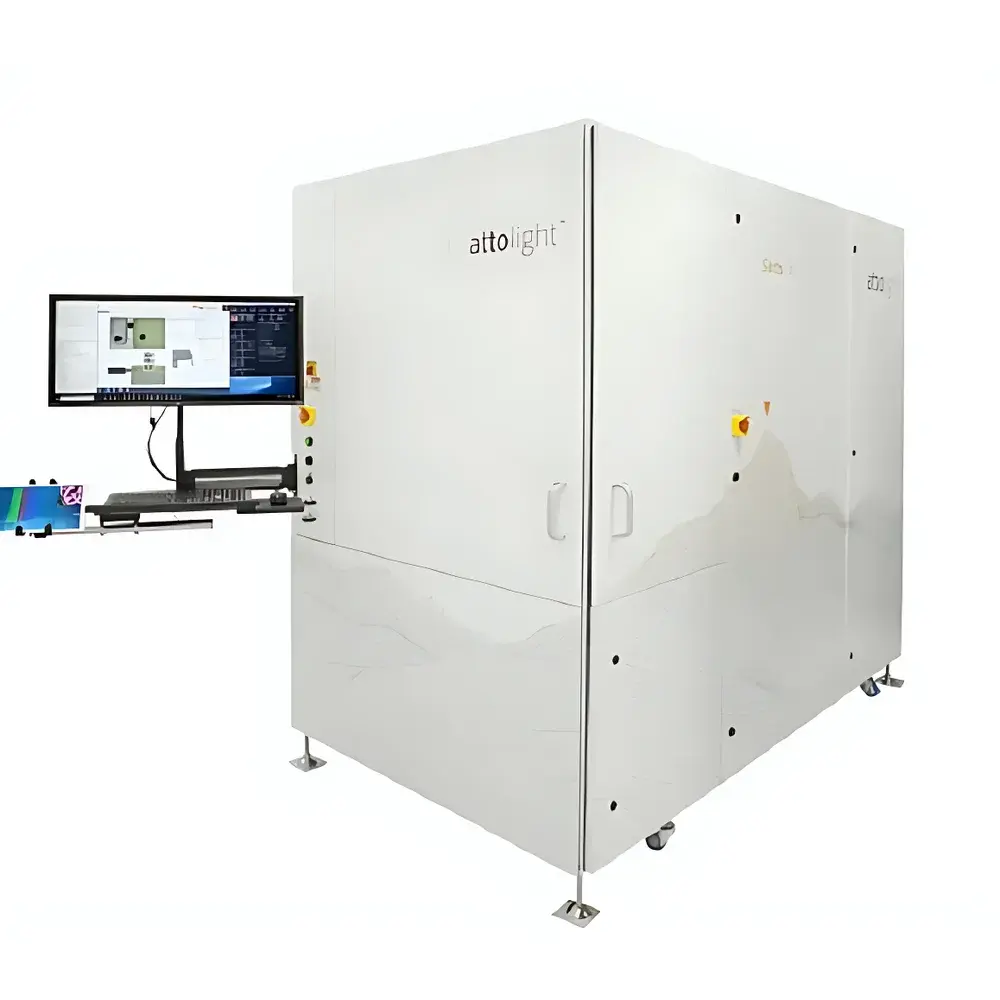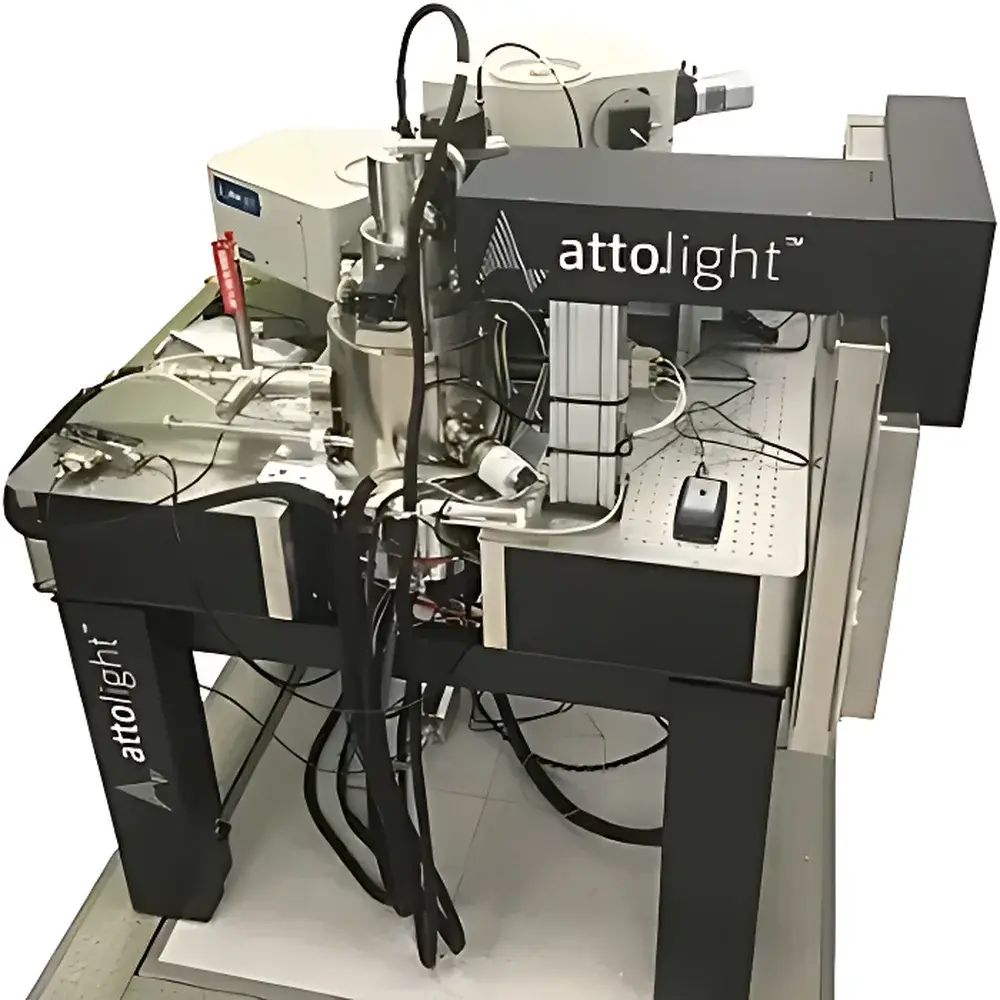
Attolight Chronos Picosecond Time-Resolved Cathodoluminescence CL-SEM System
| Brand | Attolight |
|---|---|
| Origin | Switzerland |
| Model | Chronos |
| Electron Gun | Schottky Field Emission with Ultrafast Laser-Driven Pulsing |
| Spatial Resolution | <10 nm (3–10 keV) |
| Temporal Resolution | 2 ps (streak camera), 20 ps FWHM (TCSPC) |
| Spectral Range | UV–IR (200–1700 nm) |
| Detector Options | Streak Camera + TCSPC Modules |
| Automation | Fully Automated CW/Pulsed Mode Switching |
| Compliance | Designed for GLP/GMP-adjacent nanophotonics labs, compatible with ASTM E2845 and ISO/IEC 17025 traceability frameworks |
| Dimensions | 1437 × 1039 mm (footprint), 2236 × 2426 mm (recommended lab space) |
| Weight | ~1170 kg |
Overview
The Attolight Chronos is a purpose-built, integrated picosecond time-resolved cathodoluminescence (CL) system engineered for correlative scanning electron microscopy (SEM) and ultrafast optical spectroscopy. Unlike conventional CL platforms operating exclusively in continuous-beam mode, Chronos uniquely combines high-brightness Schottky field-emission electron optics with ultrafast laser-triggered pulsed electron excitation—enabling synchronized, time-gated detection of photon emission dynamics at the nanoscale. Its core architecture leverages Attolight’s proprietary Allalin quantitative CL platform, optimized for absolute intensity calibration and spectral fidelity across wideband detection (200–1700 nm). The system operates on two complementary excitation paradigms: steady-state CL for high-spatial-resolution mapping and time-resolved CL (TR-CL) for carrier lifetime quantification, recombination pathway analysis, and non-equilibrium photodynamics—all within a single vacuum-integrated SEM column. This dual-mode capability is realized through automated, software-controlled switching between DC and pulsed electron beam operation—requiring less than five minutes per transition—making Chronos suitable for shared-facility environments where throughput, reproducibility, and multi-user adaptability are critical.
Key Features
- Ultrafast electron pulsing: Integrated femtosecond-laser-driven photocathode excitation enables sub-10 ps electron pulse generation synchronized to optical detection electronics.
- Nanometer-scale spatial resolution: Electron probe diameter <10 nm across 3–10 keV acceleration voltages, maintained under both CW and pulsed modes.
- Dual-detection architecture: Simultaneous or sequential operation of a high-sensitivity streak camera (2 ps temporal resolution, QE >20% at 500 nm) and time-correlated single-photon counting (TCSPC) module (20 ps FWHM, 1 GHz counting rate, 4-channel input).
- Quantitative CL collection: Attolight’s parabolic mirror-based collection optics deliver >40% solid-angle collection efficiency with calibrated spectral response traceable to NIST standards.
- Full automation suite: Mode switching, beam alignment, spectral acquisition, and lifetime decay fitting are managed via ChronosControl™ software—designed for minimal operator intervention and audit-ready logging.
- Vacuum-integrated design: Compatible with standard SEM columns (e.g., Zeiss, Thermo Fisher, JEOL) via custom flange interfaces; no external beamline required.
Sample Compatibility & Compliance
Chronos supports electrically insulating and conductive specimens—including bulk semiconductors, 2D materials, quantum dots, photonic crystals, and heteroepitaxial thin films—without mandatory metallization or charge compensation. Cryogenic sample stages (4–300 K) are available for temperature-dependent TR-CL studies. The system meets mechanical and electromagnetic compatibility requirements per IEC 61326-1 and is designed to support laboratories operating under quality management systems aligned with ISO/IEC 17025. Data acquisition workflows incorporate electronic signatures, timestamped metadata, and full parameter logging—facilitating compliance with FDA 21 CFR Part 11 when deployed in regulated R&D settings. All optical and electronic calibrations are documented and repeatable per ASTM E2845 (Standard Guide for Cathodoluminescence Microscopy).
Software & Data Management
ChronosControl™ provides unified control of electron optics, laser synchronization, detector gating, spectral acquisition, and lifetime deconvolution. Raw TCSPC histograms and streak camera images are stored in HDF5 format with embedded experimental metadata (beam energy, dwell time, detector gain, laser repetition rate, etc.). Built-in analysis modules include multi-exponential decay fitting (Levenberg–Marquardt algorithm), spectral unmixing, spatiotemporal correlation mapping, and pump–probe delay scanning. Export options include CSV, MATLAB .mat, and standardized JCAMP-DX for spectral interoperability. Audit trails record all user actions, parameter changes, and calibration events—supporting GLP documentation requirements and laboratory information management system (LIMS) integration.
Applications
- Quantitative measurement of local radiative and non-radiative carrier lifetimes in III–V and wide-bandgap semiconductors (e.g., GaN, SiC, perovskites).
- Mapping exciton diffusion lengths and interfacial recombination velocity in type-II heterostructures and van der Waals stacks.
- Pump–probe CL spectroscopy: Resolving hot-carrier cooling, intervalley scattering, and phonon-assisted relaxation pathways with sub-picosecond temporal precision.
- Dynamic SEM imaging: Correlating nanoscale topography, crystallographic orientation (EBSD), and transient luminescence decay kinetics in real time.
- Fundamental studies of plasmon–exciton coupling, Purcell enhancement, and cavity quantum electrodynamics effects in nanophotonic cavities.
FAQ
What is the minimum detectable carrier lifetime using Chronos?
Chronos achieves effective lifetime resolution down to ~5 ps using the streak camera and ~25 ps using TCSPC—limited primarily by instrument response function convolution and signal-to-noise ratio, not intrinsic material limits.
Can Chronos be retrofitted onto an existing SEM?
Yes—Chronos is delivered as a modular add-on system with vacuum-compatible mounting flanges and OEM-level integration support for major SEM platforms.
Is cryogenic operation supported?
Standard configurations include a liquid-nitrogen-cooled cold finger stage (77–300 K); optional closed-cycle cryostats extend operation to 4 K.
How is quantitative CL intensity calibrated?
Calibration uses NIST-traceable tungsten halogen and deuterium lamps combined with absolute quantum efficiency measurements of all optical components—enabling radiometric CL intensity reporting in photons/s/steradian/eV.
Does Chronos comply with FDA 21 CFR Part 11 requirements?
While Chronos itself is not a medical device, its software architecture—featuring electronic signatures, audit trails, and data integrity controls—meets foundational requirements for use in regulated pharmaceutical and semiconductor process development environments.