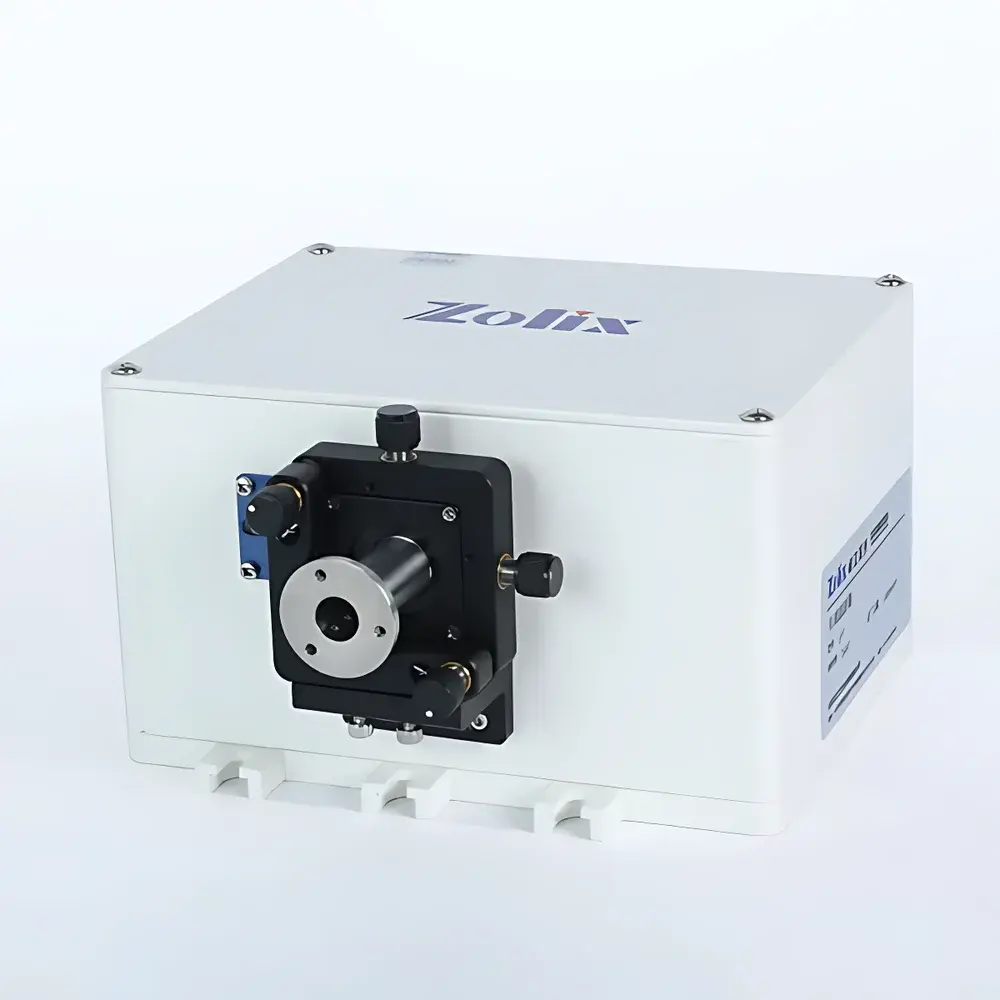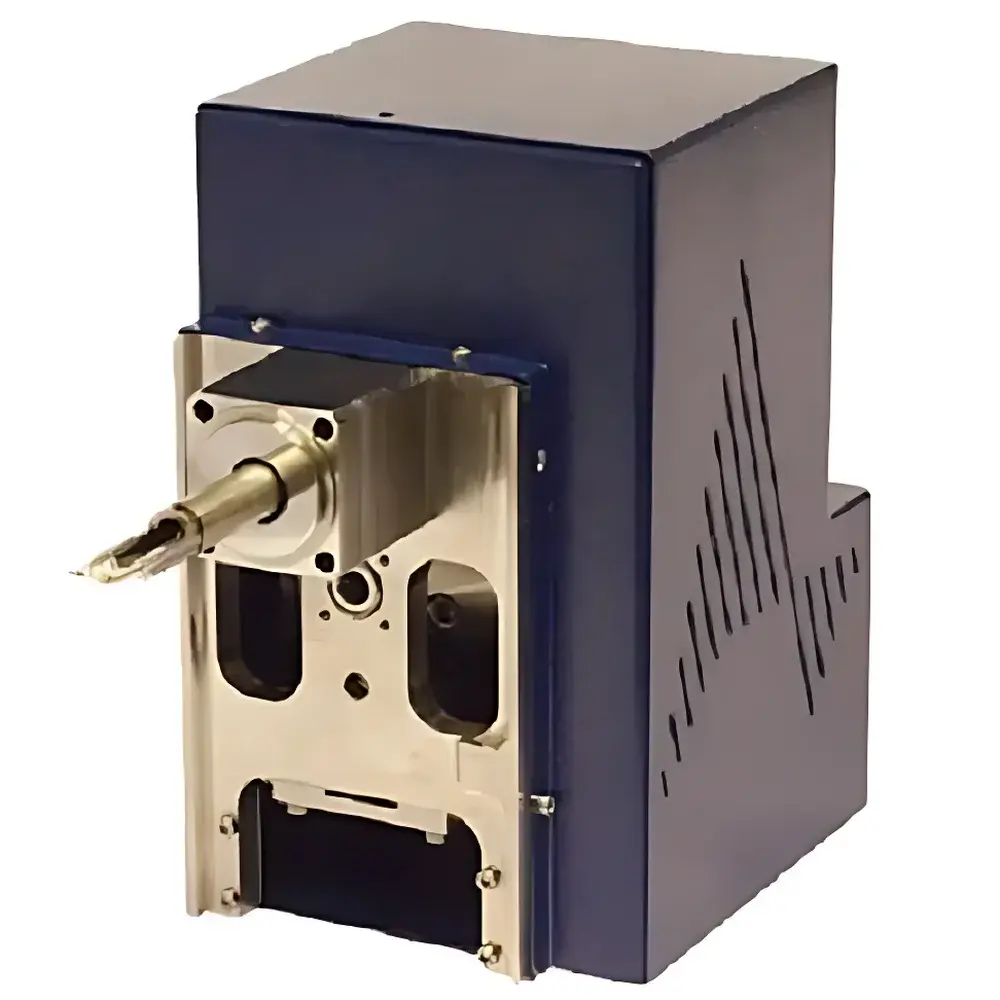
Attolight Monch STEM-Integrated Cathodoluminescence (CL) System with Parabolic Mirror Collection and Free-Space/Fiber Optical Injection
| Brand | Attolight |
|---|---|
| Origin | Switzerland |
| Model | Monch |
| Optical Collection NA | >0.4 |
| Mirror Working Distance | 300 µm |
| Mirror Reflectivity | up to 90% (200 nm – 1.7 µm) |
| Positioning Accuracy | 100 nm (absolute encoder) |
| XY/Z Travel | 30 mm (X), ±1.5 mm (Y/Z) |
| Max Imaging Speed | 900 Hz (128×128 in 18 s) |
| Compatible STEM Platforms | JEOL, Thermo Fisher Scientific (FEI), Hitachi, Nion, VG |
| Minimum Pole-Piece Gap | 4.5 mm |
| Fiber Interface | Asymmetric fiber bundle reconfigured for spectrometer slit alignment |
| Software | Windows 10+ (64-bit), Gatan DigitalMicrograph® integration, Python API (optional encrypted) |
Overview
The Attolight Monch is a high-precision, STEM-integrated cathodoluminescence (CL) system engineered for nanoscale optical characterization within scanning/transmission electron microscopes. It operates on the principle of electron-beam-induced photon emission—where a focused electron probe excites luminescent centers, defects, or plasmonic modes in solid-state materials, and the resulting photons are collected and spectrally resolved with sub-micron spatial fidelity. Unlike conventional CL systems constrained by limited collection geometry or compromised spectral integrity, the Monch employs a proprietary parabolic mirror mounted directly within the pole-piece gap—enabling collection angles exceeding NA 0.4 while maintaining working distances as short as 300 µm. This architecture ensures maximum photon throughput and minimizes aberrations inherent in off-axis optics, making it uniquely suited for quantitative, correlative CL-STEM studies where spatial resolution, spectral fidelity, and signal reproducibility are critical.
Key Features
- Parabolic mirror assembly with ≥90% reflectivity across 200 nm–1.7 µm, optimized for minimal chromatic distortion and high étendue.
- Sub-micron mirror positioning system featuring absolute encoders (100 nm repeatability) and auto-retract capability to prevent pole-piece or sample stage contact.
- Dual-mode optical interface: seamless switching between free-space injection/collection (preserving spatial coherence and irradiance) and asymmetric fiber coupling (maintaining constant spectral resolution during beam scanning).
- Modular mechanical design compatible with standard Thorlabs cage systems and major commercial (S)TEM platforms—including JEOL, Thermo Fisher Scientific (FEI), Hitachi, Nion, and VG—with pole-piece gaps down to 4.5 mm.
- Integrated control electronics supporting up to four analog inputs (12-bit) for external detectors (e.g., PMTs, APDs) and synchronized STEM scan coordination via two analog outputs.
Sample Compatibility & Compliance
The Monch supports a broad range of inorganic and organic specimens without requiring conductive coatings or vacuum-compatible optical modifications. Its non-contact, mirror-based architecture eliminates thermal loading and electrical interference risks common with fiber-fed or lens-coupled CL systems. The system complies with standard ultra-high vacuum (UHV) requirements for TEM/STEM operation (<1×10⁻⁷ mbar), and all internal components are bakeable to 120 °C. Mechanical interfaces adhere to ISO 3543 and ASTM E2775 standards for electron microscope accessory integration. Data acquisition workflows support audit-trail generation and user-access logging—facilitating GLP/GMP-aligned documentation where required for regulated R&D environments.
Software & Data Management
Control and acquisition are managed through a native Windows 10 (64-bit) application enabling real-time mirror alignment, optical path configuration, and synchronized detector triggering. Native integration with Gatan DigitalMicrograph® allows direct overlay of CL intensity maps, hyperspectral cubes (λ–x–y), and STEM imaging data within a single analytical environment. Optional Python API (AES-256 encrypted) provides programmatic access to motor control, spectral acquisition, and metadata tagging—enabling automated batch measurements, machine-learning-driven spectral clustering, and integration into FAIR-compliant data pipelines. All acquired spectra include embedded calibration metadata (wavelength, grating position, detector gain, dwell time) compliant with ISO/IEC 17025 traceability frameworks.
Applications
The Monch enables quantitative nanophotonic analysis across multiple advanced material domains:
- Semiconductor optoelectronics: carrier lifetime mapping in GaN HEMTs, defect-associated recombination in SiC power devices, and strain-dependent band-edge shifts in InP-based lasers.
- Photovoltaics: spatially resolved quantum efficiency assessment in perovskite thin films, grain-boundary non-radiative recombination in polycrystalline CdTe, and interface state density profiling in GaAs multi-junction cells.
- 2D materials: exciton valley polarization in WS₂ monolayers, plasmon dispersion in graphene nanostructures, and defect-bound luminescence in hexagonal boron nitride.
- Quantum emitters: spectral stability and photon indistinguishability evaluation of diamond NV⁻ centers and colloidal quantum dots under controlled electron dose.
- Geosciences & ceramics: trace-element identification via rare-earth activation signatures in zircon and apatite; phase segregation analysis in transparent conducting oxides and ferroelectric perovskites.
FAQ
Is the Monch compatible with field-emission STEMs operating at 60–300 kV?
Yes—the system is validated for use with high-brightness cold-FEG and Schottky-FEG sources across standard accelerating voltages, including low-dose conditions required for beam-sensitive specimens.
Can the parabolic mirror be repositioned during acquisition to correct for stage drift?
Yes—real-time closed-loop mirror tracking is supported via integrated encoder feedback and optional software scripting, enabling dynamic compensation for thermal or mechanical drift over extended acquisitions.
Does the asymmetric fiber interface degrade spectral resolution when imaging large fields-of-view?
No—the fiber bundle’s reconfigured geometry maintains fixed illumination geometry relative to the spectrometer entrance slit, ensuring consistent resolution regardless of scan position or dwell time.
What vacuum feedthroughs are required for installation?
A single 6-pin D-sub feedthrough suffices for motor control and detector I/O; optical paths remain entirely internal to the column, eliminating additional viewports or differential pumping stages.
Is spectral calibration traceable to NIST standards?
Yes—factory calibration includes Hg/Ar lamp references and temperature-stabilized wavelength registration; users may perform in situ recalibration using integrated LED references or external calibrated sources.