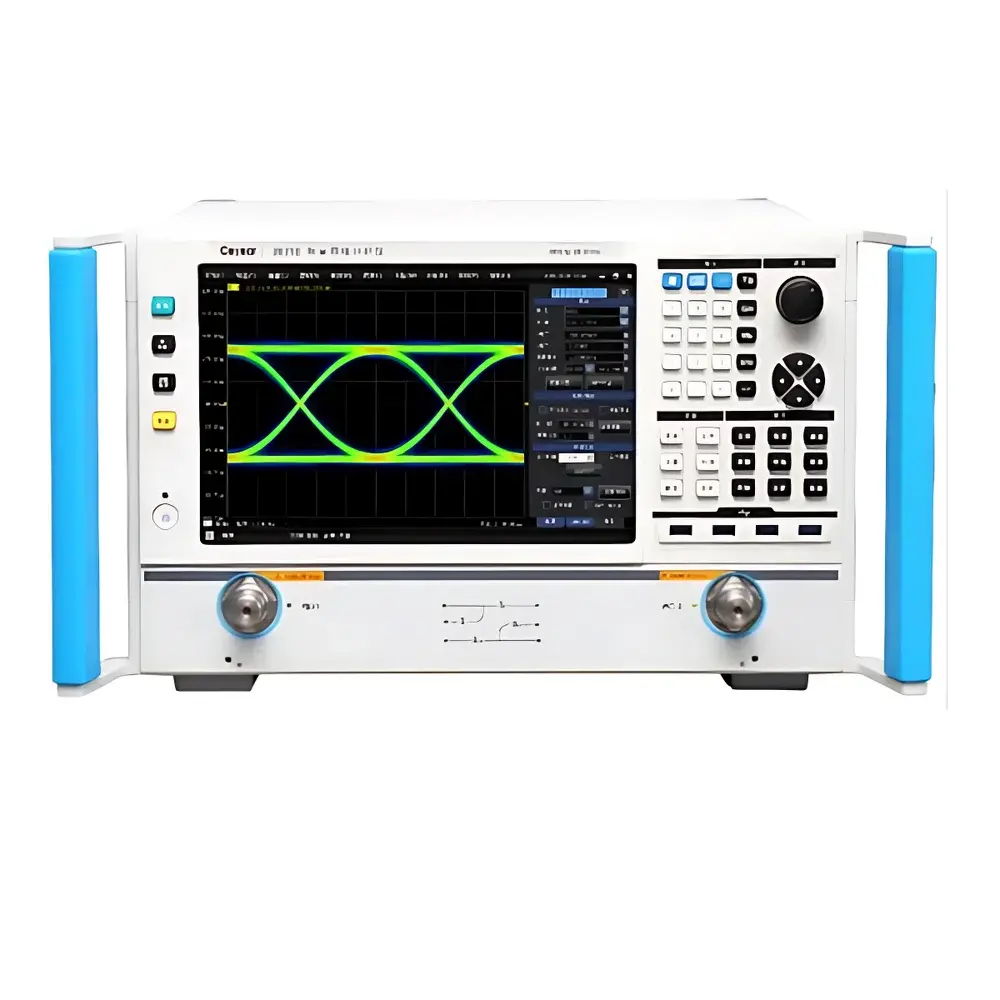
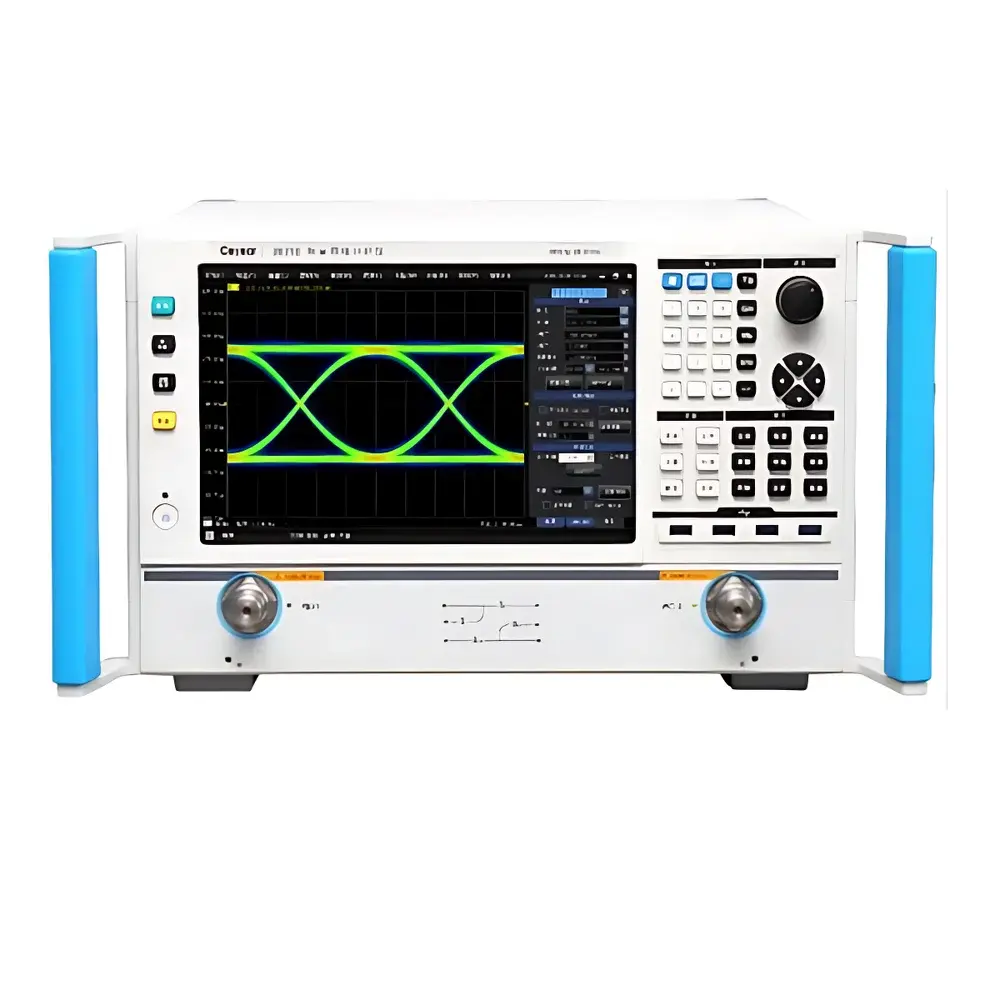
Auniontech 3671 Series Vector Network Analyzer (VNA)
| Brand | Auniontech |
|---|---|
| Model | 3671C/D/E/G |
| Frequency Range | 100 kHz–14 GHz (3671C) / 100 kHz–20 GHz (3671D) / 100 kHz–26.5 GHz (3671E) / 10 MHz–43.5 GHz (3671G) |
| IF Bandwidth | 1 Hz–30 MHz |
| Dynamic Range | Up to 133 dB @ 10 MHz–4 GHz (2-port) |
| Output Power | +15 dBm (typ., 10 MHz–4 GHz) down to –60 dBm (typ.) |
| Display | 12.1″ capacitive multi-touch LCD (1280×800) |
| Interfaces | USB 2.0/3.0, LAN (10/100/1000BASE-T), GPIB, VGA, HDMI |
| Calibration Methods | Response, Response-Isolation, Enhanced Response, Full 2-Port, ECal |
| Supported Formats | Log Mag, Lin Mag, SWR, Phase, Group Delay, Smith Chart, Polar Plot |
| Optional Features | Time Domain Reflectometry (TDR), Eye Diagram Simulation, Automatic Fixture Removal (AFR) |
Overview
The Auniontech 3671 Series Vector Network Analyzer (VNA) is a high-performance, benchtop-grade microwave measurement platform engineered for precision S-parameter characterization across RF and microwave frequencies. Based on heterodyne superheterodyne receiver architecture with dual-source synthesis and digital IF processing, the 3671 Series delivers vector-corrected amplitude and phase data essential for device modeling, impedance matching, filter design, and high-speed interconnect validation. Its modular frequency coverage—spanning from 100 kHz up to 43.5 GHz across four configurations (3671C, 3671D, 3671E, and 3671G)—enables consistent metrology across low-frequency passive components, RF power amplifiers, millimeter-wave antennas, and 5G/6G front-end modules. Designed for laboratory, R&D, and production test environments, the instrument adheres to fundamental VNA principles: coherent signal generation, phase-stable sampling, and real-time error correction using embedded calibration algorithms compliant with IEEE 1785.1 (Standard for Microwave Network Analyzers).
Key Features
- Multi-band frequency options: 3671C (100 kHz–14 GHz), 3671D (100 kHz–20 GHz), 3671E (100 kHz–26.5 GHz), and 3671G (10 MHz–43.5 GHz), supporting wideband component verification from audio-range parasitics to Ka-band waveguide transitions.
- High dynamic range performance: up to 133 dB at 10 MHz–4 GHz (2-port, 10 Hz IFBW), enabling accurate measurement of high-rejection filters and low-loss substrates.
- Flexible IF bandwidth selection from 1 Hz to 30 MHz, balancing measurement speed and noise floor for applications ranging from narrowband oscillator stability analysis to broadband pulse response capture.
- Comprehensive calibration suite including full 2-port SOLT, response-isolation, enhanced response, and electronic calibration (ECal) support—compatible with industry-standard calibration kits (e.g., Keysight N443x, Maury Microwave 850xx series).
- 12.1-inch capacitive multi-touch display with 1280×800 resolution and intuitive GUI supporting both English and Chinese language modes—optimized for touch-driven workflow in cleanroom and engineering lab settings.
- Integrated time-domain analysis (TDR/TDT) option enabling impedance profiling, discontinuity localization, and virtual eye diagram generation via convolution of measured S-parameters with user-defined bit patterns (NRZ, PAM4).
- Automatic Fixture Removal (AFR) software module for de-embedding non-coaxial fixtures—including probe stations, IC sockets, and custom PCB launch structures—using single-ended or differential fixture models defined via open/short/thru standards.
Sample Compatibility & Compliance
The 3671 Series supports direct connection to standard 3.5 mm, SMA, and 2.92 mm coaxial interfaces. With optional adapter kits and probe station integration, it accommodates on-wafer DUTs, packaged MMICs, LTCC modules, and high-density PCB interconnects. All hardware and firmware comply with IEC 61000-4 electromagnetic compatibility standards and meet CE marking requirements for industrial equipment. Data integrity and audit readiness are ensured through built-in GLP/GMP-aligned features: user-access logging, timestamped calibration records, and traceable measurement history export (CSV, S1P/S2P, Touchstone v2.0). While not FDA 21 CFR Part 11 certified out-of-the-box, the system supports third-party validation packages for regulated QA/QC workflows in telecom infrastructure and aerospace electronics manufacturing.
Software & Data Management
Built on a Linux-based real-time OS, the 3671 Series runs proprietary Auniontech VNA Control Software with native SCPI command support (IEEE 488.2 compliant) for seamless integration into automated test systems (ATE). Measurement data can be exported in industry-standard formats including Touchstone (.s1p, .s2p), CSV, BMP, and PNG. The software includes scripting capability via Python API (PyVISA-compatible), enabling custom sweep sequencing, pass/fail template matching against ITU-T G.993.2 or IEEE 802.3bj eye mask definitions, and batch processing of multi-DUT datasets. All calibration state files, fixture models, and measurement configurations are stored in encrypted project containers with SHA-256 checksum verification to ensure data provenance and reproducibility.
Applications
- RF and microwave component characterization: filters, couplers, isolators, circulators, and antenna matching networks.
- High-speed digital interconnect validation: PCB trace impedance, via stub analysis, connector crosstalk (near-end/far-end), and channel compliance testing per PCIe Gen5/6, USB4, and IEEE 802.3ck specifications.
- Millimeter-wave research: 5G NR FR2 (24.25–52.6 GHz) front-end module tuning, GaN HEMT small-signal modeling, and metamaterial unit cell extraction.
- Academic and government R&D: metamaterial dispersion analysis, radar cross-section (RCS) simulation validation, and THz metamirror characterization (via harmonic mixing extension).
- Production line testing: automated go/no-go screening of RF filters, duplexers, and BAW/SAW devices using customizable limit lines and statistical process control (SPC) dashboards.
FAQ
What calibration methods are supported by the 3671 Series?
The analyzer supports response, response-isolation, enhanced response, full 2-port SOLT, and electronic calibration (ECal) using compatible ECal modules. Custom calibration kits can be defined via user-input offset delay, loss, and phase parameters.
Does the 3671 Series support time-domain analysis natively?
Time-domain reflectometry (TDR) and transmission (TDT) capabilities are available as an optional software license. Once activated, users gain access to gated measurements, impedance profiling, and virtual eye diagram generation with jitter/noise injection and equalization modeling.
Can the instrument perform automatic fixture removal without external modeling tools?
Yes—the integrated Automatic Fixture Removal (AFR) module enables full de-embedding of single-ended and differential fixtures directly within the instrument GUI, using only measured open/short/thru standards and geometric fixture definitions.
Is remote operation possible over LAN or USB?
Yes—SCPI commands are fully supported over TCP/IP (LAN), USBTMC, and GPIB. The instrument appears as a VXI-11 or HiSLIP-compliant resource, enabling integration with LabVIEW, MATLAB, and Python-based test frameworks.
What is the minimum measurable insertion loss at 26.5 GHz?
At 26.5 GHz, the typical system dynamic range is 115 dB (2-port, 10 Hz IFBW), allowing reliable detection of insertion loss down to approximately –110 dB with appropriate averaging and noise floor management.
Related Products