
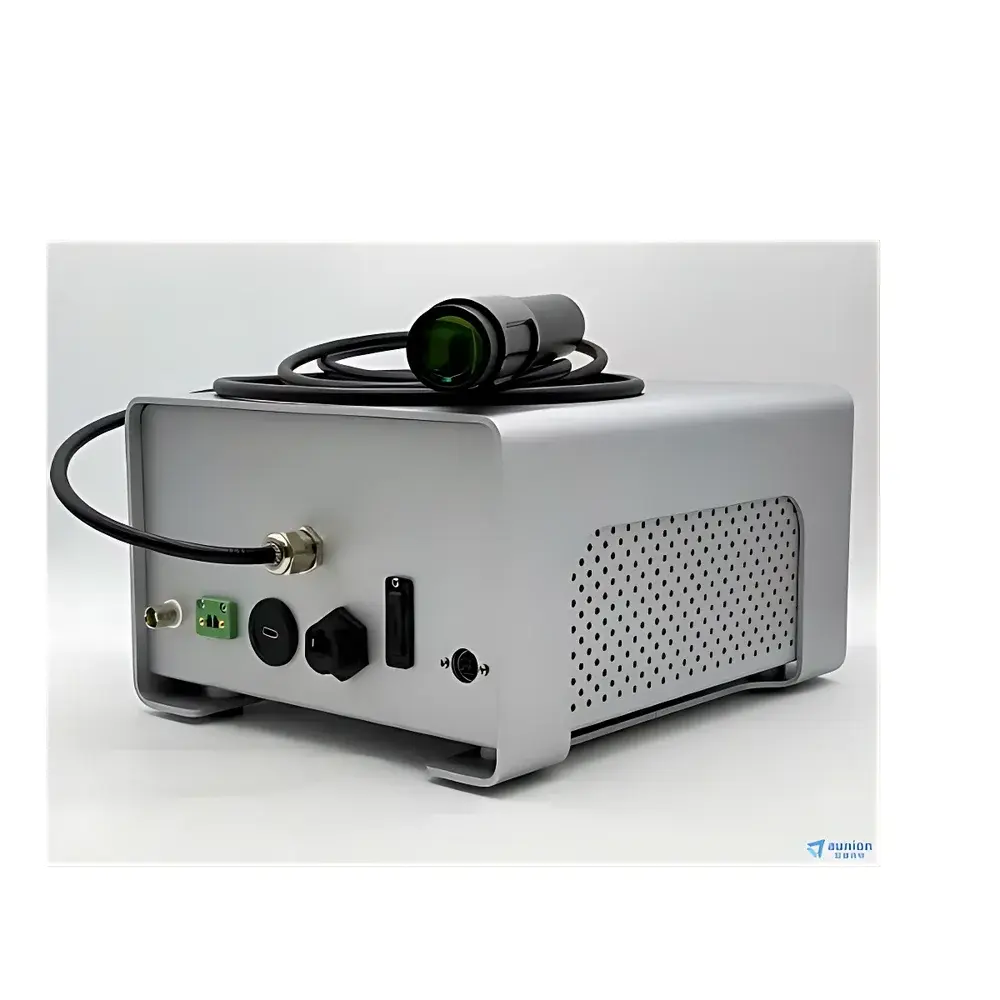
Auniontech AR-2000 Dual-Wavelength Reflective Pyrometer with Real-Time Emissivity Measurement
| Brand | Auniontech |
|---|---|
| Model | AR-2000 |
| Temperature Range | 500–1500 °C (custom ranges available) |
| Optical Fiber Probe Length | 2 m (custom lengths available) |
| Working Distance | 400 mm |
| Spot Size | 5 mm @ 400 mm |
| Spectral Bands | 1.3 µm & 1.5 µm |
| Laser Safety Class | 3B (measuring beam), Class 2 (aiming laser) |
| Temperature Resolution | 1 °C |
| Typical Uncertainty | ±10 °C @ 1500 °C |
| Measurement Rate | 10 Hz (100 Hz optional) |
| Output Interfaces | 4–20 mA, 0–10 V, Ethernet |
| Data Storage | SD card (up to 32 GB) |
| Display | 7-inch touchscreen or remote PC interface |
| Dimensions (electronics unit) | 210 × 140 × 250 mm |
| Weight | 2.5 kg |
| Operating Ambient | 15–30 °C |
| Power Supply | 80–260 V AC to 24 V DC adapter |
Overview
The Auniontech AR-2000 is a dual-wavelength reflective pyrometer engineered for non-contact, high-fidelity temperature measurement in dynamic thermal environments where surface emissivity is unknown, variable, or time-dependent. Unlike conventional two-color (ratio) pyrometers—which assume constant spectral emissivity—the AR-2000 actively measures both radiance and reflectance at two precisely defined near-infrared wavelengths (1.3 µm and 1.5 µm) to compute real-time emissivity (ε) and deliver corrected true temperature. This capability is grounded in the principle of active reflectance compensation: by illuminating the target with a low-power, eye-safe Class 2 aiming laser and analyzing the ratio of reflected to emitted radiation across two narrowband channels, the instrument decouples emissivity from radiance, eliminating reliance on pre-assumed ε values. The system operates under the physical constraint that for opaque, thermally stable surfaces, Kirchhoff’s law holds (α = ε), enabling accurate emissivity derivation without prior calibration against reference standards. It is particularly suited for applications involving oxidation kinetics, phase transitions, induction-heated metals, and thin-film processing—where surface optical properties evolve rapidly and unpredictably.
Key Features
- Dual-band radiometric sensing at 1.3 µm and 1.5 µm with synchronized reflectance interrogation
- Real-time emissivity calculation at up to 100 Hz (standard: 10 Hz), enabling closed-loop thermal process control
- Fiber-coupled optical head with adjustable focus; standard working distance 400 mm, spot size 5 mm
- Integrated Class 2 visible aiming laser for precise targeting without interfering with measurement integrity
- Simultaneous output of multiple derived parameters: brightness temperature, two-color temperature, reflectance-corrected temperature, instantaneous emissivity, and dual-band reflectance ratio
- Robust electronics enclosure rated for ambient operation between 15 °C and 30 °C; fanless design ensures EMI/RFI immunity critical for induction heating and plasma environments
- Comprehensive I/O suite: analog (4–20 mA / 0–10 V), Ethernet (TCP/IP + Modbus TCP), and local SD-card logging (32 GB max)
Sample Compatibility & Compliance
The AR-2000 is optimized for metallic, ceramic, and composite surfaces exhibiting moderate to high reflectivity in the 1.3–1.5 µm range—including oxidizing steel, annealing copper molds, sintering tungsten carbide, and laser-clad alloys. Its reflectance-based algorithm remains valid for semi-transparent materials only when thickness exceeds optical penetration depth at both wavelengths. The instrument complies with IEC 61000-6-2 (immunity) and IEC 61000-6-4 (emissions) for industrial environments. While not certified to FDA 21 CFR Part 11, its software architecture supports audit-trail-capable data export (CSV, ASCII) and timestamped calibration metadata—enabling alignment with GLP/GMP documentation requirements when integrated into validated manufacturing workflows. Calibration certificates traceable to NIM (National Institute of Metrology, China) are supplied with each unit.
Software & Data Management
The AR-2000 is managed via Auniontech’s PyroControl Suite—a Windows-based application accessible locally or remotely over Ethernet. The interface provides real-time visualization of all computed parameters on configurable multi-axis plots, including emissivity vs. time overlays and temperature deviation heatmaps. Users may define custom scaling for individual channels, set alarm thresholds on emissivity drift (>±0.02), and export synchronized time-series data with microsecond-level timestamp resolution. Calibration files (radiometric and reflectance) are stored separately and can be loaded, compared, or regenerated using factory-provided reference sources. Software supports firmware updates, configuration backup/restore, and batch export of SD-card logs. All measurement data include embedded metadata: sensor ID, acquisition time, ambient temperature, fiber length, and active calibration version.
Applications
- Real-time monitoring of oxide layer growth during hot rolling or annealing of stainless steel and aluminum alloys
- Temperature validation in electromagnetic interference–prone induction heating systems where thermocouples fail or perturb fields
- Quantitative emissivity tracking for degradation analysis of refractory tooling (e.g., copper dies in high-pressure die casting)
- In-process thermal profiling of additive manufacturing builds—especially for reactive metals (Ti-6Al-4V, Inconel 718) undergoing surface oxidation
- Validation of thermal models in vacuum furnace qualification, where emissivity uncertainty dominates total error budget
- Research-grade emissivity spectroscopy for novel high-temperature coatings and metamaterials
FAQ
Does the AR-2000 require emissivity input from the user?
No. It autonomously calculates spectral emissivity in real time using dual-band reflectance and radiance measurements—no manual ε entry or lookup tables are needed.
Can it measure through quartz or sapphire viewports?
Yes, provided the viewport transmits >90% at both 1.3 µm and 1.5 µm and exhibits minimal thermal emission at operating temperatures. Standard fused silica is suitable up to ~800 °C; synthetic sapphire is recommended above that threshold.
How is calibration maintained over time?
The system includes factory-applied radiometric and reflectance calibrations. Users may perform field verification using NIST-traceable blackbody sources. Drift correction is supported via two-point adjustment within the software, referencing known temperature/emissivity points.
Is the aiming laser safe for continuous operation?
Yes—the Class 2 visible laser (≤1 mW, 635 nm) complies with IEC 60825-1 and poses no retinal hazard under normal viewing conditions, even with prolonged exposure.
What is the minimum measurable spot size?
At 400 mm working distance, the standard optical head achieves 5 mm diameter. Optional focusing optics support 1.5 mm spots at 300 mm, subject to signal-to-noise constraints at lower temperatures.



