Auniontech Aunion_4_0Mpix_SuperSpeed_V_Module DMD Spatial Light Modulator
| Brand | Auniontech |
|---|---|
| Origin | Germany |
| Model | Aunion_4_0Mpix_SuperSpeed_V_Module |
| Pixel Count | 2560 × 1600 (4.096 Mpix) |
| Max Frame Rate | 22,727 Hz (1-bit) |
| On-chip Memory | 64 Gbit |
| Interface | USB 3.0 |
| Wavelength Range | 350–2500 nm |
| DLP Chipset | Texas Instruments Discovery 4100 |
| FPGA | Virtex-7 |
| Control Software | ALP-4.3 |
| Compliance | USB 3.0 Class, RoHS, CE |
Overview
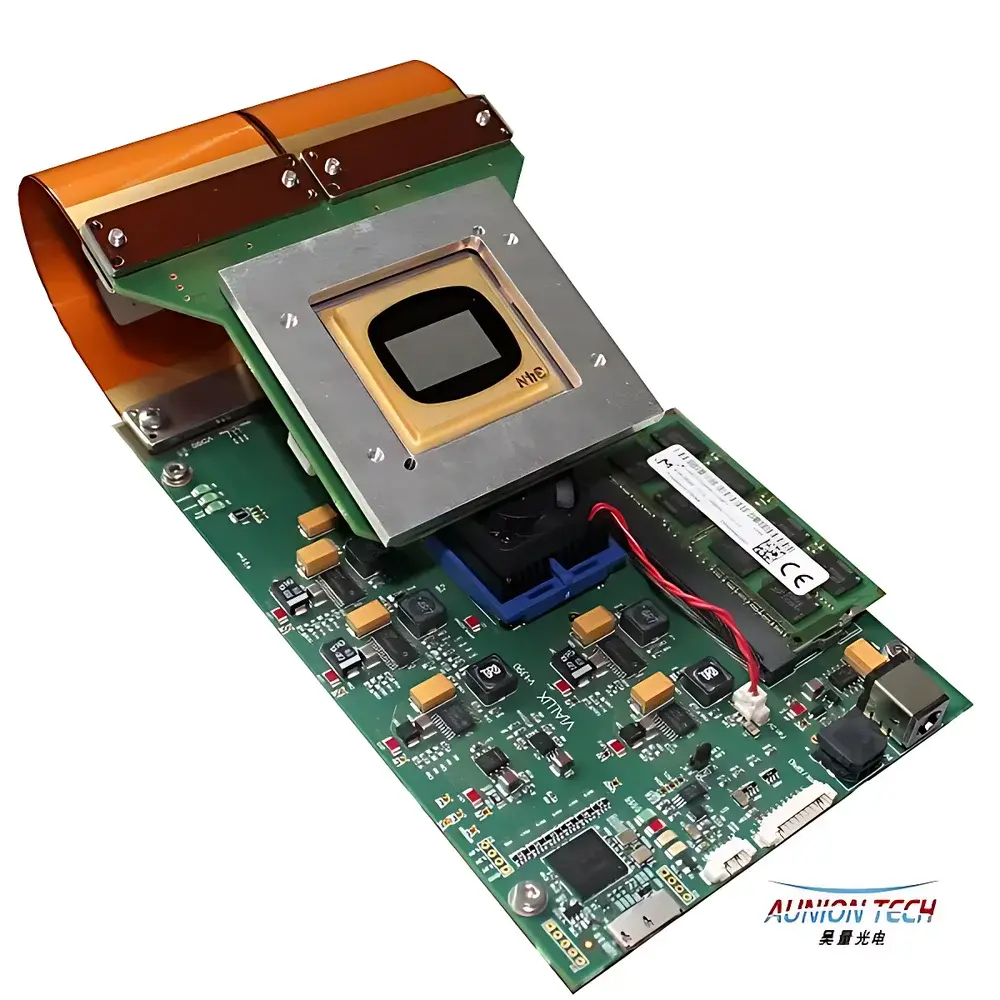
The Auniontech Aunion_4_0Mpix_SuperSpeed_V_Module is a high-performance digital micromirror device (DMD)-based spatial light modulator engineered for demanding optical modulation tasks requiring both ultra-high resolution and exceptional temporal fidelity. Built around the Texas Instruments Discovery 4100 chipset, this module implements a 2560 × 1600 pixel micromirror array with 7.6 µm mirror pitch, delivering 4.096 million individually addressable binary optical switches. Its operation relies on electrostatic actuation of aluminum-coated micro-mirrors, each capable of rapid bistable tilting (±12°) to steer incident light into or away from an optical path—enabling precise, pixel-level control of amplitude, phase (via binary encoding), or intensity distribution in real time. The system is optimized for applications where deterministic, repeatable, and latency-controlled light patterning is critical—including structured illumination, computational imaging, maskless lithography, and adaptive wavefront shaping. Unlike liquid-crystal SLMs, DMD-based devices offer inherent polarization independence, broad spectral response (UV–NIR), and nanosecond-scale switching dynamics—making them uniquely suited for pulsed-laser synchronization and high-duty-cycle illumination environments.
Key Features
- Native resolution of 2560 × 1600 pixels (WQXGA), the highest among commercially available DMD modules based on the Discovery 4100 platform
- Maximum binary frame rate of 22,727 Hz—achievable via onboard 64 Gbit DDR3 memory and dual-LVDS data routing architecture
- Full spectral compatibility from 350 nm (deep UV) to 2500 nm (short-wave infrared), validated with cooled Type-A DMD package rated for continuous optical loading up to 60 W
- Integrated Virtex-7 FPGA and USB 3.0 controller firmware enabling low-latency host communication, hardware-accelerated pattern sequencing, and real-time trigger synchronization
- ALP-4.3 software suite with native support for Windows OS, including DLL libraries compatible with C++, .NET, MATLAB, LabVIEW, and Python (via ctypes)
- Open-source demonstration software with full source code access—facilitating custom algorithm integration, firmware co-development, and academic research reproducibility
- Modular mechanical design with standardized mounting interfaces (M3/M4 tapped holes), thermal management provisions, and ESD-safe handling features
Sample Compatibility & Compliance
The Aunion_4_0Mpix_SuperSpeed_V_Module is designed for integration into optomechanical systems compliant with ISO 10110 optical component standards and IEC 61000-6-3 electromagnetic compatibility requirements. Its sealed, nitrogen-purged DMD package meets MIL-STD-810G environmental robustness criteria for shock, vibration, and humidity exposure. For regulated laboratory environments, the module supports audit-ready operation when paired with ALP-4.3’s optional logging and timestamped event tracking—aligning with GLP documentation practices. While not FDA-cleared as a medical device, its optical performance characteristics satisfy key parameters referenced in ASTM E2912 (standard guide for optical testing of microdisplay systems) and ISO/IEC 17025-accredited calibration workflows. The USB 3.0 interface conforms to USB Implementers Forum (USB-IF) certification requirements, ensuring interoperability across industrial PCs and embedded vision platforms.
Software & Data Management
Control is enabled through the ALP-4.3 Application Programming Interface—a modular, thread-safe library supporting synchronous and asynchronous pattern loading, multi-device orchestration, and hardware-triggered acquisition loops. Pattern sequences can be preloaded into on-board memory for autonomous playback without host intervention, reducing jitter and eliminating bus contention during high-throughput experiments. The API provides fine-grained control over bit-depth allocation (1–8 bits per frame), grayscale dithering schemes (e.g., error diffusion, pulse-width modulation), and dynamic ROI (region-of-interest) mapping—allowing partial-array updates at accelerated rates (e.g., >50 kHz for sub-512×512 regions). All configuration states, timing logs, and frame counters are exportable in CSV/JSON format for traceability. Optional integration with HDF5-based data pipelines enables direct streaming into scientific computing environments for real-time reconstruction or machine learning inference.
Applications
This DMD module serves as a core engine in advanced photonics infrastructure: in quantitative phase microscopy, it enables high-speed structured illumination patterns for optical sectioning and speckle-free widefield imaging; in maskless photolithography, its UV-compatible optics and thermal stability allow direct-write patterning at sub-5 µm feature sizes using mercury-xenon or excimer sources; in single-pixel imaging systems, it functions as a programmable Hadamard encoder with >10⁶ pattern cycles before mirror fatigue; in adaptive optics, it implements open-loop wavefront correction for astronomy or ophthalmic instrumentation when coupled with Shack-Hartmann sensors; and in additive manufacturing, it powers high-resolution stereolithography (SLA) and digital light processing (DLP) 3D printers operating at >100 µm/s layer speeds. Its deterministic binary response also makes it suitable for quantum optics experiments involving heralded photon routing and time-bin entanglement manipulation.
FAQ
Is the module compatible with Linux or macOS?
The ALP-4.3 SDK officially supports Windows 10/11 (64-bit). Linux support is available under NDA for OEM integrators via custom driver development; macOS is not supported.
What cooling options are available for high-power laser use?
The standard Type-A DMD package includes integrated thermoelectric cooling and heatsink mounting points. For CW lasers exceeding 30 W, optional water-cooled baseplates and IR-transparent window variants are available upon request.
Can multiple units be synchronized?
Yes—hardware triggering via TTL/RS-422 inputs enables sub-microsecond inter-module synchronization. Up to eight units can be daisy-chained using the ALP-4.3 master-slave configuration.
Does the module support analog voltage input for grayscale modulation?
No—this is a binary DMD device. Grayscale is achieved through temporal dithering (pulse-width modulation) or spatial multiplexing, both fully managed by ALP-4.3 firmware.
Is factory calibration provided?
Each unit ships with mirror tilt angle verification, dead-pixel mapping, and USB enumeration validation. NIST-traceable irradiance uniformity reports are available as an add-on service.