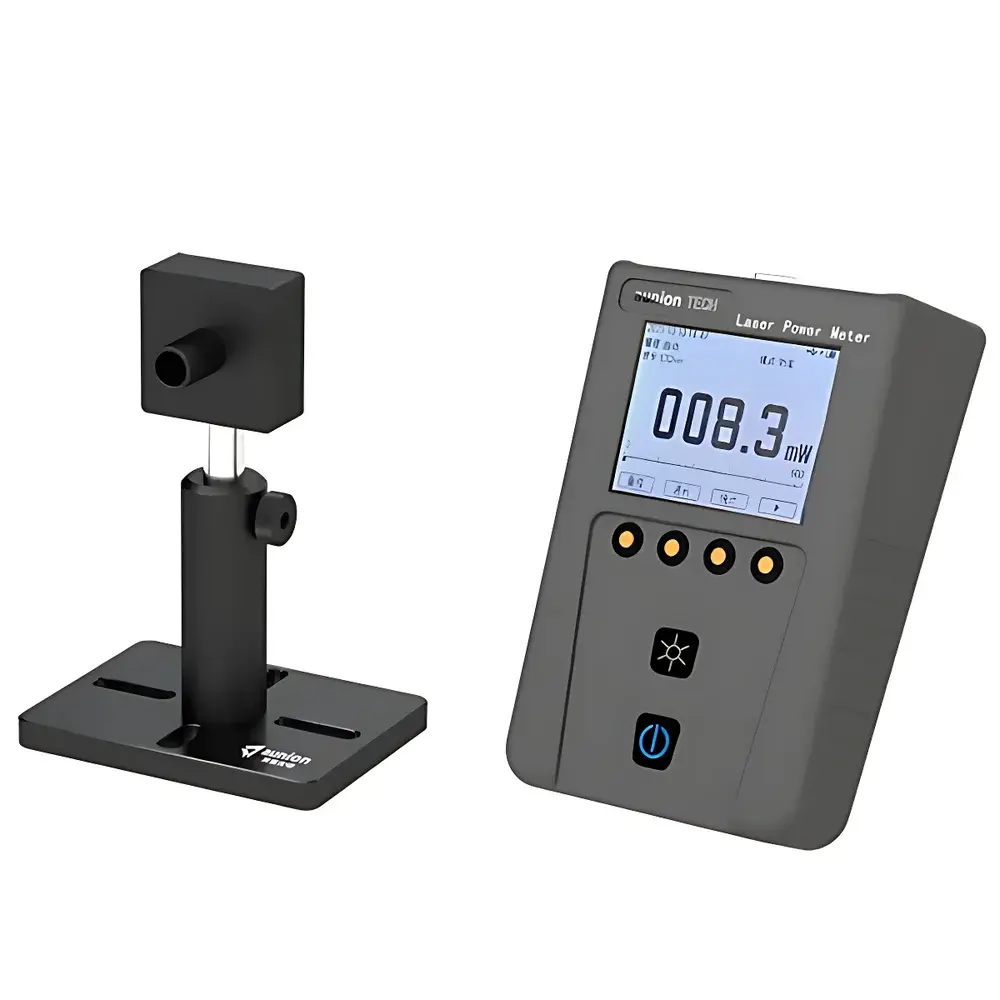
Auniontech AUT-5W-N / AUT-40W-N / AUT-100W-N Thermopile-Based Laser Power Meter
| Brand | Auniontech |
|---|---|
| Origin | Shanghai, China |
| Model Series | AUT-5W-N, AUT-40W-N, AUT-100W-N |
| Spectral Range | 0.19–15 µm (AUT-5W-N), 0.19–25 µm (AUT-40W-N & AUT-100W-N) |
| Power Range | 100 µW–5 W |
| Linearity | < ±1% |
| Accuracy | < ±3% |
| Response Time | < 1 s (AUT-5W-N & AUT-40W-N), < 2 s (AUT-100W-N) |
| Aperture Diameter | 10 mm |
| Max Avg. Power Density | 1.5 kW/cm² |
| Max Energy Density | 0.3 J/cm² @ 1064 nm, 1 ns (AUT-5W-N) |
| Resolution | 5 µW |
| Cooling | Passive (Natural Convection) |
| Interface | DB-9M |
| Cable Length | 1.5 m |
Overview
The Auniontech AUT-N series thermopile-based laser power meters are precision instruments engineered for reliable, wide-spectrum optical power measurement in industrial and research environments. Operating on the Seebeck effect—where a temperature gradient across dissimilar conductors generates a proportional voltage—the AUT-N sensors integrate densely packed thermocouple junctions into a monolithic thermopile structure. This architecture ensures high thermal inertia stability, minimal drift under continuous irradiation, and intrinsic wavelength independence across the ultraviolet to far-infrared spectrum (0.19–25 µm). Unlike photodiode-based meters, thermopile sensors do not require calibration corrections for spectral responsivity, making them ideal for broadband sources including excimer lasers, CO₂ lasers, quantum cascade lasers, supercontinuum sources, and tunable OPOs. The series comprises three models differentiated by aperture size, power handling capacity, and resolution to accommodate diverse operational requirements—from low-power alignment verification to high-power industrial laser process monitoring.
Key Features
- True broadband response from 190 nm to 25 µm without spectral correction factors
- High damage threshold: up to 20 kW/cm² average power density (with CW power limits enforced per model)
- Fast thermal stabilization: response times < 1 s (AUT-5W-N, AUT-40W-N) and < 2 s (AUT-100W-N) enable real-time process feedback
- Exceptional linearity (< ±1%) over full dynamic range supports traceable power scaling in ISO/IEC 17025-compliant labs
- Passive cooling design eliminates fan noise, vibration, and power supply dependencies—critical for interferometric or ultra-low-noise optical setups
- Ruggedized aluminum housing with standardized DB-9M analog output interface for seamless integration into PLC-controlled manufacturing lines or DAQ systems
- Factory-calibrated against NIST-traceable reference standards; calibration certificates include uncertainty budgets per ISO/IEC 17025 Annex A.1
Sample Compatibility & Compliance
The AUT-N series is compatible with continuous-wave (CW), pulsed, and modulated laser sources across material processing, biomedical, and metrology applications. Each sensor head is rated for specific maximum energy densities (e.g., 0.15 J/cm² at 1064 nm, 1 ns pulse width), ensuring safe operation within laser safety class 4 environments when used per IEC 60825-1:2014 guidelines. The instruments meet electromagnetic compatibility requirements per EN 61326-1:2013 and are designed to support GLP/GMP workflows: analog output signals are stable under ambient temperature fluctuations (±0.05%/°C typical), and mechanical construction adheres to IP20-rated enclosure specifications. While not inherently 21 CFR Part 11 compliant (as a hardware-only meter), the analog output enables integration with validated data acquisition platforms that implement audit trail, electronic signature, and data integrity controls.
Software & Data Management
The AUT-N series delivers calibrated voltage output (typically 0–10 V or ±5 V full scale, configurable via external amplifier) compatible with standard DAQ hardware (e.g., National Instruments USB-6211, Keysight 34972A). Auniontech provides technical documentation—including pinout diagrams, scaling equations, and temperature compensation coefficients—for OEM integration. For laboratory use, third-party software such as LabVIEW, MATLAB Data Acquisition Toolbox, or Python (with PyVISA or nidaqmx libraries) can acquire, log, and post-process readings with timestamping accuracy better than 1 ms. Raw analog signals retain full dynamic range and are unaffected by digital quantization artifacts, supporting post-hoc recalibration if updated reference data becomes available. No proprietary drivers or closed firmware are required—ensuring long-term maintainability and interoperability in heterogeneous instrumentation ecosystems.
Applications
- Laser material processing: real-time power monitoring during fiber laser cutting (1070 nm), CO₂ laser engraving (10.6 µm), and UV excimer ablation (248 nm, 193 nm)
- Medical laser systems: output verification for dermatology, ophthalmology, and surgical platforms operating at 532 nm, 1064 nm, or 2940 nm (Er:YAG)
- Research & development: characterization of ultrafast amplifiers, OPCPA systems, and mid-IR frequency combs where spectral flatness and pulse-energy independence are essential
- Additive manufacturing: closed-loop control of laser powder bed fusion (LPBF) systems using analog feedback to regulate diode-pumped solid-state (DPSS) or direct-diode sources
- Optical component testing: measuring transmission losses, coating absorption, and thermal lensing effects in high-power optics under realistic irradiance conditions
FAQ
Is calibration traceable to national standards?
Yes—each unit ships with a calibration certificate referencing NIST-traceable primary standards. Uncertainty budgets are provided per ISO/IEC 17025 requirements.
Can the sensor measure pulsed lasers with high peak power?
Yes, provided pulse energy remains below the specified J/cm² limit at the given pulse width and repetition rate. Thermal time constants prevent saturation for pulses > 10 µs.
Does the meter require warm-up time before accurate measurement?
No—thermopile sensors exhibit negligible zero-drift after initial thermal equilibrium (~30 seconds at ambient temperature); no active warm-up period is needed.
What is the recommended recalibration interval?
Annual recalibration is advised for ISO/IEC 17025 compliance; biennial intervals may be justified for stable lab environments with documented performance verification records.
Can multiple sensors be connected to one readout device?
Yes—via multiplexed analog inputs or separate channels on modular DAQ systems; signal isolation must be maintained to avoid ground loops.