
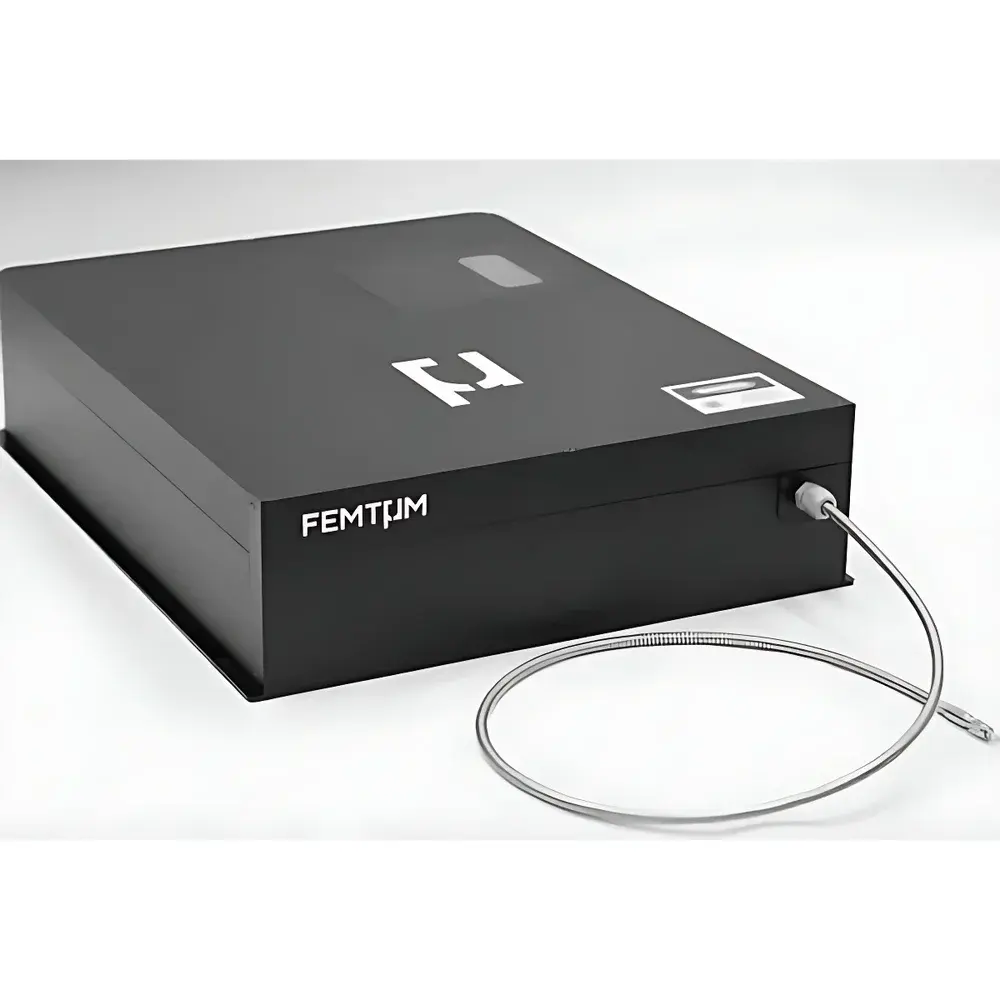
Auniontech Femtum 3400-35 Tunable Femtosecond Fiber Laser (3.0–3.4 µm)
| Brand | Auniontech |
|---|---|
| Origin | Shanghai, China |
| Manufacturer Type | Authorized Distributor |
| Product Category | Domestic |
| Model | Femtum 3400-35 |
| Wavelength Range | 3.0–3.4 µm |
| Spectral Bandwidth (FWHM) | >40 nm |
| Average Power | >100 mW (>500 mW @ 3400 nm) |
| Pulse Energy | >3.5 nJ (>17 nJ @ 3400 nm) |
| Repetition Rate | ~35 MHz (>50 MHz optional) |
| Peak Power | ~1–>50 kW |
| Pulse Duration | <500 fs |
| Beam Diameter | ~3 or 9 mm |
| Beam Quality (M²) | <1.3 |
| Polarization | Elliptical |
| Dimensions (W×H×D) | 48.3 × 14.0 × 52.1 cm |
| Cooling | Air-cooled |
| Input Power | 100/240 V AC, 50/60 Hz |
| Output | Free-space or fiber-coupled |
| Control Interface | Software-driven |
Overview
The Auniontech Femtum 3400-35 is a commercially available, turnkey tunable femtosecond fiber laser engineered for high-precision mid-infrared (MIR) scientific applications. Operating across the 3.0–3.4 µm spectral window—spanning the fundamental C–H vibrational absorption band—it leverages nonlinear frequency conversion in specialty fluoride or chalcogenide photonic crystal fibers to generate ultrashort pulses with exceptional temporal coherence and spectral stability. Unlike conventional optical parametric amplifiers or OPO-based systems, this all-fiber architecture eliminates alignment sensitivity and ensures long-term operational robustness without active realignment or vacuum maintenance. Its design conforms to the physical constraints of mode-locked erbium-doped or thulium-doped fiber oscillators followed by cascaded supercontinuum generation and spectral filtering, enabling direct access to the molecular fingerprint region where absorption cross-sections for organic compounds are orders of magnitude higher than in the near-infrared.
Key Features
- Compact, air-cooled, maintenance-free turnkey system suitable for integration into vibration-sensitive optical tables or portable laboratory setups
- Automated mode-locking stabilization with real-time dispersion compensation feedback for sustained pulse fidelity over extended operation periods
- Pulse duration consistently below 500 fs (measured via autocorrelation), supporting time-resolved spectroscopy and high-harmonic generation experiments
- High average power output exceeding 500 mW at 3400 nm—critical for efficient nonlinear conversion in difference-frequency generation (DFG) or intrapulse DFG setups
- Single-transverse-mode (TEM00) beam profile with M² < 1.3, ensuring diffraction-limited focusing for tight spatial confinement in nonlinear microscopy or ablation studies
- Software-controlled wavelength tuning across the full 3.0–3.4 µm range with step resolution ≤0.1 nm and repeatability ±0.3 nm
- Optional high-repetition-rate configuration (>50 MHz) optimized for frequency comb metrology and dual-comb spectroscopy
Sample Compatibility & Compliance
This laser system is compatible with standard MIR optics including ZnSe, BaF₂, CaF₂, and AMTIR-1 coated mirrors and lenses. Its emission spectrum overlaps with key absorption features of hydrocarbons, polymers, pharmaceutical crystallites, and biological tissues—enabling label-free identification in coherent anti-Stokes Raman scattering (CARS) and stimulated Raman scattering (SRS) microscopy. The system complies with IEC 60825-1:2014 Class 4 laser safety requirements and includes interlock-ready hardware for integration into ISO 13857-compliant enclosures. All firmware and control logic adhere to GLP-aligned logging protocols, supporting audit trails for traceable calibration and experimental metadata recording in regulated environments.
Software & Data Management
The Femtum 3400-35 integrates with Auniontech’s proprietary LabControl Suite v3.2—a cross-platform application supporting Windows, Linux, and macOS. The software provides full remote parameter orchestration—including pulse width estimation, spectral centroid tracking, and real-time intensity autocorrelation visualization—via TCP/IP or USB 2.0 interfaces. Export formats include HDF5, CSV, and MAT for seamless compatibility with MATLAB, Python (NumPy/SciPy), and Igor Pro workflows. Audit logs capture timestamped user actions, environmental sensor readings (temperature, humidity), and laser status flags—meeting minimum requirements for FDA 21 CFR Part 11 compliance when deployed with validated electronic signature modules.
Applications
- Laser Frequency Combs: Enables absolute frequency calibration in the MIR through f–2f interferometry using octave-spanning supercontinuum generation in tellurite fibers
- Mid-Infrared Hyperspectral Imaging: Delivers high peak irradiance for rapid raster scanning in reflectance/transmission modes, particularly effective for polymer degradation analysis and thin-film thickness mapping
- Nonlinear Frequency Conversion: Serves as a pump source for DFG-based quantum cascade laser seeding and optical parametric generation in orientation-patterned gallium arsenide (OP-GaAs)
- Ultrafast Pump–Probe Spectroscopy: Supports sub-picosecond dynamics studies of carrier relaxation in narrow-bandgap semiconductors (e.g., HgCdTe, InSb) and vibrational dephasing in liquid-phase organics
- High-Field Physics: Generates relativistic intensities (>10¹³ W/cm²) when focused with off-axis parabolic mirrors, facilitating strong-field ionization and attosecond pulse synthesis via high-harmonic generation in noble gases
FAQ
Is the laser system compatible with third-party pulse measurement tools such as FROG or SPIDER?
Yes—the free-space output is collimated and polarization-preserving, allowing direct coupling into commercial frequency-resolved optical gating (FROG) or spectral phase interferometry for direct electric-field reconstruction (SPIDER) devices.
Can the repetition rate be externally synchronized to a master clock?
The standard configuration supports RF synchronization input (SMA, 50 Ω) for locking to external 10 MHz or harmonic references; optional PLL modules enable sub-100-fs jitter lock to femtosecond timing distribution networks.
What optical fiber types are supported for guided output?
The system offers FC/APC-terminated output ports compatible with low-OH silica fibers up to 2.2 µm and specialized hollow-core photonic bandgap fibers (e.g., NKT Kagome) for transmission beyond 3.0 µm.
Does the laser meet CE or RoHS certification requirements?
The unit carries CE marking under the EU Electromagnetic Compatibility Directive 2014/30/EU and RoHS 2011/65/EU compliance documentation is provided upon request with batch-specific test reports.
Are OEM integration options available for embedded system developers?
Auniontech offers custom mechanical housings, TTL-triggered shutter interfaces, and SDKs with C/C++ and Python bindings for integration into automated metrology platforms or industrial inspection systems.






