
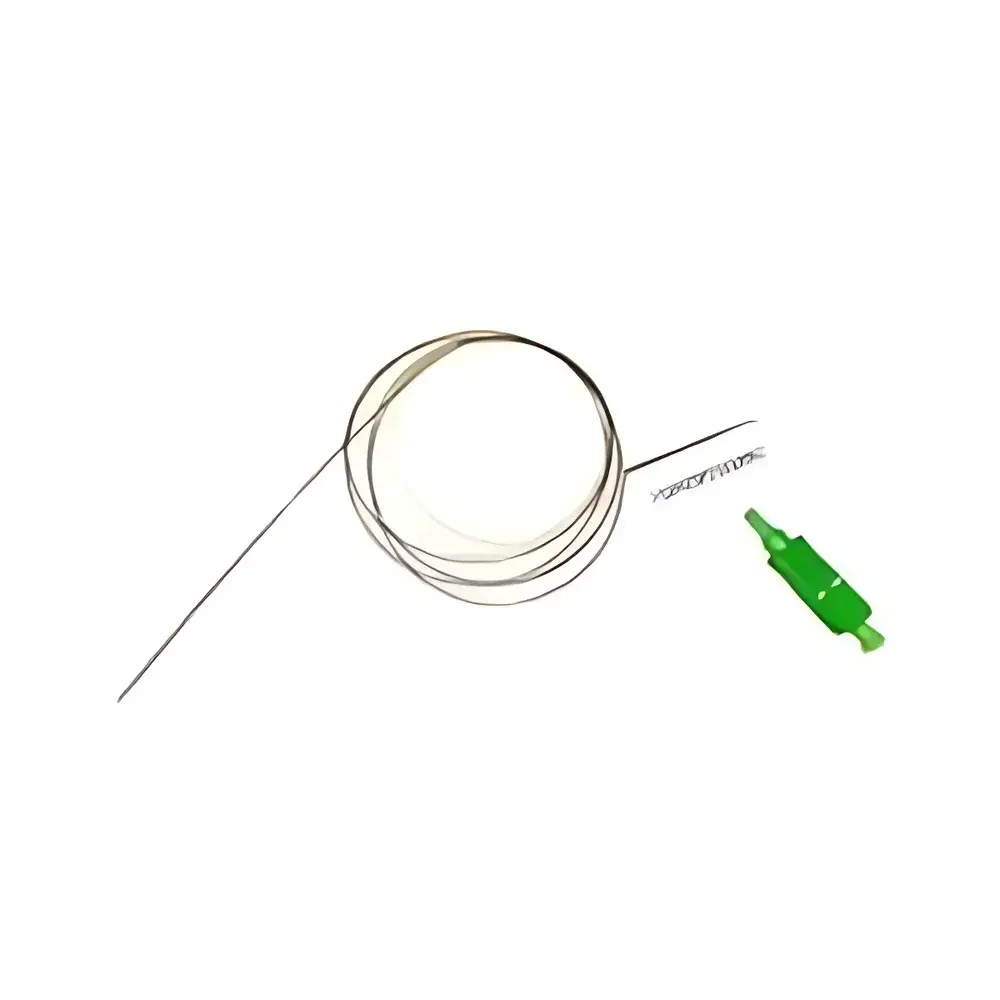
Auniontech FiberAut-S520 Series Miniature Temperature-Pressure Fiber Optic Sensor
| Brand | Auniontech |
|---|---|
| Origin | Shanghai, China |
| Manufacturer Type | Authorized Distributor |
| Country of Origin | China |
| Model | FiberAut-S520 |
| Pricing | Available Upon Request |
| Pressure Range (gauge) | 300 mmHg / 1500 mmHg (max) |
| Temperature Range | 20–50 °C (customizable) |
| Pressure Accuracy | ±1% FS |
| Temperature Accuracy | ±1 °C |
| Pressure Resolution | 0.01% FS (with compatible readout unit) |
| Temperature Resolution | 0.1 °C (with compatible readout unit) |
| Sensor Dimensions | Ø260 µm × 1.3 mm |
| Fiber Connector | SC/PC |
| Packaging Options | Glass Capillary / Stainless Steel Tube / Polyimide (PI) Tube |
Overview
The Auniontech FiberAut-S520 Series Miniature Temperature-Pressure Fiber Optic Sensor is a dual-parameter, all-fiber sensing device engineered for simultaneous, high-fidelity measurement of temperature and gauge pressure in confined, electrically noisy, or chemically aggressive environments. It integrates a MEMS-based pressure transducer with a Fabry–Perot (F–P) interferometric cavity formed directly within the optical fiber tip—enabling absolute, self-referenced measurement of both physical parameters via wavelength-encoded spectral shifts. Unlike conventional electronic sensors, the FiberAut-S520 operates without metallic conductors or active electronics at the sensing point, eliminating susceptibility to electromagnetic interference (EMI), radio-frequency interference (RFI), and galvanic corrosion. Its sub-300 µm outer diameter and 1.3 mm active length make it uniquely suited for intracavitary, intravascular, or minimally invasive applications where spatial constraints and biocompatibility are critical design requirements.
Key Features
- True all-fiber architecture: No electrical components at the probe tip—ensures intrinsic safety and EMI/RFI immunity.
- Fabry–Perot interferometry: Enables passive, drift-resistant, high-resolution detection of both pressure-induced cavity deformation and thermally induced refractive index changes.
- Miniaturized form factor: Ø260 µm × 1.3 mm active zone allows integration into catheters, endoscopic tools, microfluidic channels, and implantable monitoring platforms.
- Multi-material packaging options: Selectable hermetic encapsulation in borosilicate glass capillary (for biomedical use), medical-grade stainless steel (for mechanical robustness), or polyimide tubing (for flexibility and MRI compatibility).
- High long-term stability: F–P cavity fabricated using femtosecond laser micromachining and fusion splicing—exhibits negligible hysteresis and thermal drift over extended operation (>10,000 cycles at rated pressure range).
- Standard SC/PC optical interface: Compatible with commercial white-light interferometric interrogators supporting spectral domain analysis (e.g., OCT-based or broadband spectrometer platforms).
Sample Compatibility & Compliance
The FiberAut-S520 is designed for direct contact measurement in biological tissues, physiological fluids (e.g., blood, cerebrospinal fluid), hydrocarbon-rich industrial media (e.g., crude oil, drilling mud), and corrosive gas environments. Its glass and stainless steel variants comply with ISO 10993-5 (cytotoxicity) and ISO 10993-10 (irritation/sensitization) when used in preclinical research settings. While not certified as a Class II medical device under FDA 21 CFR Part 820, the sensor meets essential performance criteria outlined in ASTM F2081 (Standard Practice for Characterizing In Vivo Performance of Implantable Pressure Sensors) and supports GLP-compliant data acquisition when paired with validated readout instrumentation featuring audit-trail functionality and electronic signature capability per 21 CFR Part 11.
Software & Data Management
Sensor interrogation requires an external broadband light source and spectrometer-based or swept-wavelength interferometric readout system. Auniontech provides vendor-agnostic spectral processing algorithms (MATLAB® and Python-compatible) that extract peak wavelength shifts from the F–P interference spectrum and convert them into calibrated pressure (mmHg) and temperature (°C) values using factory-derived polynomial coefficients. Raw spectral data is output in HDF5 or CSV format, enabling traceable archival, batch post-processing, and integration into LabVIEW™, Python-based analytics pipelines (e.g., SciPy, Pandas), or enterprise LIMS systems. Optional firmware upgrades support real-time streaming at up to 1 kHz sampling rate when interfaced with high-speed spectrometers.
Applications
- In vivo physiological monitoring: Real-time intracranial pressure (ICP) and core body temperature tracking in rodent models; intrauterine pressure mapping during labor studies.
- Clinical translational research: Integration into neurovascular catheters for simultaneous pressure–temperature profiling during embolization or thrombectomy procedures.
- Industrial downhole sensing: Continuous temperature–pressure logging in oil/gas wellbores under high-temperature (up to 125 °C with custom thermal shielding) and high-pressure (up to 1500 mmHg equivalent) conditions.
- Micro-environmental metrology: Calibration reference in microreactors, MEMS packaging validation chambers, and vacuum-sealed optoelectronic modules.
- Academic instrumentation: Embedded sensing node in soft robotics, tissue-engineered constructs, and wearable biomechanical feedback systems.
FAQ
Is the FiberAut-S520 suitable for human clinical use?
The sensor is intended for preclinical research and instrument development. Human use requires additional regulatory clearance (e.g., FDA 510(k) or CE Marking under MDR Annex II) and sterilization validation per ISO 17664.
Can the temperature and pressure ranges be extended beyond standard specifications?
Yes—custom calibration and packaging configurations support extended ranges: pressure up to 3000 mmHg (absolute) and temperature from –20 °C to +85 °C upon request.
What readout equipment is required to operate the sensor?
A broadband interferometric interrogator with spectral resolution ≤0.05 nm and wavelength range 1250–1650 nm is mandatory. Auniontech provides compatibility documentation for Thorlabs, Micron Optics, and Luna Innovations platforms.
How is sensor calibration performed and maintained?
Each unit undergoes dual-point pressure and three-point temperature calibration at the factory. Traceable NIST-traceable certificates are supplied. Field recalibration is supported via Auniontech’s portable calibration jig (model CAL-FP-200) and software toolkit.
Does the sensor require electrical power at the probe tip?
No—operation is entirely passive and optical. Only the remote interrogator requires power; the sensor itself is dielectric and intrinsically safe.





