
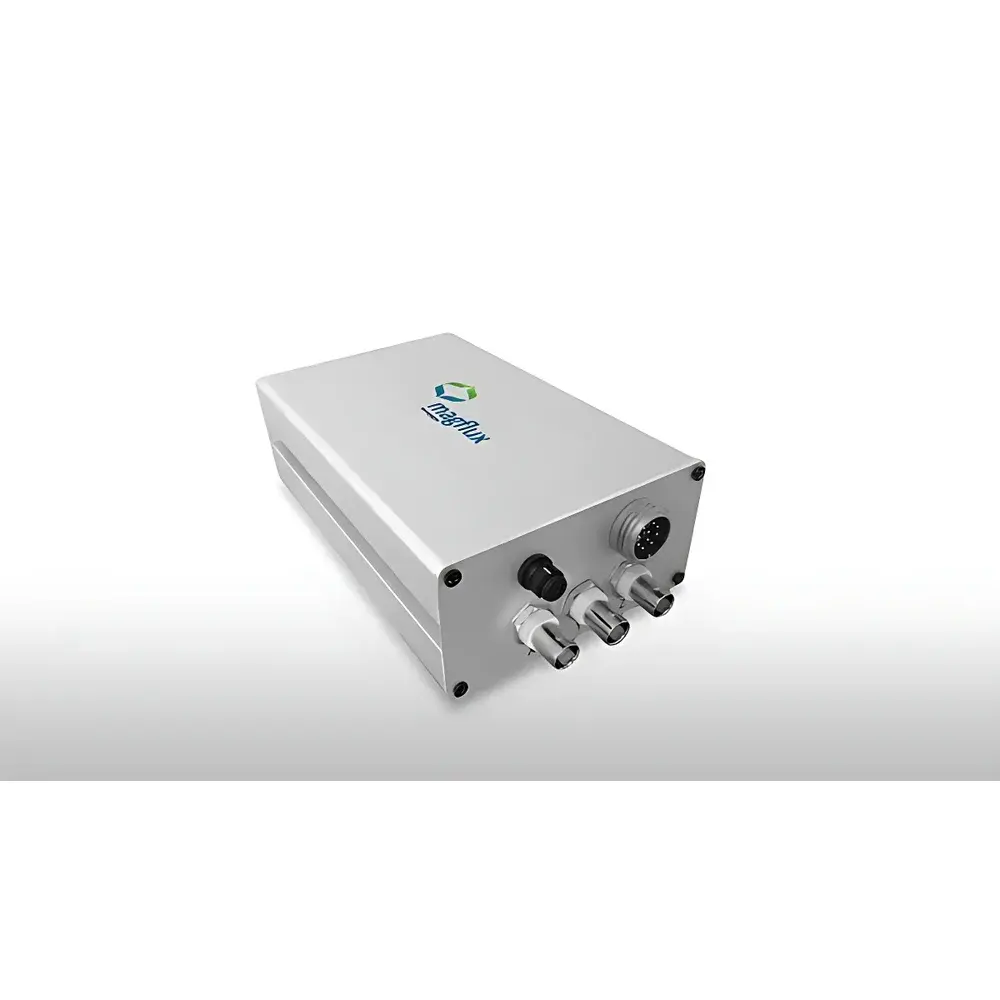
Auniontech FM-A & FM-D Single-Axis Fluxgate Magnetometers
| Brand | Auniontech |
|---|---|
| Model | FM-A (Analog) / FM-D (Digital) |
| Measurement Principle | Fluxgate Magnetometry |
| Axes | 1 (FM-D), 1 or 3 (FM-A) |
| Range | ±50 µT (FM-A), ±100 µT (FM-D) |
| Resolution | 1 nT (FM-D) |
| Noise Floor | 5 nT (0.1–10 Hz, FM-D) |
| Sampling Rate | Up to 100 Hz (FM-D) |
| ADC Depth | 24-bit (FM-D) |
| Power Supply | ±15 V (FM-A), USB-powered (≤10 mA, FM-D) |
| Field Tolerance | ≤5 mT |
| Compliance | CE-marked |
| Software Interface | DLL & LabVIEW™ drivers included |
| Application Scope | Geomagnetic monitoring, biomagnetic screening, NDT of conductive materials, EMI characterization, active field cancellation systems |
Overview
The Auniontech FM-A and FM-D single-axis fluxgate magnetometers are precision instruments engineered for high-sensitivity vector measurement of weak static and low-frequency magnetic fields. Based on the well-established fluxgate principle—where a periodically saturated high-permeability core generates even-harmonic signals proportional to ambient field strength—these sensors deliver exceptional stability, linearity, and thermal drift performance in sub-microtesla regimes. Designed for laboratory, industrial, and field-deployable applications, the FM series targets environments where resolution below 1 nT and long-term repeatability are critical: geomagnetic baseline monitoring, non-destructive evaluation of metallic structures, characterization of urban electromagnetic interference (EMI), and real-time compensation in ultra-low-field magnetic shielding systems. Unlike Hall-effect or magnetoresistive sensors, fluxgate technology provides inherent immunity to temperature-induced offset drift and superior signal-to-noise ratio in DC to ~100 Hz bandwidths—making it the preferred transduction method for metrologically traceable magnetic field quantification under GLP- and GMP-relevant conditions.
Key Features
- Dual-configuration platform: FM-D offers factory-calibrated digital output via USB interface with 24-bit ADC resolution and built-in digital filtering; FM-A delivers analog voltage output (±5 V or ±10 V full scale) optimized for integration into custom data acquisition systems requiring maximum analog fidelity.
- Sub-nanotesla resolution: FM-D achieves 1 nT effective resolution over ±100 µT range, with broadband noise density of 5 nT RMS (0.1–10 Hz), enabling detection of subtle field anomalies associated with micro-cracks, eddy current distortions, or biological magnetic sources.
- Modular sensor architecture: Both FM-A and FM-D support mechanical customization—including probe length, shielding options (mu-metal or nanocrystalline), and connector types—to accommodate confined-space measurements, robotic scanning, or embedded OEM integration.
- Low-power operation: FM-D draws ≤10 mA from standard USB 2.0 ports, eliminating need for external power supplies—ideal for portable surveying, battery-operated monitoring nodes, and distributed sensor networks.
- Traceable calibration: Each FM-D unit ships with NIST-traceable calibration certificate (per ISO/IEC 17025 requirements), specifying sensitivity, nonlinearity (<0.05% FS), and temperature coefficient (<50 ppm/°C).
Sample Compatibility & Compliance
The FM series is compatible with non-ferromagnetic, non-conductive sample holders and fixtures. For material testing applications—including crack detection in aluminum alloys, weld integrity assessment, and corrosion mapping—the sensor requires minimal standoff distance (≥5 mm recommended) to avoid perturbation by induced eddy currents. FM-A supports triaxial configurations upon request, enabling full vector field reconstruction per ASTM E3067-21 guidelines for magnetic particle inspection (MPI) auxiliary field verification. All units comply with CE Directive 2014/30/EU (EMC) and 2014/35/EU (LVD); firmware and driver libraries adhere to FDA 21 CFR Part 11 requirements for electronic records and signatures when deployed in regulated QC/QA workflows.
Software & Data Management
Auniontech provides comprehensive software toolsets including: (1) Standalone GUI for real-time visualization, spectral analysis (FFT), and time-series logging; (2) Windows-compatible DLL libraries supporting C/C++, Python (via ctypes), and MATLAB; (3) Certified LabVIEW™ drivers with example VIs for synchronized multi-channel acquisition and automated calibration routines. Audit trails, user access control, and configurable metadata tagging ensure compliance with ISO 17025 documentation standards. Raw binary data export (IEEE 754 float32) enables post-processing in third-party platforms such as OriginLab or Python-based SciPy ecosystems.
Applications
- Geomagnetic observatories: Continuous monitoring of diurnal variations and magnetic storms within Earth’s background field (~25–65 µT).
- Biomagnetic research: Detection of magnetocardiographic (MCG) or magnetoencephalographic (MEG)-scale fields in shielded rooms.
- Urban EMI profiling: Mapping stray fields from subway systems, power substations, and EV charging infrastructure.
- Non-destructive testing: Locating subsurface flaws in aircraft skins, pipeline welds, and additive-manufactured metal parts via magnetic anomaly detection.
- Active field cancellation: Closed-loop feedback input for Helmholtz coil systems maintaining <10 nT residual fields in quantum sensor labs.
- Distance sensing: Inferring position of ferrous objects through calibrated dipole field decay modeling (1/r³ dependence).
FAQ
What is the maximum allowable ambient field before sensor saturation?
The FM-D and FM-A sensors maintain linear response up to ±5 mT—well beyond their nominal measurement ranges. Operation above ±100 µT (FM-D) or ±50 µT (FM-A) requires internal gain adjustment or external attenuation.
Can FM-A be used with standard DAQ systems?
Yes—FM-A outputs differential analog voltage compliant with NI PXIe-6363, Keysight 34972A, and similar 16+ bit DAQ hardware. Recommended input impedance ≥100 kΩ to minimize loading error.
Is temperature compensation available?
FM-D includes onboard temperature sensing and firmware-based compensation (±0.01%/°C typical). FM-A users may apply polynomial correction using optional thermistor output channel.
How is calibration traceability maintained across device lifetime?
Each unit receives initial calibration at Auniontech’s ISO/IEC 17025-accredited lab. Users may perform field recalibration using Helmholtz coil systems referenced to primary standards (e.g., NMR teslameters).
Are OEM volume discounts and custom firmware options available?
Yes—Auniontech supports contract manufacturing, firmware white-labeling, and API extension for integration into turnkey test benches and automated inspection lines.



