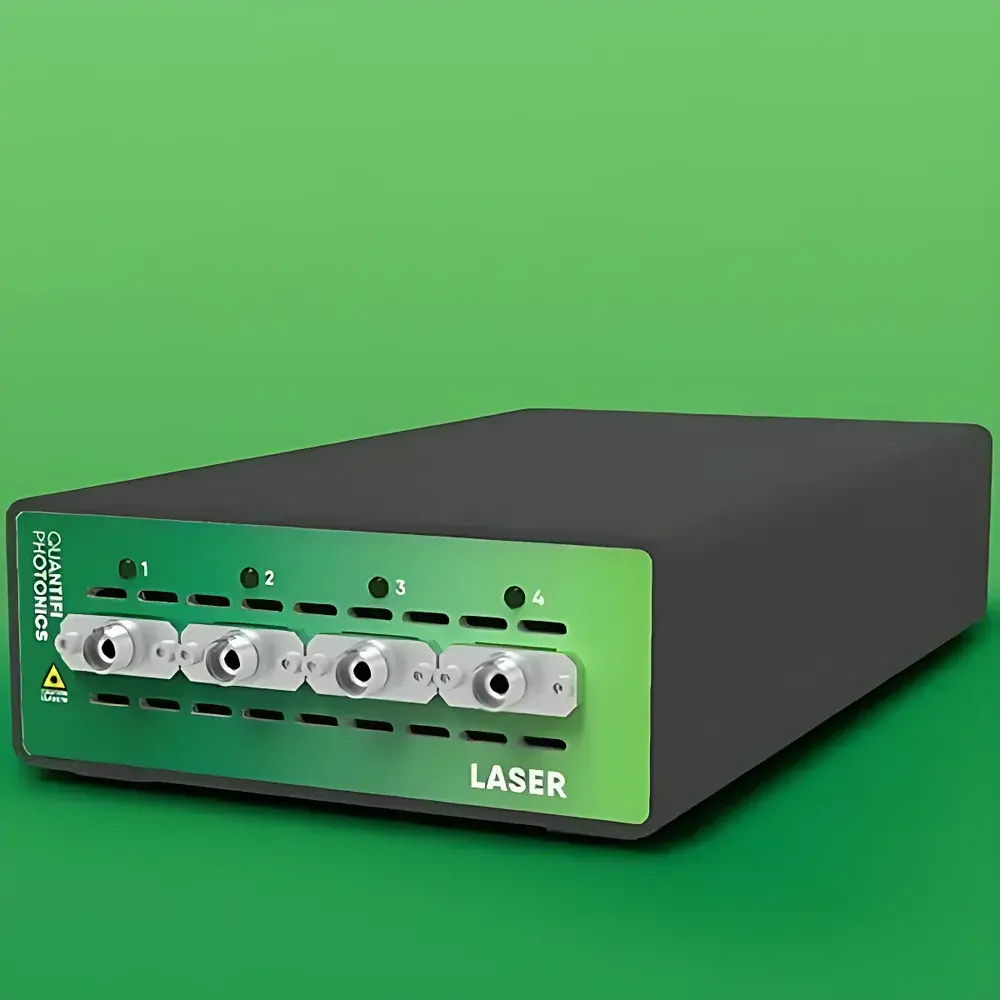
Auniontech Laser-1000 C+L-Band Tunable Laser Source
| Brand | Auniontech |
|---|---|
| Origin | Shanghai, China |
| Platform Options | MATRIQ or PXIe |
| Wavelength Range | 1527.605–1611.787 nm (C+L band) |
| Output Power | up to +16.5 dBm |
| Linewidth | <100 kHz |
| Tuning Resolution | 0.01 pm (1 MHz) |
| Polarization Extinction Ratio | >18 dB |
| Frequency Stability | ±0.3 GHz over 24 h |
| Power Stability | ±0.1 dB over 24 h |
| Interface | USB / Ethernet / Web-based control via COHESIONUI software |
| Output Connectors | FC/PC, FC/APC, SC/PC, SC/APC |
| Compliance | RoHS, CE |
Overview
The Auniontech Laser-1000 C+L-Band Tunable Laser Source is a continuous-wave (CW), single-frequency external-cavity diode laser engineered for high-precision photonic test and measurement applications. Operating across the full ITU-defined C-band (1527.605–1568.773 nm) and L-band (1568.773–1611.787 nm), the Laser-1000 delivers exceptional spectral agility and metrological fidelity. Its thermally tuned external cavity architecture ensures intrinsic wavelength stability and low phase noise—critical for coherent optical systems, interferometric sensing, and high-resolution spectroscopy. The instrument supports both coarse stepping (100 MHz / ~1 pm) and fine tuning (1 MHz / 0.01 pm), enabling precise channel alignment in DWDM system validation and calibration of optical frequency references. Designed for integration into automated test environments, the Laser-1000 is available in modular form factors compatible with industry-standard PXIe and MATRIQ platforms—ensuring scalability from benchtop R&D to production-line ATE systems.
Key Features
- Full C+L band coverage (1527.605–1611.787 nm) with seamless dual-channel operation in Model 1007
- Narrow linewidth <100 kHz (typical), supporting coherent detection and heterodyne interferometry
- High spectral purity: SMSR ≥40 dB (55 dB typical), minimizing mode competition artifacts
- Ultra-fine tuning resolution of 0.01 pm (1 MHz), enabling sub-picometer wavelength locking
- Output power up to +16.5 dBm with ±0.1 dB stability over 24 hours and ±0.6 dB absolute uncertainty
- Integrated polarization-maintaining (PM) output with PER >18 dB, eliminating polarization drift in sensitive interferometric setups
- “WhISPer” mode option (Models 1051–1055): actively suppresses frequency dithering for ultra-stable narrow-linewidth operation
- Built-in optical power monitoring and real-time RIN characterization (–140 dB/Hz, 10 MHz–40 GHz)
- Flexible interface options: USB 2.0, 10/100/1000BASE-T Ethernet, and web-native control via COHESIONUI
Sample Compatibility & Compliance
The Laser-1000 is optimized for use with polarization-sensitive components including fiber Bragg gratings (FBGs), arrayed waveguide gratings (AWGs), silicon photonics waveguides, MEMS tunable filters, and integrated coherent receivers. Its PM-fiber output ensures consistent coupling efficiency into polarization-dependent devices without manual alignment. The instrument complies with IEC 61326-1 (EMC for laboratory equipment), RoHS Directive 2011/65/EU, and CE marking requirements. For regulated environments—including GLP/GMP-compliant optical component qualification—the Laser-1000 supports audit-trail-capable logging when operated under COHESIONUI with timestamped parameter records. While not FDA 21 CFR Part 11–certified out-of-the-box, its deterministic firmware behavior and immutable configuration logs enable validation pathways for medical device photonic testing per ISO 13485.
Software & Data Management
COHESIONUI is a cross-platform, browser-based application enabling local and remote control via any modern PC, tablet, or smartphone. Its responsive UI features customizable dashboards, multi-instrument synchronization, scriptable scan sequences (Python API available), and real-time spectral overlay for comparative analysis. All parameter changes—including wavelength setpoints, power levels, and WhISPer activation—are logged with UTC timestamps and user identifiers. Export formats include CSV, HDF5, and industry-standard S2P for integration with MATLAB, LabVIEW, or Keysight PathWave. Firmware updates are delivered over secure HTTPS channels, with SHA-256 signature verification. For PXIe deployments, the Laser-1000 integrates natively with NI VeriStand and TestStand frameworks, supporting hardware-in-the-loop (HIL) test sequences compliant with IEEE 1671 GSDML.
Applications
- Coherent transceiver development: local oscillator (LO) source for Tx/Rx characterization, EVM and BER testing
- Optical component validation: insertion loss, PDL, and phase response mapping of couplers, splitters, and WSS modules
- Fiber-optic sensor interrogation: FBG and interferometric strain/temperature sensing with sub-pm resolution
- Silicon photonics wafer-level testing: on-chip grating coupler alignment and ring resonator resonance tracking
- EDFA and Raman amplifier gain profiling across C+L bands
- Laser Doppler velocimetry (LDV) and photonic Doppler velocimetry (PDV) source for shock physics and material dynamics studies
- Optical coherence tomography (OCT) swept-source development and calibration
- Mach-Zehnder and Michelson interferometer stabilization for gravitational wave detector R&D
- WDM channel loading and spectral tilt analysis in long-haul transmission system emulation
FAQ
What is the difference between “stepping” and “fine tuning” modes?
Stepping mode provides rapid wavelength jumps (≤25 s settling time) at 100 MHz (~1 pm) intervals for coarse channel selection; fine tuning enables sub-MHz adjustments (0.01 pm) for precision lock-in or drift compensation.
Can the Laser-1000 operate in a vacuum or at elevated temperatures?
The standard unit is rated for ambient operation from 5 °C to 45 °C and storage from –40 °C to 70 °C. Custom hermetic packaging and thermoelectric cooling options are available upon request for non-standard environmental deployment.
Is optical isolation included?
The Laser-1000 does not integrate an internal optical isolator; however, it is designed for direct coupling into external isolators (e.g., 30 dB broadband PM isolators) to prevent back-reflection-induced instability.
How is frequency accuracy verified and maintained?
Each unit undergoes factory calibration against NIST-traceable wavemeters. Frequency uncertainty is specified as ±2.5 GHz (±22 pm); users may perform in-situ recalibration using a reference Fabry–Pérot interferometer or optical frequency comb.
Does COHESIONUI support automated compliance reporting for ISO/IEC 17025 labs?
Yes—COHESIONUI generates PDF-formatted calibration reports with traceable metadata, operator ID, environmental conditions, and pass/fail status per user-defined acceptance criteria, aligning with ILAC-P10 requirements.