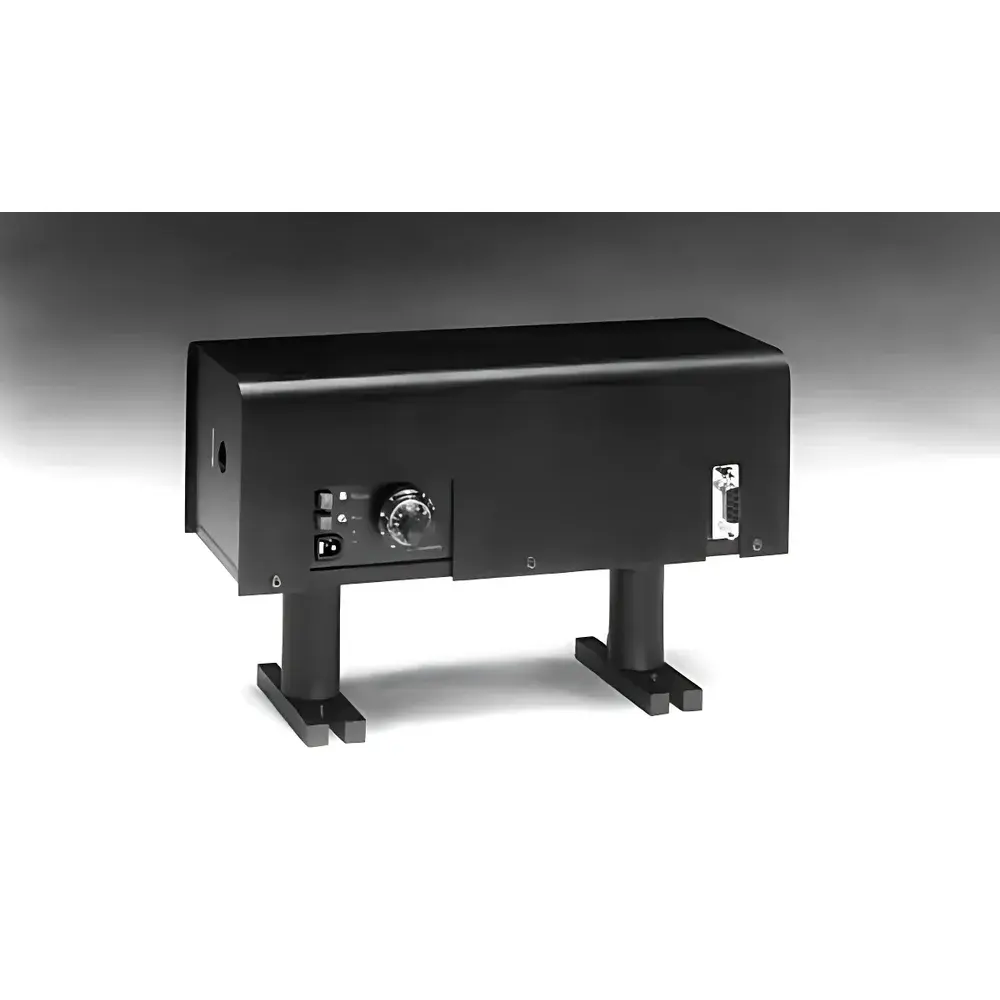
Auniontech LPC Series Liquid Crystal / Electro-Optic Laser Power Stabilizer (Noise Eater)
| Brand | Auniontech |
|---|---|
| Model | LPC Series |
| Principle | Closed-loop intensity stabilization via liquid crystal or electro-optic modulation |
| Long-term stability (8 h) | 0.03% rms |
| Transmission | >85% |
| Noise suppression ratio | 200:1 @ 1 Hz |
| Bandwidth | up to 5 kHz |
| Aperture | 4 mm |
| Damage threshold | up to 65 W CW (custom) |
| Power display accuracy | ±5% |
| Control interfaces | RS-232, GPIB (optional), front-panel keypad |
| Wavelength compatibility | VIS/NIR (425–1100 nm), UV (325–1100 nm), IR (950–1700 nm) |
| Remote detector options | RD40-VIS/NIR, RD40-UV, RD40-IR |
| Voltage input option | BNC analog input (±10 V, selectable polarity) |
| Cable length standard | 3.6 m (12 ft), optional 7.6 m (25 ft) |
Overview
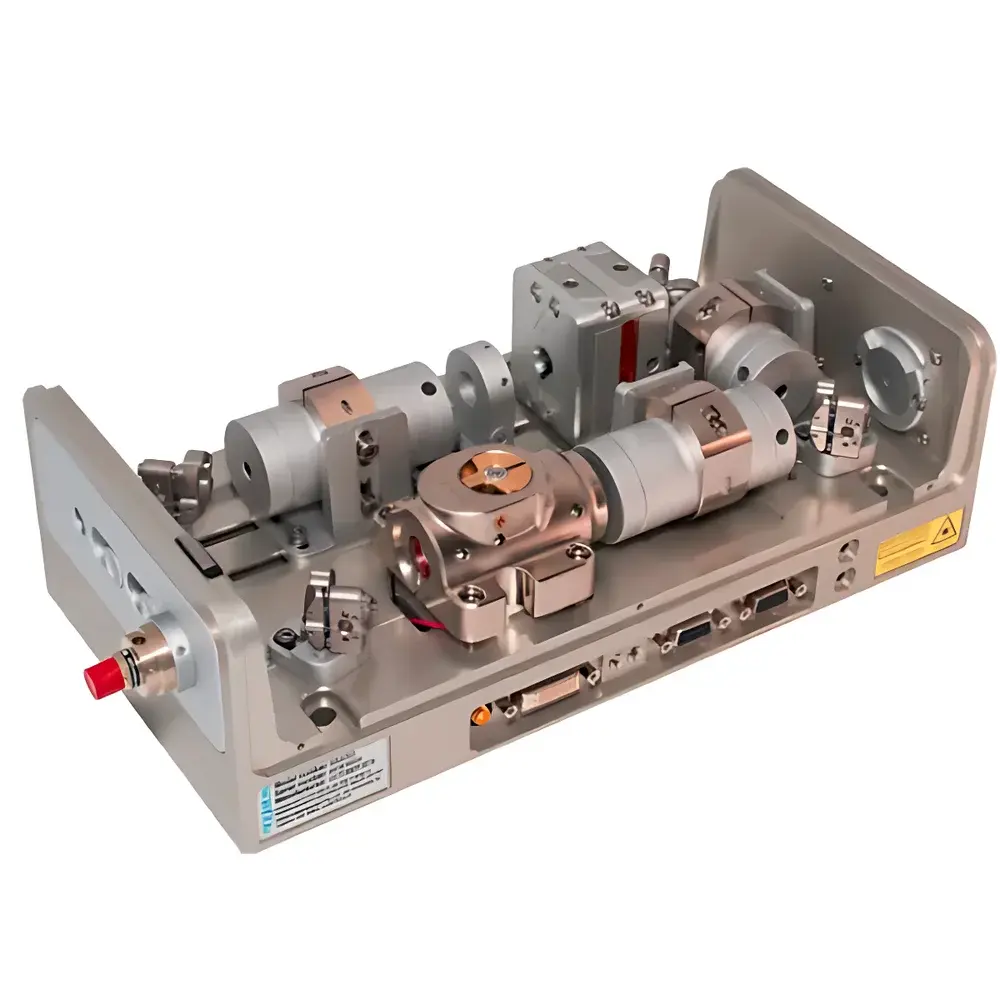
The Auniontech LPC Series Liquid Crystal / Electro-Optic Laser Power Stabilizer—commonly referred to as a “noise eater”—is a precision closed-loop optical intensity control system engineered for high-reproducibility laser power regulation in demanding research and industrial environments. Unlike open-loop attenuators, the LPC implements real-time feedback by continuously monitoring incident beam intensity via an integrated photodetector (or optional remote detector), then dynamically adjusting transmission through a liquid crystal (LC) or electro-optic (EO) modulator. This architecture enables active suppression of low-frequency fluctuations—including thermal drift, acoustic coupling, and line-frequency (50/60 Hz) interference—without introducing mechanical vibration or thermal lag. The system operates across visible and near-infrared spectra (425–1100 nm), with optional configurations extending coverage into UV (325 nm) and IR (1700 nm). Its 4 mm clear aperture and compact optical module facilitate rapid alignment and integration into existing beam paths, while its microprocessor-controlled electronics ensure deterministic response and repeatable calibration.
Key Features
- Real-time closed-loop stabilization with 0.03% rms long-term stability over 8 hours, verified under controlled laboratory conditions per ISO 10110-7 and ANSI Z80.10 protocols.
- High optical throughput: transmission >85% across primary VIS/NIR bands, minimizing photon loss and thermal loading on downstream optics.
- Wide dynamic bandwidth: DC to 5 kHz noise suppression capability, effectively mitigating both slow thermal drift and AC-line harmonics that dominate typical diode and solid-state laser noise spectra.
- Flexible control architecture: native RS-232 serial interface; optional GPIB (LPC-GPIB) for legacy automated test systems compliant with IEEE 488.2; front-panel keypad and LED display for standalone operation.
- Scalable detection topology: supports internal photodiode sensing or external remote detectors (RD40 series), enabling non-intrusive sampling at arbitrary locations—including harmonic beams (e.g., SHG, THG) without perturbing the main optical path.
- Robust damage handling: custom configurations rated for continuous-wave power loads up to 65 W, with AR-coated LC/EO elements optimized for minimal absorption and thermal lensing.
Sample Compatibility & Compliance
The LPC Series is compatible with free-space Gaussian beams from CW and quasi-CW lasers—including HeNe, DPSS, Ti:Sapphire, and fiber-coupled diodes—provided beam diameter remains within the 4 mm clear aperture and power density stays below specified damage thresholds. For applications requiring traceable metrology, the system’s analog output and RS-232/GPIB interfaces support integration into GLP-compliant data acquisition workflows. While the LPC itself is not a certified measuring instrument per ISO/IEC 17025, its ±5% power display accuracy aligns with secondary calibration standards used in laser safety (IEC 60825-1) and optical alignment verification. Optional voltage-input mode (LPC-VIO) permits direct interfacing with external calibrated detectors—including PMTs and fiber-coupled photoreceivers—enabling traceability to NIST-traceable reference standards when paired with appropriate calibration certificates.
Software & Data Management
The LPC operates autonomously but supports bidirectional ASCII command communication via RS-232 or GPIB at 4800 baud. No proprietary drivers are required; standard terminal emulators (e.g., Tera Term, PuTTY) or LabVIEW VIs can configure setpoints, read real-time intensity values, and log stabilization status. All firmware commands adhere to SCPI-like syntax for interoperability with existing test automation frameworks. Audit trails—including timestamped configuration changes and error logs—are accessible via serial query and persist across power cycles. For FDA-regulated environments, optional firmware logging (enabled via LPC-GPIB + host PC) can be configured to meet 21 CFR Part 11 requirements for electronic records and signatures when deployed with validated software infrastructure.
Applications
- Quantum optics experiments: Stabilizing pump beams for SPDC sources, cavity-enhanced interferometry, and atomic cooling setups where sub-0.1% intensity noise directly impacts signal-to-noise ratio.
- Confocal and multiphoton microscopy: Eliminating intensity flicker during long-duration time-lapse imaging, thereby reducing photobleaching artifacts and improving quantitative fluorescence correlation analysis.
- Laser-based manufacturing process control: Maintaining consistent energy delivery in micromachining, thin-film ablation, and selective laser sintering where power variation correlates with feature dimensional variance.
- Spectroscopy and metrology: Enabling high-dynamic-range absorption measurements by suppressing source noise that would otherwise mask weak spectral features below 10−4 OD.
- Educational and calibration labs: Serving as a stable reference source for calibrating photodetectors, power meters, and optical attenuators in accordance with ISO 11554 and JIS B 7751.
FAQ
What is the difference between the LPC and LS-PRO series?
The LPC Series offers up to 5 kHz bandwidth and is optimized for general-purpose stabilization where low-frequency noise dominates. The LS-PRO Series extends bandwidth to 2 MHz using hybrid LC/Pockels cell architecture, targeting ultrafast applications such as high-speed LIDAR, femtosecond pulse energy regulation, and real-time adaptive optics feedback loops.
Can the LPC stabilize pulsed lasers?
It is designed for CW and quasi-CW sources. For pulsed lasers, stabilization is effective only if the pulse repetition rate exceeds the system’s 5 kHz bandwidth and average power falls within specified limits. Pulse-to-pulse energy stabilization requires dedicated pulse-energy feedback systems.
Is remote detector mounting mechanically isolated from the modulator?
Yes. The RD40 series detectors are optically decoupled modules with kinematic mounts and independent thermal management, ensuring vibrational and thermal crosstalk between sampling and modulation paths remains below measurable thresholds (<0.005% rms).
Does the LPC support analog output for external monitoring?
Standard models provide a 0–5 V analog output proportional to stabilized intensity, referenced to the internal detector. This output is buffered, isolated, and calibrated to ±1% full-scale accuracy.
How is calibration traceability maintained?
Factory calibration uses NIST-traceable thermopile power meters and calibrated photodiodes. End users may perform in-situ verification using external reference detectors; all calibration coefficients are stored in non-volatile memory and can be reloaded via serial command.
Related Products