
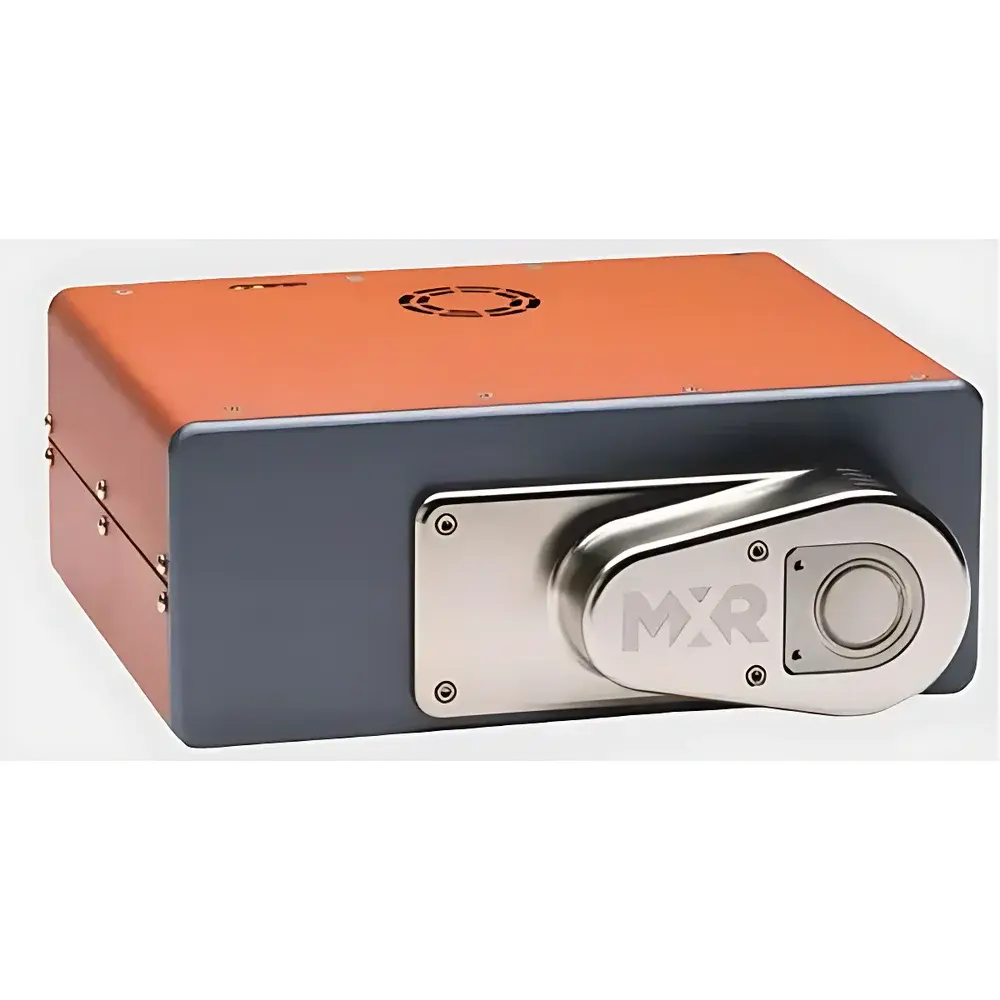
Auniontech MICRO FOCUS X Microfocus X-ray Source
| Brand | Auniontech |
|---|---|
| Model | MICRO FOCUS X |
| Target Spot Size | 5–10 µm (power-dependent) |
| Operating Voltage | 20–100 kV |
| Max Power | 15 W |
| Focus-to-Window Distance (FOD) | 7 mm |
| Anode Material | Tungsten (W) / Copper (Cu) |
| Input Power | 24 VDC / 2 A |
| Weight | 4.5 kg |
| Dimensions | 524 × 490.25 × 206.5 mm |
| Window Thickness | 0.254 mm |
| Beam Divergence | 95° conical |
| Cooling | Integrated fan (sufficient for ambient ≤28°C) |
| Operating Temp | +10°C to +40°C |
| HV Ripple (full load) | ≤0.1% p-p |
| Voltage/Current Regulation | ±0.25% |
| Interface | RS-232C |
| OS Compatibility | Windows 7/8.1/10 |
| Window Type | Side-window and end-window configurations available |
Overview
The Auniontech MICRO FOCUS X is a fully integrated, compact microfocus X-ray source engineered for high-resolution 2D radiography and 3D micro-computed tomography (micro-CT) applications in industrial inspection, semiconductor metrology, and preclinical imaging. Based on thermionic emission and electrostatic focusing principles, the source generates a highly collimated electron beam accelerated toward a solid anode target (tungsten or copper), producing bremsstrahlung and characteristic X-ray photons. Its defining feature is a sub-10 µm focal spot—achieving 5 µm at 7.5 W, scaling predictably with power—enabling geometric magnification without significant penumbral blurring. With a minimal focus-to-window distance of only 7 mm and a wide 95° conical beam divergence, the MICRO FOCUS X delivers exceptional spatial resolution and photon flux efficiency within a rigid, self-shielded mechanical envelope. Designed for OEM integration and benchtop systems, it operates from a single 24 VDC supply and features built-in high-voltage generation, real-time thermal management, and digital control via RS-232C—eliminating external HV modules and simplifying system architecture.
Key Features
- Fully integrated design: co-located X-ray tube, high-voltage generator, and digital controller in one sealed housing
- Sub-10 µm focal spot size (5 µm @ 7.5 W; 10 µm @ 15 W), calibrated per IEC 62220-1-2 for effective focal spot measurement
- Short focus-to-window distance (7 mm) optimized for high-magnification radiography and low-geometric-unsharpness CT reconstruction
- Dual anode material option (W or Cu) supporting both high-energy penetration (W Kα = 59.3 keV) and high-contrast soft-tissue or polymer imaging (Cu Kα = 8.0 keV)
- Stable output regulation: voltage and current stability better than ±0.25% under dynamic load, with HV ripple <0.1% peak-to-peak
- Passive and active thermal management: internal fan-cooled design validated for continuous operation at ambient temperatures up to 28°C
- OEM-friendly interface: RS-232C protocol supports remote parameter setting (kV, µA, exposure time), status monitoring, and fault logging
- Compact form factor (524 × 490.25 × 206.5 mm) and low mass (4.5 kg) enabling integration into space-constrained platforms including portable CT scanners and automated inline inspection stations
Sample Compatibility & Compliance
The MICRO FOCUS X is compatible with standard scintillator-based flat-panel detectors (e.g., Hamamatsu C7942, PerkinElmer XRD 1611), CMOS-based direct-detection sensors, and phosphor-coupled CCD systems. Its 0.254 mm beryllium exit window ensures transmission efficiency >85% for photons above 5 keV while maintaining vacuum integrity and radiation shielding. The device complies with IEC 61000-6-3 (EMC emission) and IEC 61000-6-2 (immunity), and meets mechanical safety requirements per ISO 13857 for accessible openings. While not certified as a medical device under FDA 21 CFR Part 820 or EU MDR, its performance parameters align with ASTM E2737 (standard practice for microfocus X-ray computed tomography) and ISO/IEC 17025–accredited laboratories routinely use this source for nondestructive evaluation (NDE) of electronic assemblies per IPC-A-610 and JEDEC J-STD-033. For GLP/GMP environments, audit-ready operation logs and parameter traceability are supported via the Windows GUI and RS-232 command set.
Software & Data Management
The MICRO FOCUS X is controlled through a native Windows application (compatible with Windows 7, 8.1, and 10) offering intuitive configuration of kV (20–100), tube current (up to 150 µA), exposure timing, and interlock states. All operational parameters—including real-time anode temperature, HV feedback, and error codes—are logged with timestamps and exportable to CSV. The RS-232C interface implements a documented ASCII command protocol enabling seamless integration into third-party acquisition software (e.g., Bruker CT Studio, Nikon XT Software, or custom LabVIEW/Python frameworks). Firmware supports firmware-upgradable calibration tables for kV/current linearity and spot size drift compensation. Audit trails include user-initiated parameter changes, runtime hours, and thermal event history—supporting compliance with FDA 21 CFR Part 11 when deployed with appropriate system-level validation protocols.
Applications
- High-resolution failure analysis of packaged ICs, wire bonds, and solder joints in semiconductor packaging
- Non-destructive inspection of multilayer PCBs for void detection, trace alignment, and BGA solder ball integrity
- Metrology-grade micro-CT for dimensional analysis of MEMS devices, additive-manufactured metal parts, and ceramic inject-molded components
- Preclinical small-animal imaging and ex vivo tissue specimen tomography at voxel resolutions down to 1 µm (with optical magnification)
- In-line quality assurance in battery electrode coating, composite laminate lamination, and pharmaceutical tablet coating uniformity assessment
- Forensic material analysis, including counterfeit electronics identification and layered material decomposition
FAQ
What is the minimum achievable focal spot size, and under what conditions?
The nominal focal spot size is 5 µm when operated at 7.5 W (e.g., 50 kV × 150 µA); spot size increases predictably with power due to thermal broadening—8 µm at 12 W and 10 µm at maximum 15 W.
Can the MICRO FOCUS X be used in vacuum or inert-gas environments?
No—the unit is designed for atmospheric operation only; the beryllium window and internal cooling rely on ambient air convection and must not be enclosed without forced airflow matching the specified thermal profile.
Is tungsten the default anode material, and can Cu be substituted without hardware modification?
Tungsten is standard; copper anodes are available as factory-configured variants—not field-swappable—and require recalibration of beam hardening correction tables.
Does the system support external triggering for synchronized detector acquisition?
Yes—TTL-compatible trigger input/output signals are provided via the RS-232 expansion header, allowing precise start/stop synchronization with detector frame capture.
What maintenance intervals are recommended for long-term stability?
No scheduled maintenance is required; however, annual verification of kV/current linearity and focal spot size using a pinhole camera or edge-spread function (ESF) test is recommended for ISO/IEC 17025 compliance.





