
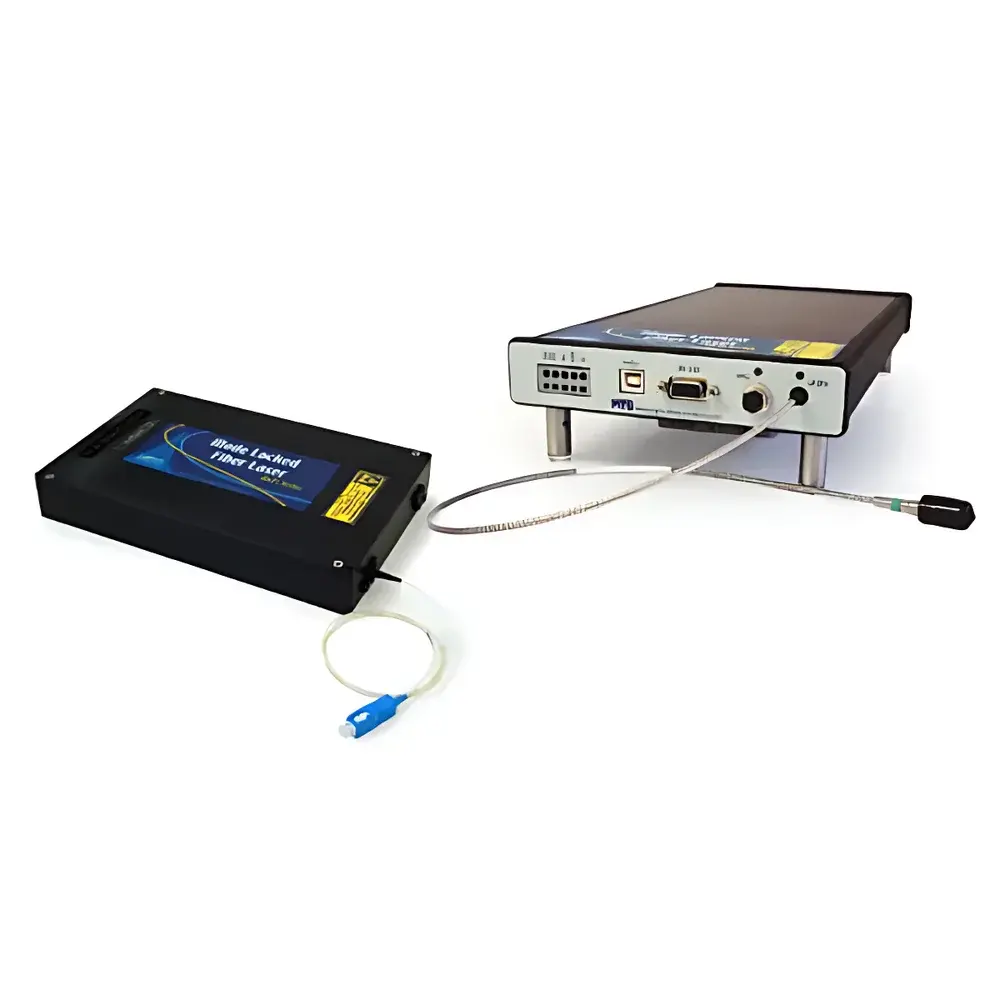
Auniontech Sub-Nanosecond & Nanosecond Pulsed Fiber Laser System
| Brand | Auniontech |
|---|---|
| Origin | Canada |
| Model | NS/ASN Series |
| Wavelength Range | 514–1550 nm |
| Pulse Width | 0.7–1.5 ns |
| Avg. Power | 0.5–10 W |
| Cooling | Air-cooled |
| Beam Quality (M²) | <1.1 |
| Timing Jitter | <10 ps RMS |
| Trigger Mode | Internal/External TTL |
| Compliance | CE, RoHS, FDA 21 CFR Part 11 (Software Optional) |
Overview
The Auniontech Sub-Nanosecond & Nanosecond Pulsed Fiber Laser System is a high-stability, all-fiber-integrated laser platform engineered for precision time-resolved optical applications requiring deterministic pulse timing, low amplitude noise, and diffraction-limited beam delivery. Based on master oscillator power amplifier (MOPA) architecture with polarization-maintaining (PM) fiber components, the system delivers transform-limited pulses across visible and near-infrared spectral bands—from 514 nm to 1550 nm—without thermal lensing or mechanical realignment. Its core operating principle relies on actively Q-switched or gain-switched fiber amplification stages, enabling precise control over pulse duration (0.7–1.5 ns), repetition rate (1 kHz–10 MHz), and inter-pulse delay with sub-10 ps RMS jitter. Designed for integration into OEM instrumentation and advanced research setups, the laser operates in continuous burst mode or single-shot triggered operation, supporting both internal clock synchronization and external TTL/PECL triggering with programmable latency compensation.
Key Features
- All-fiber, monolithic design with no free-space optics—ensuring long-term alignment stability and immunity to vibration and thermal drift
- Air-cooled, compact chassis (≤2U rack-mountable) suitable for cleanroom, microscopy, and field-deployable systems
- Programmable GUI interface supporting real-time adjustment of average power, repetition rate, pulse delay, and trigger source (internal/external)
- Ultra-low amplitude noise (<0.3% RMS, 10 Hz–10 MHz) and pulse-to-pulse energy stability (<0.5% RMS over 8 hours)
- Dual-wavelength integrated variants available (e.g., 589 nm + 655 nm) optimized for stimulated emission depletion (STED) microscopy with synchronized temporal gating
- Compliance-ready firmware architecture supporting audit trails, user access levels, and electronic signature logging per FDA 21 CFR Part 11 (optional software module)
Sample Compatibility & Compliance
This laser system is compatible with standard PM fiber-coupled optical components (FC/APC, SMA905), scanning galvanometers, acousto-optic modulators (AOMs), and time-correlated single-photon counting (TCSPC) electronics. It meets CE marking requirements for electromagnetic compatibility (EN 61326-1) and safety (EN 60825-1:2014 Class 4 laser product). For regulated environments—including GLP/GMP-compliant biophotonics labs and medical device R&D—the optional validation package includes IQ/OQ documentation, wavelength calibration certificates traceable to NIST standards, and full traceability of optical component lot numbers. All models conform to ISO 13485 manufacturing controls where applicable.
Software & Data Management
The embedded control firmware supports USB 2.0 and Ethernet (TCP/IP) interfaces, enabling remote configuration via Python, MATLAB, or LabVIEW APIs. The included AunionControl GUI provides intuitive parameter mapping, waveform preview, and multi-channel trigger sequencing. Data logging records timestamped operational parameters (power, temperature, pulse count) at user-defined intervals, exportable as CSV or HDF5. For regulated workflows, the optional Compliance Edition adds role-based access control (RBAC), electronic signatures, change history tracking, and 21 CFR Part 11-compliant audit logs—with encrypted local storage and configurable retention policies. All software binaries are digitally signed and version-controlled with SHA-256 checksum verification.
Applications
- Super-resolution microscopy: STED, RESOLFT, and gated-STORM using dual-wavelength synchronized excitation/depletion beams
- Time-of-flight (ToF) LiDAR and ranging: High-repetition-rate nanosecond pulses with sub-10 ps jitter for mm-level distance resolution
- Fluorescence lifetime imaging (FLIM): Time-gated detection with picosecond-level synchronization accuracy
- DNA sequencing platforms: Solid-state nanopore signal excitation and fluorescence tagging with spectrally matched pulses
- Defense & aerospace: Eye-safe (1550 nm) rangefinders, countermeasure simulators, and LIDAR atmospheric profiling
- Ultrafast spectroscopy: Pump-probe experiments requiring precise inter-pulse delays between visible/NIR channels
FAQ
What is the typical pulse-to-pulse timing jitter specification?
RMS timing jitter is ≤8 ps for all models when operating in external trigger mode with low-noise TTL input; internal clock jitter is ≤5 ps RMS.
Can the laser be integrated into a custom OEM instrument?
Yes—mechanical, electrical, and optical integration support is provided, including SDKs, pinout diagrams, thermal management guidelines, and EMC pre-compliance testing reports.
Is wavelength calibration traceable to national standards?
Each unit ships with a factory calibration certificate referencing NIST-traceable wavemeters; recalibration services are available annually with full uncertainty budget reporting.
Does the system support burst-mode operation with variable intra-burst spacing?
Yes—up to 1024 pulses per burst with programmable inter-pulse delays from 100 ns to 10 ms, fully synchronized to external master clocks.
What maintenance is required during normal operation?
None—fully solid-state, air-cooled design with no consumables, moving parts, or periodic alignment; mean time between failures (MTBF) exceeds 50,000 hours.






