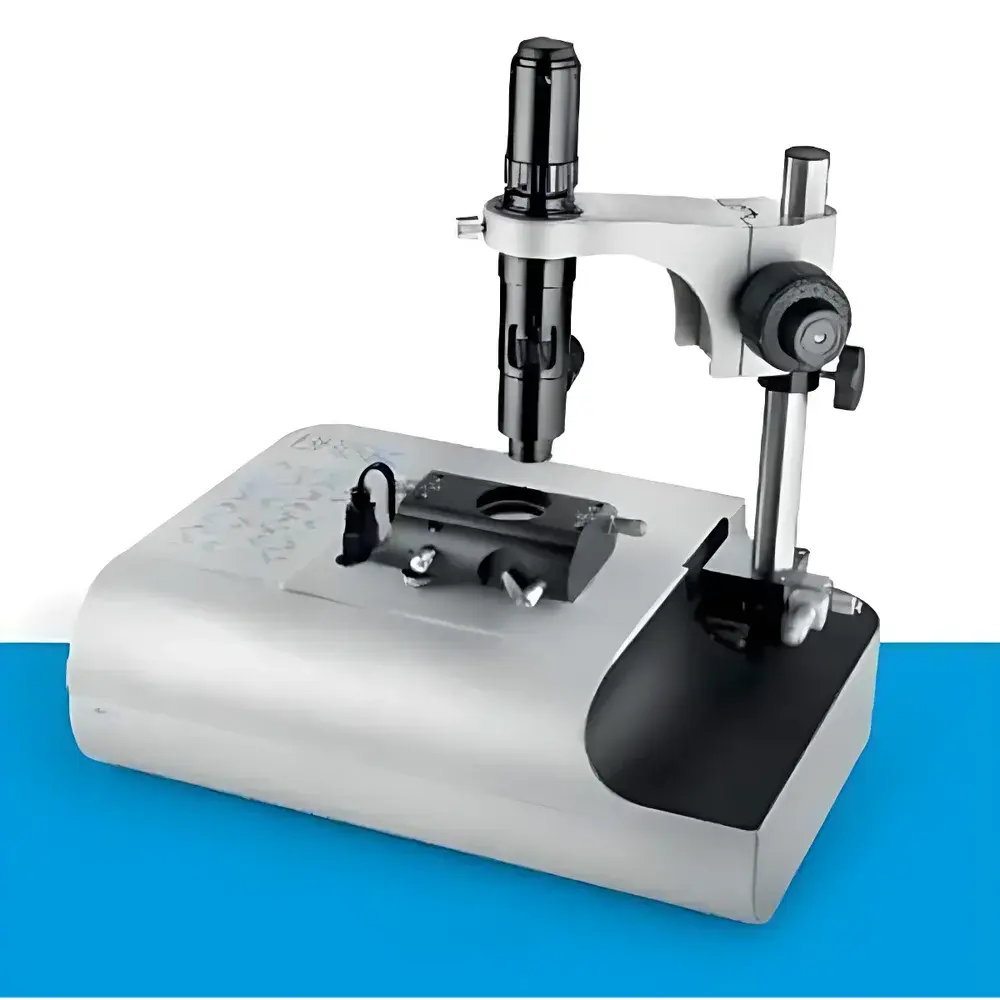
Auniontech Portable Atomic Force Microscope
| Brand | Auniontech |
|---|---|
| Origin | Shanghai, China |
| Manufacturer Type | Authorized Distributor |
| Product Origin | Domestic (China) |
| Model | AFM-Portable Series |
| Pricing | Available Upon Request |
Overview
The Auniontech Portable Atomic Force Microscope (AFM) is a compact, benchtop-grade scanning probe instrument engineered for high-resolution surface topography characterization at the nanoscale. Unlike optical microscopy—limited by the diffraction barrier of visible light (~200 nm resolution)—this AFM operates on the principle of mechanical force detection between a sharp probe tip and the sample surface. It employs a microfabricated silicon cantilever with a V-shaped pyramidal tip (typical radius < 10 nm), mounted on a precision piezoelectric scanner. As the tip raster-scans across the surface in contact, tapping, or non-contact mode, interatomic forces—including van der Waals, capillary, electrostatic, and magnetic interactions—induce cantilever deflection. This deflection is detected via an optical lever system: a laser beam reflected from the cantilever’s backside onto a quadrant photodiode, generating position-sensitive differential signals proportional to vertical displacement. The resulting data reconstructs true three-dimensional surface morphology with sub-nanometer vertical resolution and lateral resolution down to ~1 nm under optimal conditions.
Key Features
- Compact & Transportable Design: Engineered for minimal lab footprint (< 30 cm × 30 cm base), integrated vibration-damping chassis, and low-power operation—enabling deployment in teaching labs, cleanrooms, field service environments, and multi-user shared facilities.
- Modular Probe Exchange System: Tool-free, alignment-free cantilever holder enables rapid tip replacement (< 60 seconds) without recalibration, supporting standard commercial probes (e.g., PPP-NCHR, RTESPA, MPP-11100) across contact, AC, and phase-imaging modes.
- Real-Time High-Speed Imaging: Digital controller based on FPGA architecture achieves line rates up to 5 Hz at 512 × 512 pixels, with adaptive scan speed control to maintain signal fidelity on heterogeneous surfaces.
- Integrated Optical Preview: Co-aligned coaxial LED illumination and CMOS camera (1.3 MP) provide real-time optical navigation and region-of-interest selection prior to AFM scanning—reducing setup time and improving targeting accuracy.
- Unified Control Architecture: All motion, feedback, and signal acquisition subsystems are synchronized within a single embedded controller, eliminating timing jitter and ensuring reproducible tip-sample interaction dynamics.
- Low-Noise Signal Chain: Analog front-end optimized for dynamic range > 80 dB and RMS noise floor < 0.1 nm/√Hz (in Z-channel), critical for quantitative nanomechanical mapping (e.g., adhesion, stiffness, dissipation).
Sample Compatibility & Compliance
The Auniontech Portable AFM accommodates rigid and semi-rigid samples up to 50 mm in diameter and 20 mm in height, including conductive (metals, doped semiconductors), insulating (polymers, oxides, biological substrates), and soft materials (hydrogels, lipid bilayers). Sample mounting uses standard magnetic or adhesive stubs; optional environmental enclosures support ambient, dry nitrogen, or humidity-controlled operation. The system complies with IEC 61000-6-3 (EMC emission standards) and IEC 61010-1 (safety requirements for electrical equipment for measurement). Data acquisition workflows support audit trails and user-access logging—facilitating GLP-compliant documentation when paired with validated software configurations.
Software & Data Management
Control and analysis are performed via AunionTech AFM Suite v4.x—a Windows-based application developed in C++ with Qt framework. Core capabilities include real-time image preview, multi-channel simultaneous acquisition (topography, error, phase, amplitude), automated tip approach, and closed-loop piezo calibration. Export formats include TIFF, ASCII, Gwyddion (.gwy), and HDF5 for interoperability with MATLAB, Python (NumPy/SciPy), and open-source SPM analysis tools. Software supports 21 CFR Part 11–ready configuration (electronic signatures, role-based permissions, immutable audit logs) upon customer-requested validation package. Remote operation is enabled via secure TCP/IP interface compatible with institutional VPNs and LabView integration through DLL API.
Applications
- Nanoscale metrology of semiconductor wafers, MEMS structures, and thin-film coatings per ASTM E2529 and ISO/IEC 17025–accredited protocols.
- Surface roughness quantification (Sa, Sq, Sz) in QC/QA labs for medical device packaging, implant coatings, and pharmaceutical tablet film layers.
- In situ nanomechanical mapping of polymer blends, battery electrode composites, and biomaterials using force-distance spectroscopy and harmonic inversion techniques.
- Teaching nanoscience fundamentals: hands-on training in SPM principles, feedback control theory, and nanoscale imaging artifacts (e.g., convolution, drift, thermal noise).
- Correlative microscopy workflows: overlaying AFM topography with optical fluorescence or Raman maps acquired on the same sample stage.
FAQ
What is the typical lateral and vertical resolution achievable with this portable AFM?
Lateral resolution is governed by tip geometry and operational mode—typically 1–3 nm on atomically flat samples (e.g., HOPG, mica); vertical resolution is < 0.05 nm RMS under vibration-isolated conditions.
Does the system support advanced modes such as Kelvin Probe Force Microscopy (KPFM) or Magnetic Force Microscopy (MFM)?
Yes—via optional upgrade kits including dual-pass scanning electronics, shielded probe holders, and calibrated MFM/KPFM tips; firmware and software modules are licensed separately.
Is the instrument suitable for biological samples in liquid environments?
The base configuration supports ambient air and inert gas; fluid cell accessories (with sealed scanner and flow-compatible cantilevers) are available as add-ons for physiological buffer imaging.
How is calibration traceability maintained for quantitative measurements?
Each unit ships with NIST-traceable step-height standards (Si grating, 20 nm and 100 nm steps) and certified piezo sensitivity values; annual recalibration services are offered through Auniontech’s Shanghai service center.
Can the AFM be integrated into automated production inspection lines?
Yes—through programmable API access, TTL trigger I/O, and Ethernet-based command scripting; integration with PLCs and MES systems requires custom middleware development, supported under engineering services agreement.