
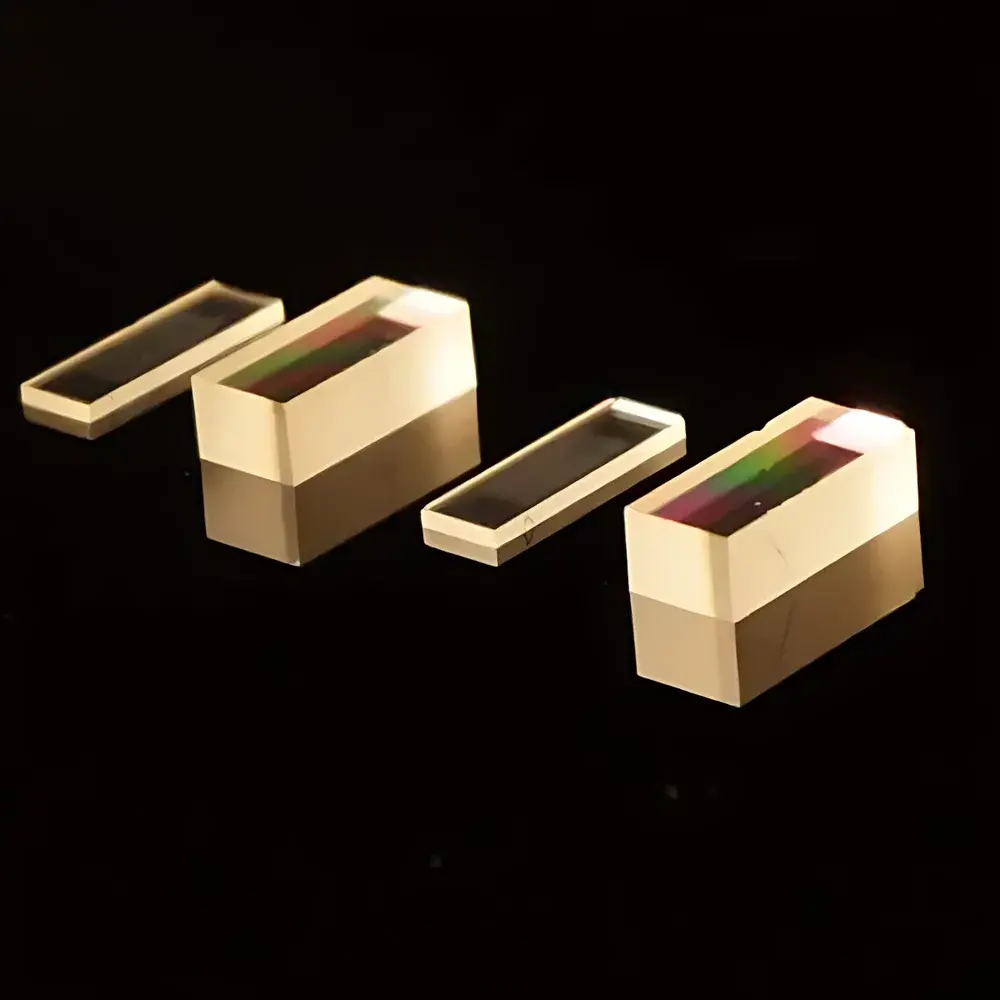
Auniontech PPKTP Periodically Poled Potassium Titanyl Phosphate Crystal
| Brand | Auniontech |
|---|---|
| Origin | Shanghai, China |
| Manufacturer Type | Authorized Distributor |
| Product Category | Domestic |
| Model | PPKTP Crystal Substrate (Periodically Poled) |
| Component Type | Nonlinear Optical Element |
| Nonlinear Coefficient | d₃₃ = 16.9 pm/V |
| Transmission Range | 400–3000 nm |
| Maximum Crystal Length | 30 mm |
| Aperture | 4 × 4 mm² |
| Optional Coatings | AR/HR for specified wavelengths |
| Customization | Domain period, poling uniformity, non-periodic (chirped/structured) poling patterns, temperature-tuned phase-matching design |
Overview
The Auniontech PPKTP (Periodically Poled Potassium Titanyl Phosphate) crystal is a ferroelectric, dielectric nonlinear optical material engineered for high-efficiency quasi-phase-matched (QPM) frequency conversion in continuous-wave and pulsed laser systems. Unlike birefringent phase matching, QPM leverages precisely engineered domain inversions—alternating regions of reversed spontaneous polarization—to compensate for the wavevector mismatch inherent in second-order nonlinear processes. This architecture enables full utilization of the material’s largest nonlinear coefficient (d33 = 16.9 pm/V), eliminates spatial walk-off, and supports broadband, temperature-tunable, and polarization-flexible operation across the 400–3000 nm spectral window.
Key Features
- High optical damage threshold (> 1 GW/cm² for 1064 nm, 10 ns pulses), suitable for high-peak-power nanosecond and picosecond laser systems
- Engineered domain periodicity with sub-micron uniformity control, enabling precise phase-matching wavelength selection via grating period tuning
- Standard aperture of 4 × 4 mm² with optional expansion to ≥ 6 × 6 mm²; crystal lengths up to 30 mm available for enhanced conversion efficiency
- Customizable poling profiles—including uniform, chirped, fan-out, and patterned domains—for advanced applications such as broadband SPDC or multi-wavelength OPOs
- Available with laser-grade surface finish (λ/10 @ 633 nm) and certified wavefront distortion (< λ/8 over clear aperture)
- Optional dielectric coatings: single-wavelength or broadband anti-reflection (AR) coatings (R < 0.2% per surface) or high-reflection (HR) stacks tailored to pump/signal/idler bands
Sample Compatibility & Compliance
PPKTP crystals are compatible with standard optomechanical mounts (e.g., kinematic crystal holders, temperature-controlled ovens) and integrate seamlessly into commercial and custom-built nonlinear optical setups. All crystals undergo rigorous quality control per ISO 10110-7 (surface imperfections) and ISO 14997 (laser-induced damage testing). Documentation includes full traceability of poling parameters, interferometric surface flatness verification, and spectral transmission data. For regulated environments—including GLP-compliant quantum optics labs and FDA-audited biophotonics instrumentation—the material meets RoHS compliance standards and supports full audit trails when integrated with calibrated temperature controllers and power monitoring systems.
Software & Data Management
While the PPKTP crystal itself is a passive optical element, its optimal deployment requires accurate phase-matching modeling. Auniontech provides supporting software tools—including MATLAB-based QPM calculator scripts and Python-compatible domain period lookup tables—that incorporate Sellmeier equations, thermal dispersion coefficients, and effective nonlinear susceptibility maps. These tools assist users in selecting appropriate poling periods for target interactions (e.g., SHG at 532 nm from 1064 nm, SPDC at 810 nm with degenerate signal/idler), estimating acceptance bandwidths, and predicting temperature sensitivity (typically ~0.1 nm/°C near room temperature). Exportable configuration files can be imported into system-level simulation platforms (e.g., LASCAD, RP Fiber Power) for end-to-end optical design validation.
Applications
- Spontaneous Parametric Down-Conversion (SPDC): Generation of polarization-entangled photon pairs with high spectral purity and brightness—critical for quantum key distribution (QKD), Bell inequality tests, and heralded single-photon sources compliant with NIST SP 800-185 guidelines
- Second-Harmonic Generation (SHG): Efficient green light generation (532 nm) from Nd:YAG/Nd:YVO4 lasers; also used for UV generation via cascaded processes (e.g., 1064 nm → 532 nm → 266 nm)
- Sum- and Difference-Frequency Generation (SFG/DFG): Mid-IR source development (3–5 µm) for gas sensing and spectroscopy; upconversion detection for low-light NIR imaging in biological tissue
- Backward-Wave Optical Parametric Oscillation (BWOPO): Compact, cavity-less DFG architectures enabling broadband mid-IR emission without intracavity losses or alignment sensitivity
- Optical Parametric Amplification (OPA) and Oscillation (OPO): Tunable coherent sources for ultrafast pump-probe experiments and time-resolved fluorescence lifetime imaging (FLIM)
FAQ
What input information is required to specify a custom PPKTP crystal?
Wavelengths (pump, signal, idler), polarization states (e.g., Type-0, Type-I), desired interaction length, aperture size, operating temperature range, and coating requirements (AR/HR center wavelength and bandwidth).
Can PPKTP be used for femtosecond pulse applications?
Yes—provided group-velocity mismatch (GVM) is compensated via crystal length optimization or chirped poling; typical usable pulse durations range from ~100 fs to several ps.
Is thermal tuning supported, and what is the typical temperature acceptance bandwidth?
Yes—phase-matching temperature sensitivity is ~0.1–0.3 nm/°C depending on wavelength; standard oven-controlled mounts achieve ±0.1 °C stability for narrowband operation.
Are non-periodic (e.g., chirped or structured) domain patterns available?
Yes—custom poling masks can be fabricated for broadband SPDC, octave-spanning supercontinuum seeding, or dispersion-engineered parametric processes.
What surface quality and coating options are standard?
λ/10 surface flatness, scratch-dig 10–5, and broadband AR coating (400–1100 nm) are standard; HR coatings (R > 99.9%) and dual-band AR stacks are available upon request.




