
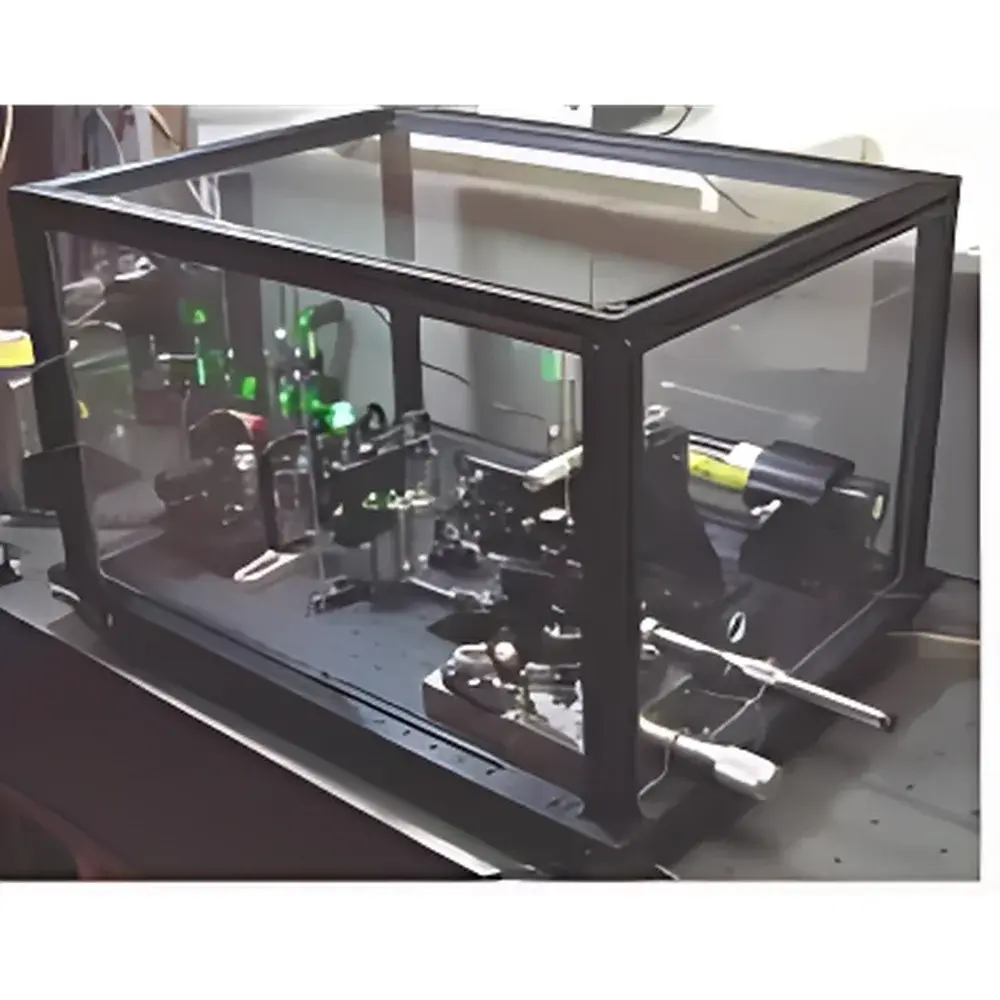
Auniontech PTM-1000 Photothermal Measurement System
| Brand | Auniontech |
|---|---|
| Origin | Shanghai, China |
| Model | PTM-1000 |
| Detection Principle | Pump–Probe Photothermal Deflection Based on Thermal Lens Effect |
| Pump Wavelength | Customizable (Typical 1064 nm / 532 nm / 355 nm) |
| Probe Wavelength | 633 nm (He–Ne Laser) |
| Chopping Frequency | 390 Hz ± 10 Hz |
| Surface Absorption Sensitivity (Transmissive, Fused Silica Substrate, 1 W Pump) | < 0.25 ppm |
| Bulk Absorption Sensitivity (Transmissive, Fused Silica, 1 W Pump) | < 5 ppm/cm |
| Surface Absorption Sensitivity (Reflective Configuration) | < 0.5 ppm |
| Noise-Equivalent Absorbed Power (Surface, Transmissive) | < 0.25 µW |
| Noise-Equivalent Absorbed Power (Bulk, Transmissive) | < 5 µW/cm |
| Noise-Equivalent Absorbed Power (Reflective) | < 0.5 µW |
| Probe Beam Spot Size (FWHM) | 225 µm ± 50 µm |
| Pump Beam Spot Size (FWHM) | 75 µm ± 20 µm |
| Lateral Spatial Resolution (FWHM) | < 60 µm |
| Axial (Depth) Resolution (FWHM) | < 1 mm |
| XYZ Translation Stage | 50 mm × 50 mm × 50 mm, Stepper Motor Driven |
| Probe Laser | Pacific Lasertec 05-LHP-121 or Equivalent |
| Probe Output Power | 2 mW (Class 3R) |
| Probe RMS Intensity Noise | ≤ 0.1% (30 Hz – 10 MHz) |
| Signal Processing | Dual Lock-in Amplifier Synchronized to Chopping Frequency |
| Compliance | Designed for GLP/GMP-adjacent R&D Environments |
Overview
The Auniontech PTM-1000 Photothermal Measurement System is a high-sensitivity, laboratory-grade instrument engineered for quantitative characterization of optical absorption in low-loss dielectric materials. It operates on the well-established pump–probe photothermal deflection principle, leveraging thermal lensing induced by non-radiative relaxation of absorbed photons. In this configuration, a modulated “pump” laser beam—typically at near-IR or visible wavelengths—is focused onto the sample surface or bulk volume, generating localized periodic heating. A collimated, spatially separated “probe” beam (633 nm He–Ne) traverses the thermally perturbed region, experiencing refractive index gradients that induce measurable beam deflection or intensity modulation. The resulting AC/DC signal ratio, extracted via dual-phase lock-in amplification synchronized to the mechanical chopper frequency (390 Hz), provides a linear, calibration-free metric proportional to local absorption coefficient. Unlike integrating sphere or calorimetric methods, the PTM-1000 enables spatially resolved, non-contact, sub-ppm-level absorption quantification—critical for high-power laser optics, ultrafast amplifier gain media, EUV multilayer coatings, and quantum photonic substrates.
Key Features
- Sub-part-per-million (ppm) absorption detection limit: <0.25 ppm surface sensitivity and <5 ppm/cm bulk sensitivity under standard 1 W pump power conditions
- Configurable pump–probe geometry with precise angular alignment (cross-angle: 0.12 rad ± 0.02 rad) to minimize interference and optimize thermal gradient coupling
- Dual-detection capability: transmissive mode for bulk and interface absorption; reflective mode for front-surface or thin-film characterization
- High spatial resolution: lateral FWHM <60 µm and axial resolution <1 mm—enabling mapping of absorption heterogeneity across polished optics, crystalline wafers, or deposited thin films
- Integrated XYZ precision translation stage (50 mm travel per axis, stepper motor actuation) with repeatable positioning accuracy <1 µm for automated raster scanning
- Dedicated low-noise probe source: Class 3R He–Ne laser (633 nm, 2 mW) with RMS intensity noise ≤0.1% over 30 Hz–10 MHz bandwidth
- Signal integrity architecture: dual lock-in amplifier system referenced to chopper frequency ensures robust rejection of ambient light, acoustic vibration, and thermal drift artifacts
Sample Compatibility & Compliance
The PTM-1000 accommodates planar optical components up to Ø50 mm and 25 mm thickness—including coated mirrors, anti-reflection filters, fused silica and CaF2 substrates, nonlinear crystals (e.g., BBO, LBO), semiconductor wafers (Si, GaAs), and dielectric metasurfaces. Sample mounting is facilitated via kinematic V-groove holders or vacuum chucks (optional), ensuring minimal stress-induced birefringence. While not certified for regulatory compliance per se, the system’s architecture aligns with key metrological frameworks used in optics manufacturing and laser damage research: it supports traceable calibration protocols compliant with ASTM F2681-21 (laser-induced damage threshold assessment) and ISO 11551 (optical surface damage testing). Its digital signal chain—including timestamped raw data export, configurable averaging windows, and hardware-triggered acquisition—facilitates audit-ready documentation required under GLP and pre-GMP R&D environments. No proprietary firmware locks or vendor-specific data formats are employed; all output files are ASCII-based (.csv, .txt) for third-party analysis interoperability.
Software & Data Management
The PTM-1000 is controlled via a cross-platform desktop application built on Qt/C++, compatible with Windows 10/11 and Linux (Ubuntu LTS). The software provides real-time visualization of both DC baseline and AC amplitude/phase channels, with adjustable time constants (10 ms–10 s), filter slopes (6–24 dB/octave), and harmonic detection (1f, 2f). Automated scan routines support grid-based absorption mapping with user-defined step size, dwell time, and region-of-interest cropping. All acquired datasets include embedded metadata: timestamp, pump/probe power logs, stage coordinates, chopper frequency, lock-in settings, and environmental temperature (via optional external sensor input). Export options include CSV (for MATLAB/Python post-processing), HDF5 (for large-scale volumetric datasets), and PNG/PDF reports with SI-traceable units. The software adheres to FAIR data principles—Findable, Accessible, Interoperable, Reusable—and generates machine-readable JSON sidecar files describing measurement provenance, enabling integration into institutional ELN (Electronic Lab Notebook) systems.
Applications
- Quantitative absorption profiling of high-reflectivity mirror coatings used in gravitational wave interferometers (e.g., LIGO, Virgo)
- Bulk absorption screening of Yb:YAG, Nd:YVO4, and Ti:sapphire crystals prior to high-energy laser amplifier qualification
- Defect localization in fused silica optics via absorption hotspot mapping correlated with polishing-induced subsurface damage
- Thermal diffusion coefficient extraction from time-resolved photothermal decay curves (with optional pulsed pump upgrade)
- Carrier recombination lifetime estimation in photoconductive semiconductors using modulated photocarrier absorption
- Photorefractive response characterization in LiNbO3 and BSO crystals under uniform illumination
FAQ
What absorption mechanisms does the PTM-1000 detect?
It measures non-radiative absorption pathways—including defect-related mid-gap states, impurity absorption bands, phonon-assisted transitions, and free-carrier absorption—provided they generate measurable local heating.
Can the system measure absorption at wavelengths other than 1064 nm?
Yes. The pump laser source is modular; common configurations include 355 nm (UV), 532 nm (green), 1064 nm (NIR), and 1550 nm (telecom band), with wavelength selection dependent on sample transparency and target absorption features.
Is vacuum or inert atmosphere operation supported?
The base platform is ambient-air compatible. Optional vacuum-compatible stages and sealed probe beam paths are available for oxygen-sensitive or hygroscopic samples (e.g., perovskite thin films).
How is calibration performed?
Absolute calibration is achieved using reference samples with certified absorption values (e.g., NIST-traceable fused silica standards) or through comparative measurements against a calibrated calorimeter. Relative scans require no daily recalibration due to inherent ratiometric (AC/DC) signal derivation.
Does the system support automated pass/fail testing for production QA?
Yes. Scriptable test sequences, configurable thresholds, and pass/fail flagging per scan point can be implemented via Python API access to the control layer, enabling integration into automated optical coating inspection lines.



