Auniontech QBF Series Quantum Bragg Narrowband Filter (VBG-Based Reflective Volume Bragg Grating)
| Brand | Auniontech |
|---|---|
| Origin | Shanghai, China |
| Manufacturer Type | Authorized Distributor |
| Product Category | Domestic |
| Model | Volumetric Bragg Grating (VBG) |
| Bandwidth Options | 10 GHz, 25 GHz, 50 GHz |
| Central Wavelength Range | 600–2500 nm |
| Diffraction Efficiency | >90% |
| Grating Thickness | 8 mm, 17.5 mm, 27.5 mm |
| Physical Dimensions | 7 mm × 5 mm or 9 mm × 6.5 mm |
| Deflection Angle | 8°–10° |
| Compliance | ISO 10110-7, MIL-PRF-13830B Surface Quality |
Overview
The Auniontech QBF Series Quantum Bragg Narrowband Filter is a high-performance reflective volume Bragg grating (RBG) filter engineered for ultra-precise spectral selection in quantum optical systems. Fabricated in photosensitive silicate glass using holographic recording techniques, the QBF operates on the principle of Bragg diffraction within a periodic refractive index modulation—enabling exceptionally narrow spectral transmission windows with minimal sideband leakage and near-zero group delay dispersion across the passband. Unlike interference-based thin-film filters, the VBG architecture provides intrinsic thermal stability (Δλ/ΔT < 0.002 nm/°C), polarization-insensitive operation, and immunity to angular shift under collimated illumination—critical attributes for locking diode lasers to atomic transitions or isolating single-photon sources in time-bin or frequency-encoded quantum protocols.
Key Features
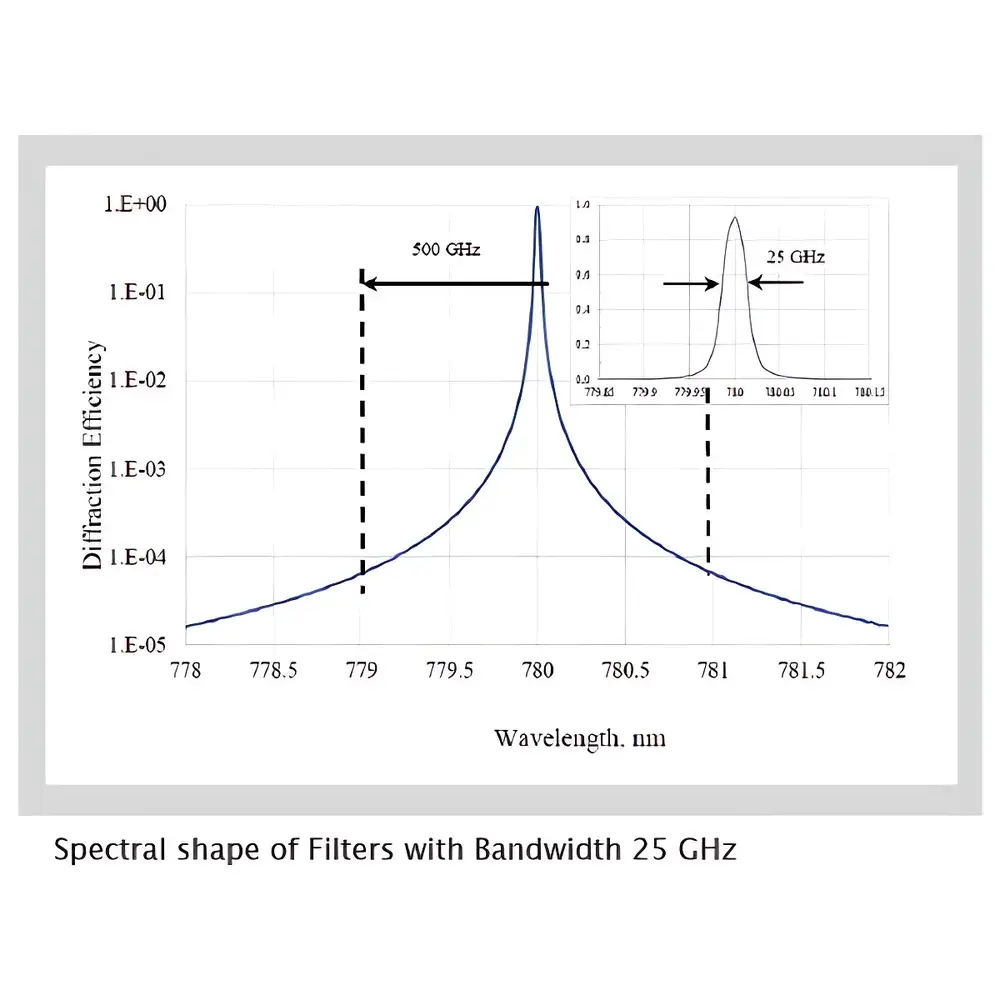
- Ultra-narrow bandwidth options: 10 GHz (≈0.08 pm @ 780 nm), 25 GHz (≈0.20 pm), and 50 GHz (≈0.40 pm) full-width at half-maximum (FWHM), calibrated per ITU-T G.694.1 recommendations for optical frequency referencing.
- High diffraction efficiency exceeding 90% across all standard and custom wavelengths—validated via calibrated integrating sphere measurements traceable to NIM (National Institute of Metrology, China).
- Robust monolithic design: no adhesives or layered coatings; grating structure is volumetrically embedded, ensuring long-term stability under vacuum, cryogenic (4 K), and high-power (up to 500 mW CW) conditions.
- AR-coated fused silica substrates (R < 0.25% per surface, 600–2500 nm) minimize insertion loss and ghost reflections—essential for low-noise homodyne detection and cavity-enhanced spectroscopy.
- Standardized mechanical footprint (7 × 5 mm and 9 × 6.5 mm) compatible with industry-standard kinematic mounts (e.g., Thorlabs KM100, Newport UMB1) and OEM integration into compact quantum modules.
Sample Compatibility & Compliance
The QBF series supports collimated free-space beam coupling with divergence < 1.5 mrad and input beam diameters up to 3 mm (1/e²). It is compatible with TEM₀₀ Gaussian beams from external-cavity diode lasers (ECDLs), distributed feedback (DFB) lasers, and fiber-pigtailed semiconductor sources. All units undergo 100% spectral verification using a high-resolution scanning Fabry–Pérot interferometer (FSR = 1 GHz, finesse > 300) and are certified to ISO 10110-7 for surface quality (scratch-dig 10-5) and MIL-PRF-13830B for laser damage threshold (LIDT > 5 J/cm² at 1064 nm, 10 ns pulse). Devices shipped with calibration certificates include wavelength accuracy ±0.005 nm (k = 2) and bandwidth repeatability ±0.5 GHz.
Software & Data Management
While the QBF is a passive optical component, Auniontech provides optional spectral characterization reports in standardized formats (CSV, SDF) compliant with IEEE Std 1672™-2022 for optical filter data exchange. These reports include measured transmission spectra, polarization-dependent loss (PDL < 0.05 dB), and temperature-dependent wavelength drift coefficients. For system integrators, spectral models (based on coupled-wave theory) are available upon request to support ray-tracing simulations in Zemax OpticStudio or Synopsys Code V. All documentation adheres to GLP-compliant archiving protocols, with raw measurement logs retained for ≥15 years per internal QA policy.
Applications
- Atomic physics experiments: laser frequency stabilization to Rb (780 nm, 795 nm), Cs (852 nm, 894 nm), and Sr (689 nm) D-lines; Doppler-free saturation spectroscopy.
- Quantum communication: spectral filtering of heralded single photons (e.g., SPDC at 810 nm or 1550 nm) to suppress pump leakage and Raman noise in fiber-based QKD systems.
- Brillouin microscopy: rejection of Rayleigh-scattered light while transmitting weak Brillouin-shifted signals (< 10 GHz offset) with high out-of-band suppression (>60 dB).
- Optical atomic clocks: ultra-stable reference cavities requiring sub-MHz linewidth filtering for probe beam conditioning.
- Low-noise laser spectroscopy: background suppression in cavity ring-down (CRDS) and noise-immune cavity-enhanced optical heterodyne molecular spectroscopy (NICE-OHMS).
FAQ
What is the maximum incident power the QBF can handle without thermal distortion?
Continuous-wave power handling is rated at 500 mW for 7 mm × 5 mm devices (10 GHz bandwidth) under collimated illumination and active heat sinking. For pulsed operation, LIDT exceeds 5 J/cm² at 10 ns pulse width (1064 nm), verified per ISO 21254-1.
Can the QBF be used at cryogenic temperatures?
Yes. Devices have been validated down to 4 K in liquid helium environments with no measurable degradation in diffraction efficiency or bandwidth—enabled by matched thermal expansion between photosensitive glass and fused silica substrate.
Do you provide wavelength calibration traceable to national standards?
Each unit ships with a NIM-traceable calibration certificate (certificate number included), reporting central wavelength, FWHM, and sideband suppression ratio at 23 ± 0.5 °C per ISO/IEC 17025:2017 requirements.
Is angle-tuning supported for fine wavelength adjustment?
No. The QBF is designed for fixed-wavelength operation under normal incidence. Angular tuning introduces significant bandwidth broadening and efficiency loss due to the steep dispersion of the Bragg condition—thus not recommended for precision applications.