
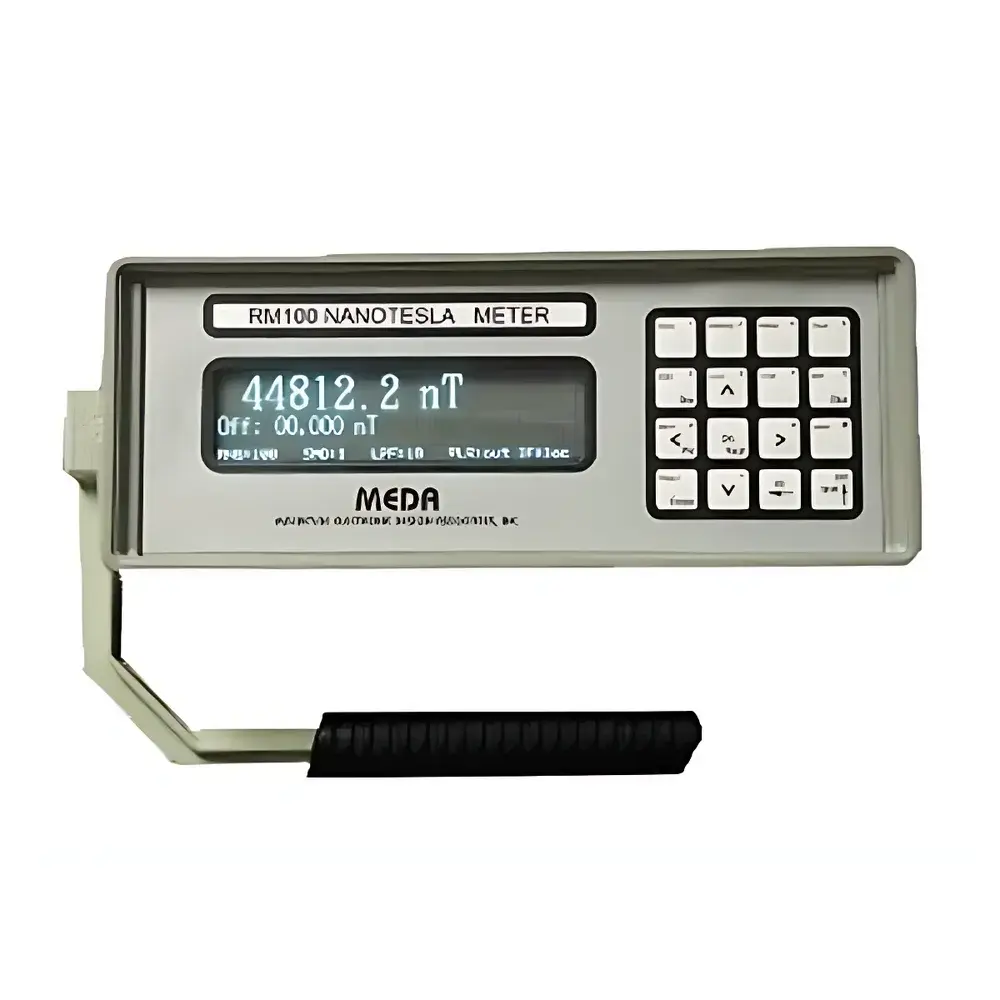
Auniontech RM100 Nanotesla Grade Benchtop Fluxgate Magnetometer
| Brand | Auniontech |
|---|---|
| Origin | Shanghai, China |
| Model | RM100 Fluxgate Magnetometer |
| Measurement Principle | Differential Fluxgate Sensing |
| Full-Scale Range | ±200,000 nT (±2 G) |
| Resolution | 0.1 nT |
| Absolute Accuracy | ±(0.01% of reading + 0.25% of range + 1 nT) |
| Offset Field Accuracy | ±(0.01% of reading + 0.2 nT) |
| Differential Field Accuracy | ±(0.25% of reading + 1 nT) |
| Temperature Stability | 0.5 ppm/°C (offset), 5.0 ppm/°C (differential), 50 ppm/°C (analog output) |
| Analog Output | 10 V / full scale ±1% |
| Low-Pass Filter Cutoffs | 10, 50, 100, 500, 1000 Hz (±2%) |
| Power Line Rejection | >40 dB at 60 Hz |
| Data Storage | 16,384 points |
| Interface | RS-232 (9.6–115.2 kbps), 10BASE-T Ethernet (SCPI-compliant) |
| Compliance | NIST-traceable calibration, ISO/IEC 17025-aligned metrology practices |
Overview
The Auniontech RM100 Nanotesla Grade Benchtop Fluxgate Magnetometer is a precision metrological instrument engineered for absolute and differential magnetic field measurement in laboratory, calibration, and geophysical research environments. Based on dual-sensor differential fluxgate architecture, the RM100 separates ambient field compensation from residual field detection—enabling sub-nanotesla resolution under high-background fields up to ±100,000 nT (1 G). Its core sensing mechanism relies on the nonlinear magnetization response of high-permeability ferromagnetic cores driven by orthogonal excitation coils; second-harmonic detection of induced voltage provides linear, low-drift output proportional to the axial component of the magnetic field. Designed for traceability to the National Institute of Standards and Technology (NIST), the RM100 delivers absolute accuracy of ±0.01% of reading (with additional term-based uncertainty), making it suitable as a primary reference standard for calibrating vector magnetometers, Hall sensors, magnetoresistive probes, and fluxgate-based navigation systems.
Key Features
- Dual-channel differential architecture: independent offset-field generation (±100,000 nT dynamic range) and ultra-low-noise residual-field sensing (0.1 nT resolution)
- Full-scale range of ±200,000 nT (±2 G) with selectable differential ranges: 100 µT, 10 µT, 1 µT, and 100 nT
- Front-panel vacuum fluorescent display (VFD) for real-time differential field readout and status indicators
- Analog output (BNC) with 10 V/full-scale scaling, programmable low-pass filtering (10–1000 Hz, ±2% cutoff tolerance), and <40 dB 60 Hz power-line interference rejection
- Comprehensive onboard data handling: zeroing, min/max/average/peak-to-peak computation, alarm thresholds (user-definable upper/lower limits), and internal storage of up to 16,384 timestamped measurements
- Remote operation via RS-232 serial interface (9.6–115.2 kbps) or IEEE 488.2–compliant SCPI over 10BASE-T Ethernet, enabling integration into automated test benches and distributed monitoring networks
- Thermal stability optimized to 0.5 ppm/°C for offset field and 5.0 ppm/°C for differential field—validated across 0–50 °C operating range with 25 °C ±5 °C long-term (1000 h) drift characterization
Sample Compatibility & Compliance
The RM100 operates as a single-axis (axial) vector magnetometer and requires no sample contact or preparation. It is compatible with static and quasi-static DC to ~1 kHz fields generated by permanent magnets, electromagnets, magnetic shielding enclosures, geological specimens, spacecraft components, or terrestrial field variations. The instrument conforms to metrological best practices aligned with ISO/IEC 17025:2017 for calibration laboratories, supporting documented uncertainty budgets, traceable calibration certificates, and GLP-compliant audit trails when used with external logging software. While not FDA-regulated, its SCPI command set and deterministic timing behavior meet requirements for integration into GMP-qualified environmental monitoring systems where magnetic field integrity is critical (e.g., MRI facility QA, magnetic shielding validation).
Software & Data Management
The RM100 supports industry-standard SCPI (Standard Commands for Programmable Instruments) syntax over both RS-232 and Ethernet interfaces, ensuring interoperability with LabVIEW, MATLAB, Python (PyVISA), and custom C/C++ applications. Firmware includes built-in data logging buffers, configurable averaging windows, and binary/ASCII data streaming modes. Optional PC software provides real-time waveform visualization, XY plotting (e.g., Bx vs. time), statistical analysis (standard deviation, histogram), and export to CSV or HDF5 formats. All configuration parameters—including filter settings, alarm thresholds, and analog scaling—are stored non-volatilely and survive power cycles. Audit-ready features include timestamped command logs and firmware version reporting—critical for ISO 9001 or IEC 61508–related system qualification.
Applications
- Primary calibration of secondary magnetometers (Hall-effect, AMR, GMR, TMR, and other fluxgate units) in national metrology institutes and accredited calibration labs
- Characterization of magnetic signatures in automotive components (e.g., EV motor stray fields, brake caliper remanence)
- Geophysical monitoring: secular variation studies, magnetic anomaly detection in rock samples, and crustal field mapping
- Spacecraft magnetic cleanliness verification: dipole moment quantification and stray field mapping of satellite subsystems
- Material science: detection of magnetic contamination in ultra-high-purity metals, evaluation of magnetic shielding effectiveness (e.g., mu-metal enclosures)
- Environmental magnetism: paleomagnetic sample analysis, archaeological prospection, and urban magnetic noise profiling
FAQ
What does “NIST-traceable” mean for the RM100’s calibration?
The RM100’s factory calibration is performed using reference standards whose uncertainties are directly traceable to NIST SRM 2501 (DC magnetic field standard), with documented uncertainty budgets meeting ISO/IEC 17025 requirements. Calibration certificates include expanded uncertainties (k=2) and environmental conditions.
Can the RM100 measure AC magnetic fields?
Yes—its analog output bandwidth supports frequencies up to 1 kHz (dependent on selected low-pass filter setting), and the digital sampling engine captures transient events with microsecond-level timestamp resolution when streamed externally.
Is the RM100 suitable for three-axis vector measurements?
No—the RM100 is a single-axis instrument. For full vector characterization, three orthogonal RM100 units may be deployed with rigid mechanical alignment and synchronized triggering; alternatively, Auniontech offers complementary triaxial fluxgate systems with integrated orthogonality correction.
How is thermal drift compensated during extended measurements?
The RM100 employs hardware-level temperature compensation circuits and stores thermal coefficient data per sensor channel. Users may apply optional two-point temperature calibration routines to further reduce drift contributions in high-stability applications.
Does the RM100 support remote firmware updates?
Firmware updates are performed via Ethernet using signed binary packages and require authenticated access credentials. Update logs are retained in non-volatile memory for compliance review.



