
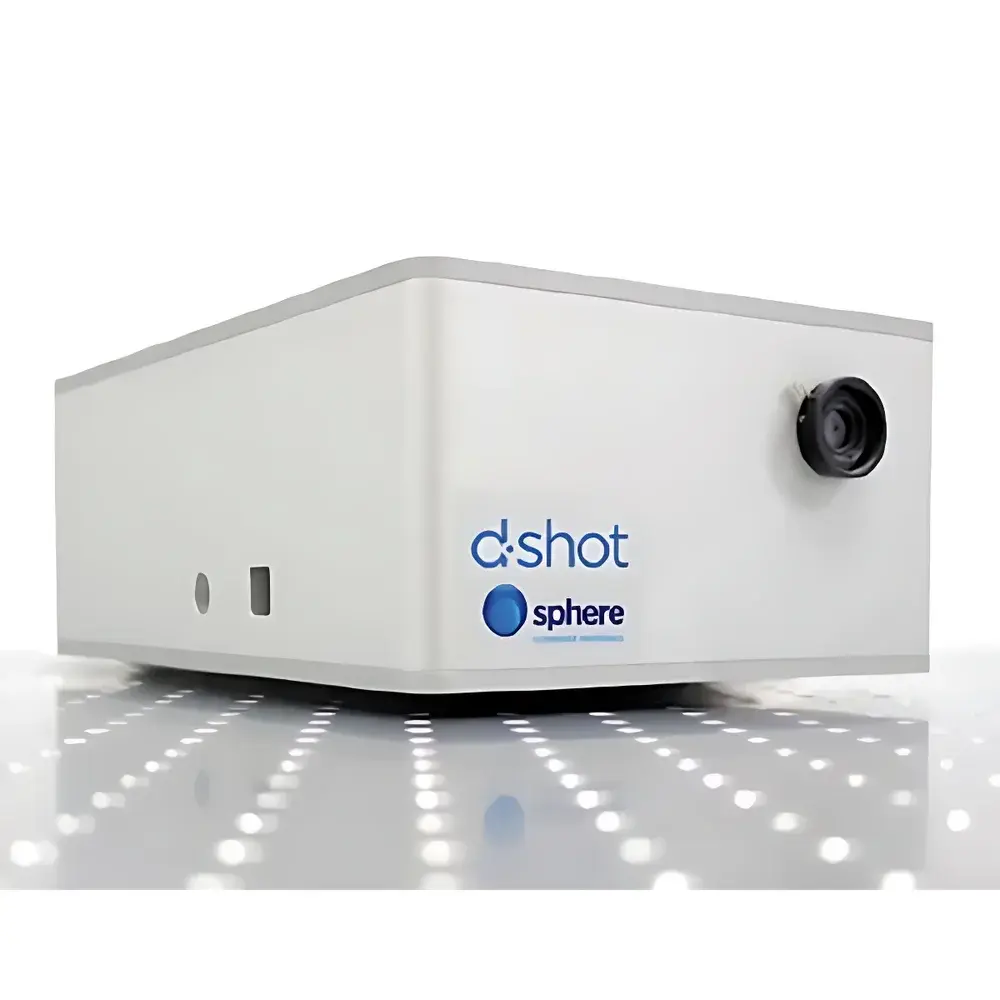
Auniontech d-shot Single-Shot Ultrafast Pulse Characterizer
| Brand | Auniontech |
|---|---|
| Origin | Shanghai, China |
| Model | d-shot |
| Measurement Principle | Dispersion-Scan (D-scan) |
| Pulse Duration Range | < 50 fs |
| Repetition Rate Support | Single-shot to MHz |
| Compatible Pulse Types | Few-cycle and Multi-cycle Pulses |
| Output | Full Electric Field Reconstruction (Amplitude & Phase) |
| Software | Real-time Retrieval Algorithm with Visual Trajectory Feedback |
| Compliance | Designed for GLP/GMP-aligned ultrafast labs |
Overview
The Auniontech d-shot Single-Shot Ultrafast Pulse Characterizer is an advanced, turnkey instrument engineered for complete temporal and spectral phase characterization of ultrashort laser pulses. Unlike intensity-only diagnostics such as autocorrelators, the d-shot implements dispersion-scan (D-scan) — a robust, single-shot frequency-domain technique rooted in nonlinear optical spectroscopy. In D-scan, the input pulse is spectrally resolved after propagation through a variable dispersive medium (e.g., chirped mirrors or prism pairs) followed by second-harmonic generation (SHG) in a nonlinear crystal. The resulting 2D spectrogram — intensity versus wavelength and dispersion delay — encodes both spectral amplitude and spectral phase information. Through iterative phase retrieval algorithms, the d-shot reconstructs the full complex electric field E(t), delivering time-domain intensity |E(t)|², phase φ(t), and instantaneous frequency (chirp), enabling precise quantification of pulse duration, dispersion imbalance, and higher-order phase distortions.
Key Features
- True single-shot operation: Captures full pulse characterization without averaging — essential for low-repetition-rate or non-repetitive ultrafast sources.
- Broadband compatibility: Optimized for few-cycle (< 10 fs) and multi-cycle (10–50 fs) pulses across visible to near-infrared (e.g., 700–1000 nm typical).
- Real-time feedback interface: Intuitive trajectory visualization in software provides immediate insight into pulse evolution during alignment or compression optimization.
- Minimal alignment overhead: Beam coupling requires < 5 minutes; no interferometric stability constraints or active path-length control.
- Proprietary phase retrieval engine: Based on constrained optimization with physical consistency checks (energy conservation, causality), ensuring high fidelity and convergence reliability.
- Compact, air-cooled architecture: No water cooling or external pump lasers required — designed for integration into vacuum chambers, amplifier chains, or OPCPA beamlines.
Sample Compatibility & Compliance
The d-shot accepts free-space collimated beams with diameters from 3 mm to 12 mm and divergence < 1 mrad. It is compatible with Ti:sapphire oscillators, Yb-based amplifiers, optical parametric chirped-pulse amplifiers (OPCPA), and post-compression systems (e.g., hollow-core fiber + chirped mirror compressors). The instrument meets mechanical and electrical safety standards per IEC 61010-1. Data output formats (CSV, HDF5) support traceability requirements under GLP and GMP environments. While not FDA-certified (as it is a research-grade diagnostic tool), its structured metadata schema — including timestamp, dispersion setting, SHG crystal orientation, and algorithm version — enables full audit trail generation for ISO/IEC 17025-accredited laboratories.
Software & Data Management
The d-shot is operated via a native Windows application with GPU-accelerated retrieval (NVIDIA CUDA). Each measurement session automatically logs raw spectrograms, reconstructed E(t)/E(ω), phase residuals, and convergence metrics. Export options include time-domain pulse profiles (ps or fs resolution), spectral phase (rad vs. nm), group delay dispersion (GDD), and third-order dispersion (TOD) estimates. All datasets are timestamped and tagged with instrument serial number and user-defined experiment ID. The software supports batch processing of sequential shots and integrates with LabVIEW and Python (via Pydshot SDK) for automated alignment loops or closed-loop pulse shaping workflows. Audit-log functionality records operator actions, parameter changes, and software updates — aligning with 21 CFR Part 11 principles for electronic records in regulated R&D settings.
Applications
- Laser system commissioning and daily stability monitoring — detecting sub-10-fs drift in oscillator-compressor chains.
- Real-time feedback for adaptive pulse shapers using spatial light modulators (SLMs) or acousto-optic programmable dispersive filters (AOPDFs).
- Characterization of post-compression dynamics in gas-filled hollow-core fibers or solid-core photonic crystal fibers.
- Validation of carrier-envelope phase (CEP) stability in few-cycle drivers for attosecond science.
- Quantitative assessment of spectral broadening mechanisms (self-phase modulation, ionization-induced blue-shift) in nonlinear media.
- Education and training in ultrafast optics laboratories — intuitive interface lowers barrier to entry for graduate students and postdocs.
FAQ
Does the d-shot require interferometric stability?
No. Unlike FROG or SPIDER, D-scan is a common-path, non-interferometric method — immune to air turbulence and vibration-induced phase noise.
Can it measure pulses shorter than 5 fs?
Yes — when used with appropriate broadband SHG crystals (e.g., BBO or BiBO) and spectrometer resolution < 0.2 nm, sub-5-fs reconstruction is achievable with proper signal-to-noise ratio.
Is calibration required before each measurement?
No routine calibration is needed. The dispersion axis is calibrated once using a known reference pulse or built-in white-light source; subsequent measurements retain this mapping unless hardware configuration changes.
What spectral resolution is necessary for accurate phase retrieval?
Minimum recommended resolution is λ/Δλ ≥ 500 over the pulse bandwidth — typically achieved with 0.1–0.3 nm optical resolution depending on center wavelength.
Can the d-shot be integrated into a vacuum beamline?
Yes — the optical head is vacuum-compatible (CF flange options available); only the spectrometer and camera remain external, connected via fiber-coupled or viewport-mounted interfaces.





