
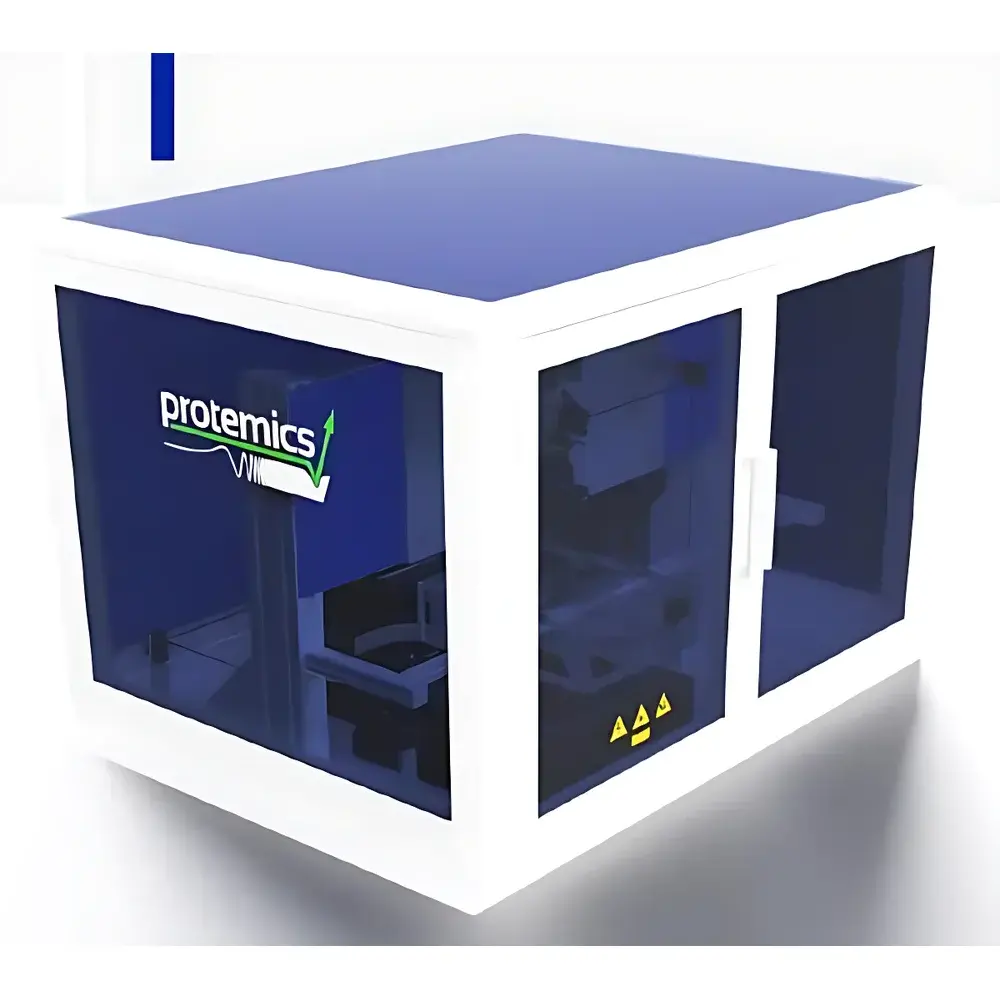
Auniontech TeraCube Scientific THz Near-Field Microscope
| Brand | Auniontech |
|---|---|
| Model | TeraCube Scientific |
| Type | THz Near-Field Scanning Microscope |
| Core Technology | Electro-optic Sampling-Based Terahertz Time-Domain Near-Field Imaging |
| Probe Type | TeraSpike THz Microprobe |
| Automation Level | Fully Motorized XYZ + Tip-Sample Distance Control |
| Laser Source Compatibility | Ti:sapphire Oscillator-Amplifier System (800 nm, <100 fs) |
| Detection Method | Lock-in Amplified Electro-optic Sampling |
| Spatial Resolution | Sub-wavelength (≤ λ/10, ~3–5 µm at 0.3–1 THz) |
| Dynamic Range | >60 dB (typical, system-limited) |
| Scan Range | Up to 100 × 100 µm² (high-res mode), 1 × 1 mm² (wide-field mode) |
| Sample Environment | Ambient air or purged N₂ (optional) |
| Compliance | CE Marked |
| Safety Class | Integrated Class 3B Laser Enclosure with Interlock System |
| Data Export | ASCII (.txt), MATLAB (.mat), HDF5 |
Overview
The Auniontech TeraCube Scientific THz Near-Field Microscope is a fully automated, laboratory-integrated scanning platform engineered for sub-diffraction-limit terahertz (THz) near-field imaging and time-domain spectroscopy. Based on electro-optic sampling (EOS) and synchronized pump-probe timing, the system enables quantitative, phase-resolved mapping of THz electric field distributions with nanoscale tip-to-sample distance control. Unlike conventional far-field THz imaging—limited by diffraction to ~300 µm at 1 THz—the TeraCube leverages scattering-type near-field detection using the TeraSpike microprobe, achieving spatial resolution down to 3–5 µm across the 0.1–2 THz bandwidth. The instrument operates as a time-domain system: a femtosecond Ti:sapphire laser pulse is split into pump (THz generation) and probe (THz detection) paths; the THz pulse interacts locally with the sample surface via the sharp metallic tip of the microprobe, and the resulting near-field enhancement is gated and measured via birefringence in a ZnTe or GaP crystal. This architecture ensures high signal fidelity, temporal resolution <100 fs, and compatibility with both transmission and reflection geometries.
Key Features
- Fully motorized XYZ scanning stage with integrated piezo-driven tip-sample distance regulation, enabling stable, closed-loop operation over extended acquisition periods.
- Real-time optical topography feedback via integrated high-magnification CCD camera—supports automatic focus, tip positioning, and morphology-guided adaptive scanning of curved or tilted samples.
- Dual-polarization THz source module: switchable linear and circular polarization generation for anisotropy studies, chiral material characterization, and vectorial field reconstruction.
- High-dynamic-range lock-in detection (60+ dB SNR) combined with low-noise EO crystals and balanced photodiode readout for robust amplitude and phase retrieval.
- Time-domain signal preview mode for rapid optical alignment and probe-sample coupling optimization prior to full scan acquisition.
- Modular open-platform design: compatible with external cryostats, vacuum chambers, or AFM integration kits for scattering-type s-SNOM–THz hybrid configurations.
- Comprehensive laser safety enclosure conforming to IEC 60825-1:2014, including interlocked access doors, beam shutters, and visible alignment lasers.
Sample Compatibility & Compliance
The TeraCube Scientific supports planar, freestanding, and moderately curved samples up to 25 mm in diameter and 10 mm in thickness. Conductive, semiconducting, and dielectric substrates—including Si wafers, graphene-on-SiC, metamaterial arrays, polymer thin films, and biological tissue sections—are routinely imaged without metallization or coating. The system complies with ISO/IEC 17025-relevant measurement traceability practices for research-grade instrumentation and meets essential requirements of the EU Machinery Directive 2006/42/EC and Electromagnetic Compatibility Directive 2014/30/EU. While not FDA-cleared, its architecture aligns with GLP-compliant data integrity principles: all raw EOS waveforms, metadata (laser power, delay stage position, polarization state), and processed images are timestamped, versioned, and stored with audit-trail capability in the native software environment.
Software & Data Management
Control and analysis are unified within the TeraCube Control Suite—a Windows-based application built on Qt and Python (NumPy, SciPy, Matplotlib). The GUI provides intuitive workflow navigation: alignment assistant, scan parameter definition (step size, dwell time, averaging), real-time waveform display, and live distance feedback. All measurements support full metadata embedding (EXIF-style tags), ensuring reproducibility across labs. Processed datasets export natively to ASCII (.txt) for spreadsheet analysis, MATLAB (.mat) for algorithm development, and HDF5 for large-scale archival or machine learning pipelines. Software modules include automated tip crash avoidance, polarization calibration routines, and FFT-based spectral extraction per pixel. No cloud dependency: all processing occurs locally, satisfying institutional IT security policies.
Applications
- Metamaterial and plasmonic nanostructure characterization—local field enhancement mapping, resonance mode identification, and dispersion analysis.
- Non-contact sheet resistance imaging of transparent conductive oxides (e.g., ITO), 2D materials (graphene, MoS₂), and doped semiconductor wafers.
- THz device metrology: antenna radiation patterns, waveguide mode profiling, and modulator transfer function validation.
- Microstructural defect detection in polymer composites, pharmaceutical tablets, and layered battery electrodes—without ionizing radiation.
- Correlative THz–topography studies when integrated with atomic force microscopy (AFM), enabling simultaneous nanomechanical and broadband electromagnetic property mapping.
- Fundamental carrier dynamics in photoexcited semiconductors, captured via pump–THz–probe delay scans with <100 fs temporal resolution.
FAQ
What laser system is required to operate the TeraCube Scientific?
A mode-locked Ti:sapphire oscillator-amplifier system emitting ~800 nm pulses with duration <100 fs and repetition rate 1–5 kHz is required. Auniontech provides detailed synchronization interface specifications and timing diagrams for third-party laser integration.
Can the system be upgraded to include cryogenic sample stages?
Yes—the open mechanical architecture supports integration of compact closed-cycle cryostats (4–300 K) with optical access ports. Custom mounting plates and thermal shielding kits are available upon request.
Is the TeraSpike probe replaceable, and what is its typical lifetime?
TeraSpike probes are field-replaceable consumables. Under standard ambient operation with proper tip approach protocols, median operational lifetime exceeds 200 hours of cumulative scanning time.
Does the software support batch processing of multi-scan datasets?
Yes—Python-based scripting API and CLI tools enable automated batch Fourier transformation, phase unwrapping, and conductivity tensor calculation across hundreds of spatially registered THz waveforms.
What installation infrastructure is mandatory?
A vibration-isolated optical table (minimum 1.5 m × 1.0 m), Class 3B laser-rated laboratory (ANSI Z136.1 or EN 60825-1), and stable AC power (230 V ±10%, 50/60 Hz) with dedicated grounding are required. Ambient humidity should remain below 60% RH to prevent EO crystal degradation.
Related Products







