
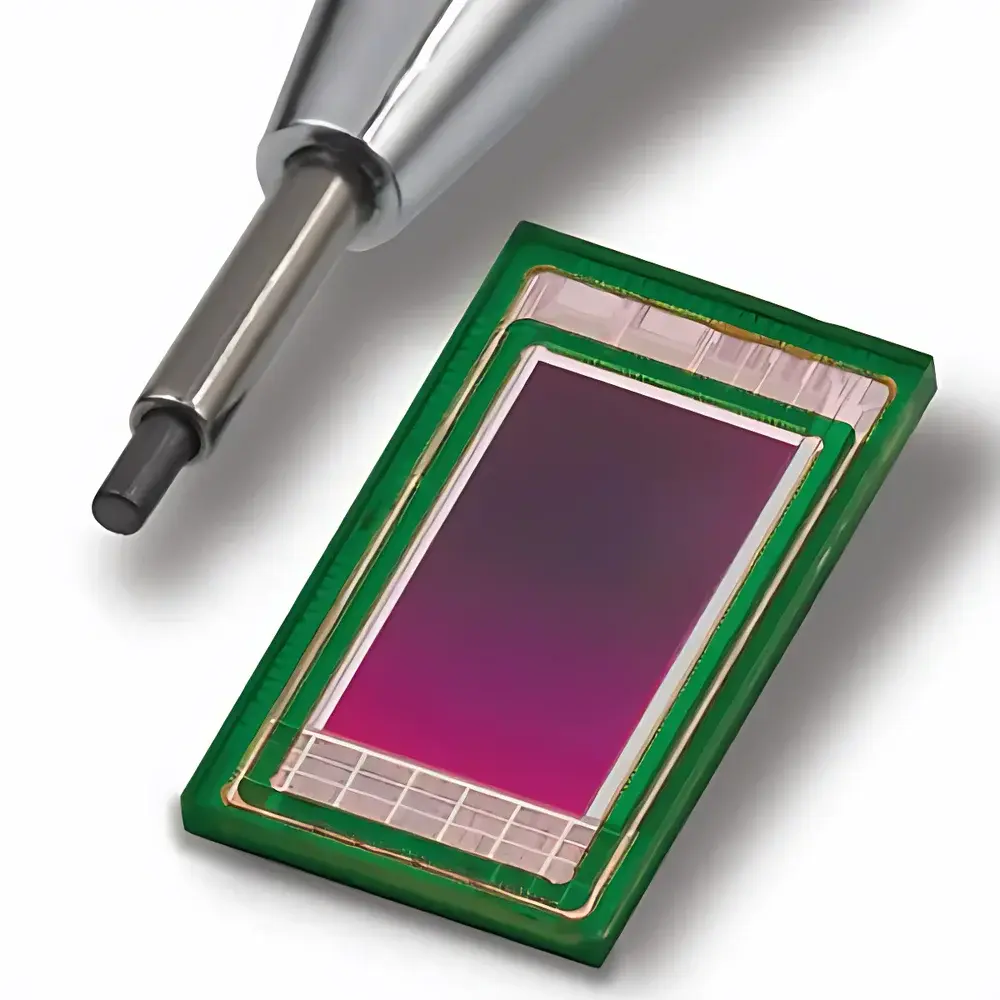
Auniontech Topaz5D 1920×1080 Global Shutter 2D/3D Image Sensor
| Brand | Auniontech |
|---|---|
| Origin | Shanghai, China |
| Manufacturer Type | Authorized Distributor |
| Origin Category | Domestic (China) |
| Model | Topaz5D |
| Resolution | 1920 × 1080 |
| Pixel Size | 2.5 µm |
| Package | Chip-Scale Package (CSP) |
| Power Consumption | <200 mW |
| Output | Simultaneous 2D + RAW 3D data streams |
| Illumination Requirement | Ambient indoor/outdoor lighting only |
| Depth Range | 4 cm to >150 cm |
| Frame Rate | Up to 30 fps (with OpenCL/CUDA-compatible processing unit) |
| SDK | Topaz5D 5D Processing SDK |
| Compliance | RoHS-compliant packaging, CE-marked evaluation hardware |
Overview
The Auniontech Topaz5D is a monolithic CMOS image sensor engineered for synchronized, real-time acquisition of both high-fidelity 2D intensity images and pixel-registered RAW 3D depth data—without requiring structured light, stereo baselines, or active illumination sources. Built on Teledyne e2v’s proprietary CMOS process and integrated with a custom-designed 3D optical back-end layer, the Topaz5D implements angular sensitivity at the pixel level—enabling direct capture of light-field–derived phase and directionality information. This architecture eliminates parallax error inherent in multi-sensor depth systems and supports deterministic depth reconstruction under varying ambient conditions—including mixed-spectrum LED, fluorescent, and daylight illumination. The sensor operates natively at full HD resolution (1920 × 1080), with 2.5 µm pixels arranged in a compact 7.65 mm × 4.45 mm die area and packaged in a chip-scale package (CSP) optimized for space-constrained integration in automotive ADAS modules, portable industrial scanners, and wearable AR platforms.
Key Features
- Single-chip 2D + 3D sensing: Delivers lossless, temporally aligned 2D luminance frames and per-pixel angular response data for depth map generation
- Global shutter operation: Ensures motion artifact-free imaging for high-speed robotic guidance and vehicle-mounted applications
- Ambient-light-only operation: No IR emitters, lasers, or projectors required—eliminates Class 1 eye-safety certification burden and reduces BOM complexity
- Ultra-low power envelope: Typical active power draw <200 mW enables battery-operated deployment in handheld, helmet-mounted, or embedded edge devices
- Hardware-agnostic SDK: Topaz5D 5D Processing SDK supports OpenCL and CUDA acceleration on host SoCs or discrete GPUs, enabling configurable depth map resolution and temporal filtering
- Compact CSP footprint: Enables integration into sub-10 mm-thick scanning engines, smart glasses, and OEM telematics housings without thermal or mechanical redesign
Sample Compatibility & Compliance
The Topaz5D is designed for operation across diverse environmental lighting conditions—from low-lux warehouse interiors (≥5 lux) to direct outdoor sunlight (≥100,000 lux), maintaining consistent depth accuracy independent of surface albedo or chromaticity. Its spectral response spans 400–900 nm, ensuring robust performance on matte, glossy, transparent, and semi-transparent targets—including glass, plastic, fabric, and human skin. All evaluation hardware—including reference PCBs, FPGA-based interface boards, and USB 3.2 Gen 1 host adapters—complies with IEC 61000-6-3 (EMI emission) and IEC 61000-6-2 (immunity) standards. The sensor die itself meets JEDEC J-STD-020 moisture sensitivity level 3 (MSL3) and is qualified for automotive-grade temperature cycling (−40°C to +85°C ambient per AEC-Q100 stress test guidelines).
Software & Data Management
The Topaz5D 5D Processing SDK provides a modular, cross-platform API (C/C++, Python bindings) for raw data ingestion, calibration-aware depth reconstruction, and application-layer fusion. Calibration parameters—including intrinsic matrix, lens distortion coefficients, and angular response lookup tables—are stored in non-volatile memory on the evaluation board and loaded automatically at initialization. Depth maps are output as 16-bit linear depth buffers (mm-scale units) with timestamp synchronization to corresponding 2D frames. The SDK includes built-in support for GLP/GMP-aligned audit trails: all processing configurations, firmware versions, and calibration timestamps are logged to encrypted binary records compliant with FDA 21 CFR Part 11 electronic record requirements when deployed on validated Windows/Linux hosts.
Applications
- Logistics automation: Bin-picking verification, parcel dimensioning, and pallet stacking validation using single-sensor depth mapping at conveyor speeds up to 2 m/s
- Mobile robotics: Real-time obstacle avoidance and navigation in unstructured indoor environments without reliance on LiDAR or time-of-flight modules
- Automotive cabin sensing: Driver attention monitoring, gesture-controlled infotainment, and occupant classification using passive 3D scene understanding
- AR/VR spatial anchoring: Sub-centimeter depth registration for occlusion handling and persistent world mapping in lightweight headsets
- Industrial metrology: Non-contact gap/step measurement in electronics assembly lines with sub-0.5 mm Z-axis repeatability
- Smart infrastructure: People counting, queue analytics, and fall detection in retail, healthcare, and transit hubs under existing architectural lighting
FAQ
Does the Topaz5D require external illumination for 3D operation?
No. It operates exclusively under ambient lighting—no IR projectors, VCSEL arrays, or laser diodes are needed.
What depth accuracy can be expected across its operational range?
At 100 cm working distance, RMS depth noise is ≤1.2 mm (1σ) under ISO 12233 chart illumination; accuracy degrades linearly to ±5 mm at 150 cm.
Is the sensor compatible with ARM-based SoCs such as NVIDIA Jetson Orin or Qualcomm QCS6490?
Yes—the SDK includes pre-compiled OpenCL kernels and verified drivers for these platforms, with documented memory bandwidth and thermal throttling thresholds.
Can the 3D output be synchronized with external triggers or encoder signals?
Yes. The sensor supports hardware trigger input (TTL) with ≤50 ns jitter and programmable exposure delay for precise motion-capture alignment.
Are factory calibration certificates provided with evaluation kits?
Each shipped evaluation board includes NIST-traceable calibration reports covering MTF, photometric linearity, and depth-plane uniformity across the full FOV.







