
Auniontech VAHEAT High-Precision Programmable Microscope Heating Stage with Dynamic Thermal Control
| Brand | Auniontech |
|---|---|
| Model | VAHEAT |
| Temperature Range (Standard) | RT–105 °C |
| Temperature Range (Extended) | RT–200 °C |
| Max. Heating Rate | 100 °C/s |
| Temperature Stability | ±0.01 °C (rms) |
| Heating Area | 5 × 5 mm² |
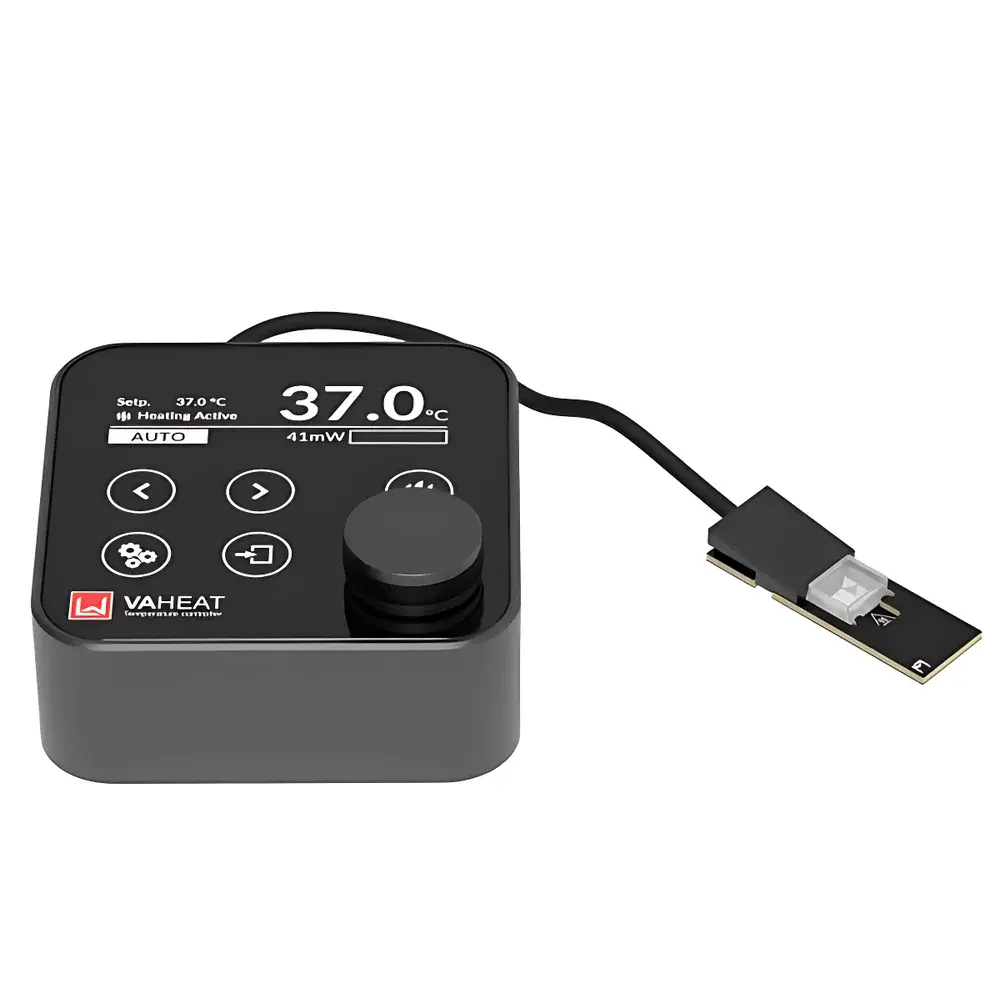
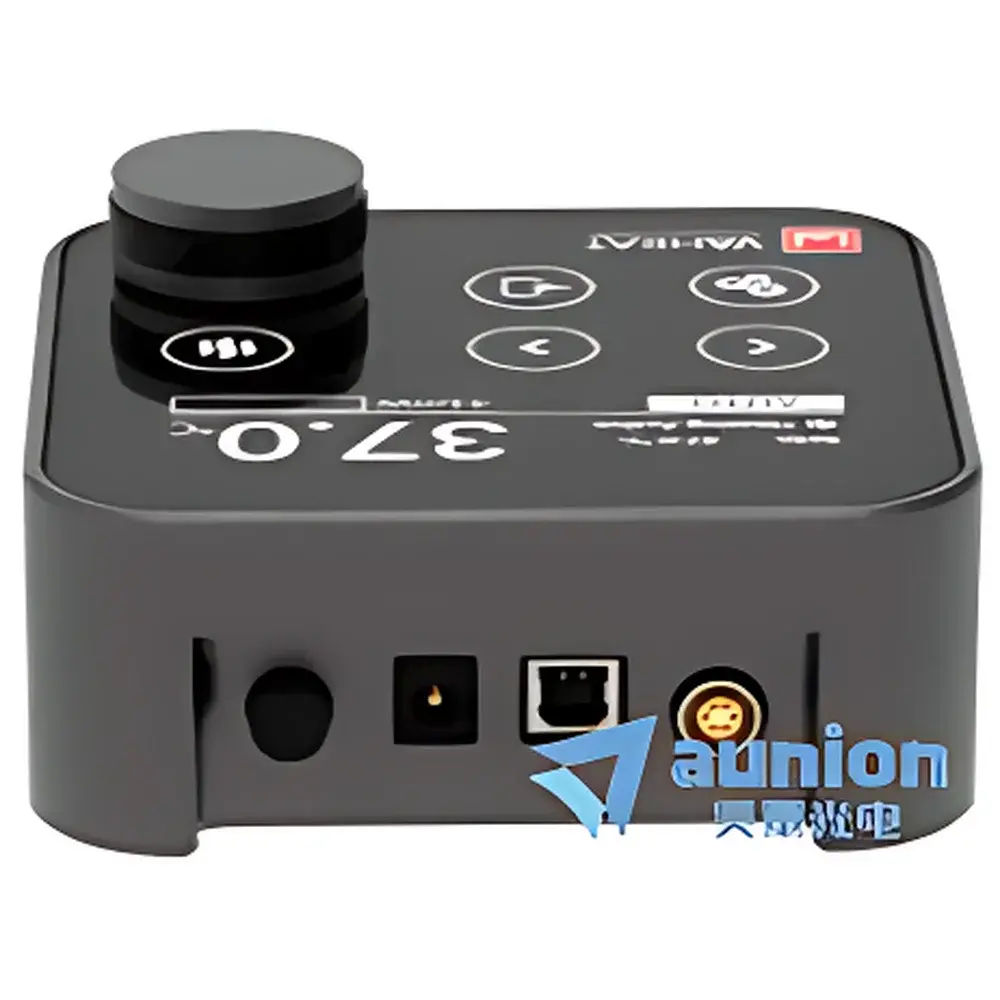
| Controller Interface | USB |
| Compatible Microscopy Modes | TIRF, Confocal, AFM, iSCAT, STED, SIM, STORM, PALM, PAINT, Widefield, Polarized Light |
| Power Input (Standard) | 2500 mW |
| Power Input (Extended) | 5000 mW |
| Substrate Material | Chemically functionalizable glass |
| Adapter Dimensions | 75 × 25 × 11 mm |
Overview
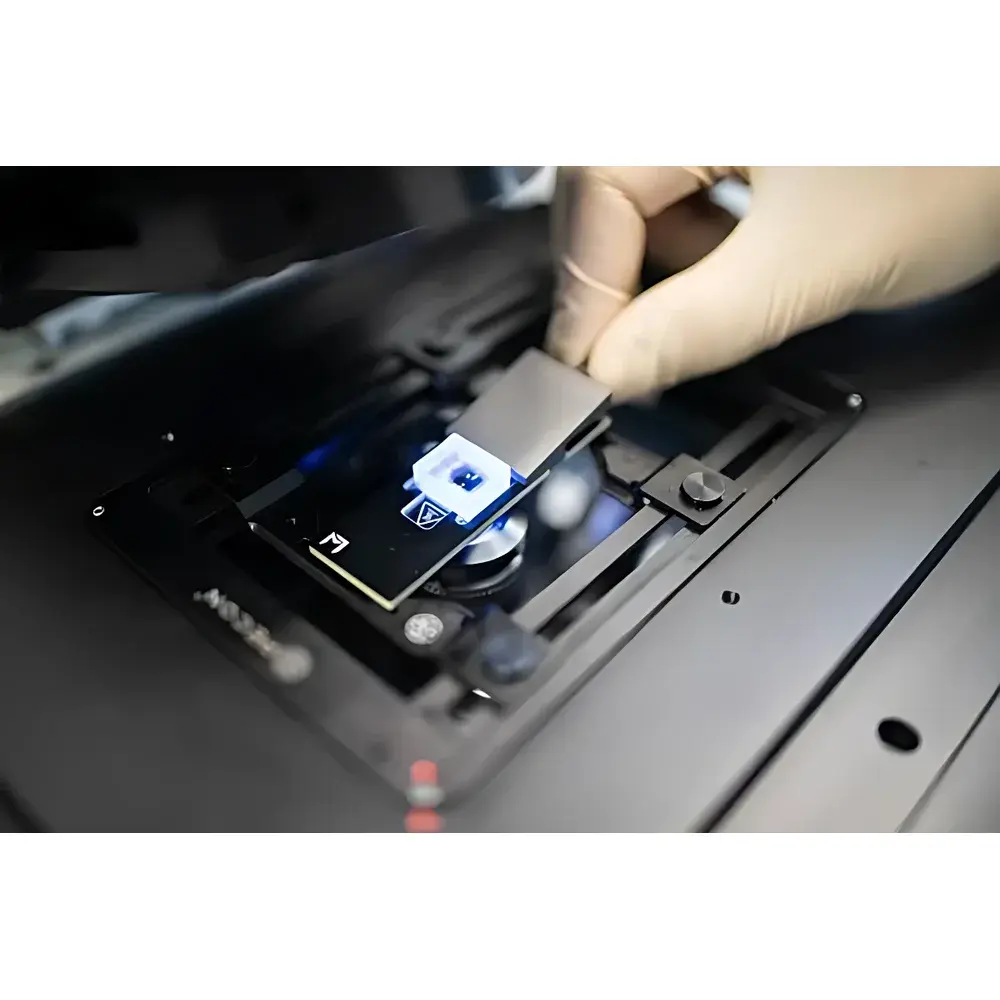
The Auniontech VAHEAT is a high-precision, programmable microscope heating stage engineered for dynamic thermal control in live-cell imaging, single-molecule biophysics, and materials phase-transition studies. Unlike conventional heated stages that rely on bulk-stage or objective-heating architectures—introducing optical aberrations, thermal drift, and slow response—the VAHEAT employs an integrated thin-film resistive heater and ultra-sensitive embedded temperature sensor directly within a 5 × 5 mm² glass substrate. This design enables direct, localized thermal regulation at the sample plane, decoupling temperature control from objective lens thermal mass and environmental perturbations. The system operates on a closed-loop PID feedback principle, with real-time temperature sensing at the sample interface ensuring sub-millisecond thermal responsiveness and long-term stability of ±0.01 °C (rms). Its architecture eliminates the need for objective-integrated heaters or oil-immersion-compatible thermal shrouds, preserving NA performance up to 80 °C and enabling compatibility with high-NA oil, water, and air objectives across modalities including TIRF, STED, and interferometric scattering (iSCAT) microscopy.
Key Features
- Four operational heating modes: Auto (PID-regulated), Direct (open-loop power control), Pulse (time-defined thermal impulse), and Profile (user-defined ramp/hold/cool sequences)
- Real-time temperature feedback via integrated Pt1000-class sensor embedded beneath the sample surface—enabling compensation for convective airflow, buffer exchange, and ambient fluctuations
- Ultra-fast thermal kinetics: 100 °C/s maximum heating rate with minimal overshoot and sub-second settling time
- Optically transparent, chemically functionalizable glass substrate compatible with fluorescence, FRET, and label-free imaging
- Mechanically stable platform with <10 nm Z-drift over 12 hours at 60 °C—validated for single-molecule localization microscopy (SMLM) and super-resolution tracking
- Modular adapter (75 × 25 × 11 mm) designed for universal integration into standard microscope stages without mechanical modification or optical path obstruction
- USB-controlled interface supporting remote scripting, synchronization with camera acquisition triggers, and timestamped thermal logging
Sample Compatibility & Compliance
The VAHEAT accommodates diverse sample formats—including glass-bottom dishes, coverslips, microfluidic chambers, and custom substrates—within its 5 × 5 mm² active zone. Its substrate geometry and thermal isolation ensure no measurable heat transfer to the microscope stage or adapter body; even at 200 °C sample temperature, the adapter remains below 35 °C. The system complies with ISO 13485–aligned manufacturing practices and supports GLP/GMP-relevant workflows through audit-trail-capable software logging. While not certified under FDA 21 CFR Part 11 by default, the VAHEAT’s deterministic thermal profiles, hardware-enforced temperature limits, and timestamped data export (CSV/TXT) facilitate validation for regulated applications such as thermal-stress testing of biomolecular assemblies or thermally triggered drug-release assays.
Software & Data Management
The cross-platform VAHEAT Control Suite provides intuitive GUI-based configuration and script-driven automation via Python API. Users define multi-step thermal protocols—including linear ramps, exponential cooling, dwell periods, and conditional triggers—with millisecond timing resolution. All temperature readings, applied power values, and system status flags are logged synchronously with external acquisition hardware using TTL or USB event signaling. Data exports include metadata headers compliant with FAIR principles (Findable, Accessible, Interoperable, Reusable), enabling direct ingestion into analysis pipelines (e.g., ImageJ/Fiji, MATLAB, Python SciPy). Firmware updates preserve backward compatibility and support firmware-level calibration traceability per NIST-traceable reference standards.
Applications
The VAHEAT serves critical roles in temperature-dependent biological and physical investigations where spatial precision, temporal fidelity, and optical integrity are non-negotiable. It enables real-time observation of thermally driven phenomena such as DNA hybridization/denaturation kinetics, liquid-liquid phase separation in intrinsically disordered proteins, meiotic chromosome dynamics under controlled thermal stress, and thermostable enzyme activity mapping in live cells. In materials science, it supports in situ characterization of polymer crystallization, ferroelectric domain switching, and metal–organic framework (MOF) structural transitions. Its compatibility with TIRF and iSCAT makes it particularly valuable for single-molecule binding assays requiring precise thermal modulation without compromising signal-to-noise ratio or localization precision.
FAQ
Is VAHEAT compatible with oil-immersion objectives?
Yes—the standard VAHEAT variant is fully compatible with high-NA oil-immersion objectives; its substrate design avoids thermal lensing and maintains wavefront fidelity up to 80 °C.
Can VAHEAT be used for cryogenic or sub-ambient experiments?
No—VAHEAT is a heating-only platform. For combined heating/cooling, consult Auniontech’s complementary VA-COOL series.
Does the system require recalibration after extended use?
The embedded Pt1000 sensor is factory-calibrated with NIST-traceable references; no user recalibration is needed. Long-term drift is <0.005 °C/year.
How is thermal uniformity verified across the 5 × 5 mm² area?
Uniformity is characterized using micro-thermocouple mapping and infrared thermography; measured gradient is <0.1 °C across the field at steady state.
Can multiple VAHEAT units be synchronized for multi-position experiments?
Yes—via USB-hub–based master/slave configuration or external TTL triggering, enabling coordinated thermal protocols across parallel imaging setups.




