
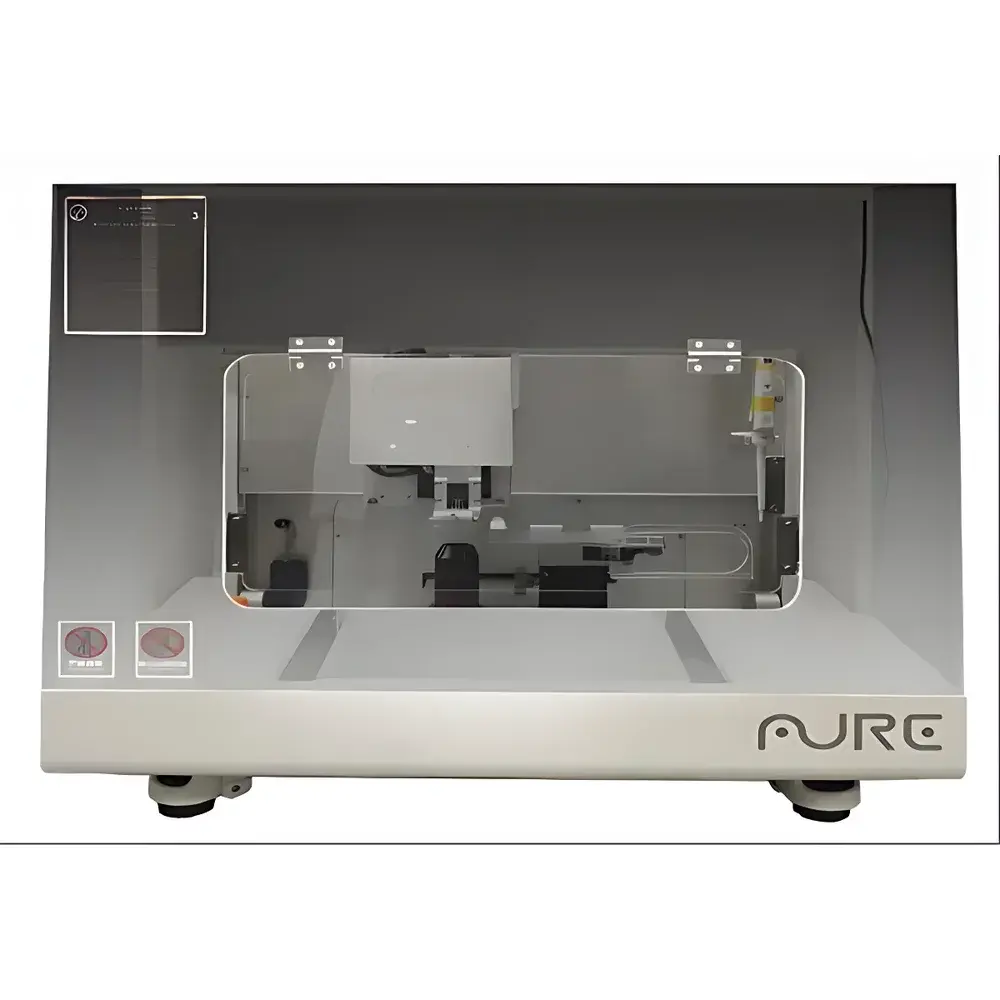
Aure BP4000 Automated 3D Spheroid Fabrication Platform
| Brand | Aure |
|---|---|
| Model | BP4000 |
| Origin | Beijing, China |
| Temperature Control Range | 2–8 °C |
| Category | Cell Preparation System for 3D Culture |
| Core Technology | CMOS-MEMS Microfluidic Digital Droplet Chip |
| Operating Principle | Precision Droplet-Based Cell Patterning on ECM Substrates |
Overview
The Aure BP4000 Automated 3D Spheroid Fabrication Platform is an engineered solution for reproducible, scalable, and standardized generation of three-dimensional (3D) cellular spheroids and organoid precursors. It operates on a microfluidic droplet digital printing principle, leveraging a proprietary CMOS-MEMS-based microfluidic chip to dispense picoliter-to-nanoliter volume droplets with single-cell resolution. Unlike conventional hanging-drop or ultra-low-attachment plate methods, the BP4000 enables spatially defined, quantitative cell deposition onto extracellular matrix (ECM)-coated substrates—such as Matrigel, collagen I, or synthetic hydrogels—initiating controlled self-aggregation under physiologically relevant conditions. The system maintains a thermally stabilized environment (2–8 °C) during loading and setup phases to preserve cell viability and reagent integrity prior to incubation. Its architecture supports integration into GLP-compliant workflows for preclinical drug screening, where batch-to-batch consistency in spheroid size, cellular composition, and structural homogeneity directly impacts assay sensitivity and inter-laboratory reproducibility.
Key Features
- Precision droplet dispensing with sub-nanoliter volumetric accuracy, enabling programmable cell seeding density per microspot (1–1000 cells/spot)
- CMOS-MEMS microfluidic chip with integrated pressure-driven actuation and real-time flow monitoring for high-fidelity droplet generation
- Automated multi-well plate handling compatible with standard 96-, 384-, and 1536-well formats
- Temperature-controlled staging module (2–8 °C) for cold-stage operation during reagent loading and chip priming
- Non-contact, low-shear cell patterning minimizing mechanical stress and preserving membrane integrity
- Configurable spheroid array geometry—including spot diameter (50–500 µm), inter-spot spacing (200–2000 µm), and total array count (up to 10,000 spots per run)
Sample Compatibility & Compliance
The BP4000 accommodates primary human cells (e.g., hepatocytes, PBMCs, tumor-derived cells), immortalized lines (e.g., HeLa, MCF-7, HT-29), and stem cell populations (iPSC-derived progenitors). All fluidic pathways are fabricated from medical-grade, USP Class VI-certified polymers, ensuring biocompatibility and leachables compliance per ISO 10993-5. The platform supports sterilization via ethanol wipe-down and UV-C exposure (254 nm, ≥15 mJ/cm²), aligning with cleanroom-compatible laboratory practices. While not classified as an IVD device, its operational parameters and documentation structure adhere to principles outlined in ISO 13485:2016 for design control traceability, and raw data logs meet ALCOA+ criteria (Attributable, Legible, Contemporaneous, Original, Accurate, Complete, Consistent, Enduring, Available) for audit readiness in GxP environments.
Software & Data Management
Control and protocol execution are managed through Aure’s SpheroidStudio™ v3.2 software suite, featuring a validated GUI with role-based access control (RBAC), electronic signature support, and full audit trail logging compliant with FDA 21 CFR Part 11 requirements. Users define spheroid templates via intuitive drag-and-drop layout editors, with parameter locking for SOP enforcement. All print sequences, environmental logs (temperature, humidity, timestamp), and chip usage metrics are exported in CSV and HDF5 formats for downstream analysis in MATLAB, Python (Pandas/Scanpy), or commercial platforms such as MetaMorph or Imaris. Software validation packages—including IQ/OQ documentation and UAT test scripts—are available upon request for regulated laboratories.
Applications
- High-throughput chemosensitivity profiling using uniform spheroids in oncology drug discovery
- Organoid biobanking with controlled initial cell number and ECM context for lineage-specific differentiation
- Toxicity assessment in liver- and kidney-on-chip models requiring reproducible 3D tissue equivalents
- Immunooncology co-culture assays integrating T cells, macrophages, and tumor spheroids under defined spatial constraints
- CRISPR screening platforms where spheroid-level phenotypic readouts (e.g., caspase activation, ATP content, hypoxia gradient imaging) depend on structural uniformity
FAQ
What cell types have been validated on the BP4000 platform?
Primary human hepatocytes, CD34+ hematopoietic stem cells, patient-derived glioblastoma cells, and iPSC-derived cortical neurons have been successfully patterned and matured into spheroids with >90% viability post-printing and 7-day culture.
Does the BP4000 require specialized training for operation?
Operators require basic cell culture proficiency; system-specific training is delivered remotely or on-site over two days, covering chip handling, software navigation, and routine maintenance protocols.
Can the BP4000 integrate with existing incubators or imaging systems?
Yes—the printed plates are fully compatible with standard CO₂ incubators (5% CO₂, 37 °C), and spheroid arrays maintain positional fidelity for automated confocal or brightfield time-lapse imaging without relocation.
Is the CMOS-MEMS chip reusable?
No—each chip is single-use to ensure sterility, prevent cross-contamination, and maintain consistent droplet performance across experiments.
How does the BP4000 ensure spheroid size uniformity compared to manual methods?
By fixing both initial cell number per droplet and ECM microenvironment geometry, the BP4000 eliminates variability introduced by gravity-driven aggregation or surface tension effects inherent in non-patterned methods, yielding CVs <8% in spheroid diameter across 96-well plates.





