
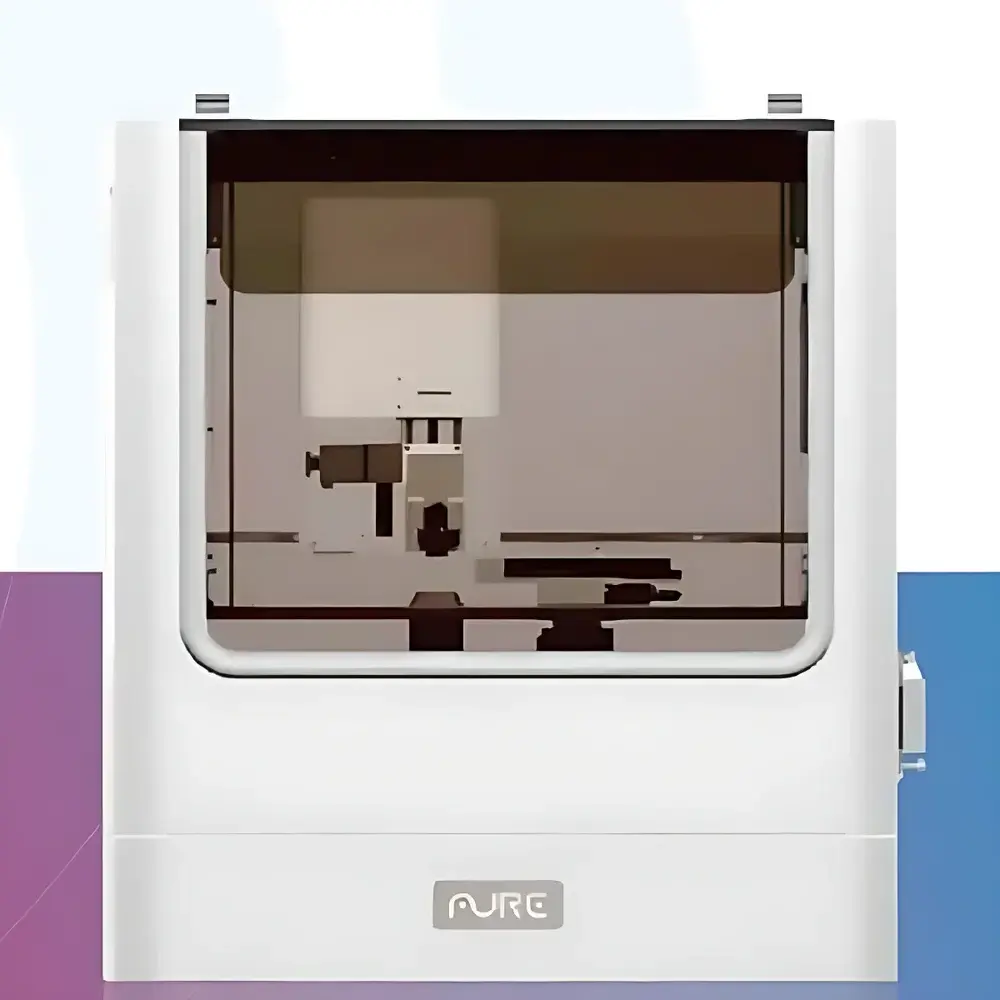
Aure SCP4000 AI-Powered Single-Cell Printing and Sorting System
| Brand | Aure |
|---|---|
| Origin | Shanghai, China |
| Manufacturer Type | Authorized Distributor |
| Country of Origin | China |
| Model | SCP4000 |
| Pricing | Available Upon Request |
| Single-Cell Recognition Accuracy | ≥98% |
| Monoclonal Guarantee Rate | >99.5% |
| Imaging Modality | Brightfield |
| Objective NA | 0.3 |
| Plate Throughput | ≤2 min/96-well plate, ≤8 min/384-well plate |
| Nozzle Count | 640 independently addressable nozzles |
| Nozzle Diameter | 30 µm |
| Droplet Volume | 24 pL |
| Compatible Substrates | 6/12/24/48/96/384/1536-well plates, 8-tube strips, glass slides, custom arrays |
| Compatible Buffers | Serum-containing media, PBS, H₂O, ethanol |
| Cell Viability Post-Printing | >90% |
| Operating Temperature | 15–30 °C |
| Relative Humidity | 20–80% RH |
| Core Chip | B150 CMOS-MEMS Integrated Microfluidic Cartridge |
| Recognition Algorithm | Convolutional Neural Network (CNN) trained on cell diameter, circularity, and morphological features |
| Sample Compatibility | CHO, HEK, tumor cell lines, iPSCs, primary cells, nuclei, protoplasts |
Overview
The Aure SCP4000 is an integrated single-cell printing and sorting platform engineered for high-fidelity, image-guided isolation and deposition of viable mammalian and non-mammalian cells. Unlike conventional fluorescence-activated or magnetic-activated cell sorters (FACS/MACS), the SCP4000 employs a nozzle-based microfluidic ejection principle grounded in piezoelectrically actuated CMOS-MEMS printhead technology. Each print event is preceded by real-time brightfield imaging at 0.3 NA resolution, followed by deterministic classification using a convolutional neural network (CNN) trained on morphometric parameters—including cell diameter, circularity, edge contrast, and spatial texture—enabling label-free discrimination of intact, phase-bright, adherent-competent single cells. The system operates without fluidic tubing or sheath flow, eliminating shear stress-induced viability loss and cross-contamination risks inherent to hydrodynamic sorting. Its closed, disposable B150 cartridge architecture ensures assay-to-assay consistency under GLP-aligned operational workflows and supports rapid transition between sample types without hardware recalibration.
Key Features
- 640 individually addressable 30 µm nozzles fabricated via standard CMOS-MEMS processes, enabling parallelized, high-throughput single-cell deposition with <24 pL droplet precision
- Label-free, morphology-driven cell recognition with ≥98% accuracy across diverse cell types including CHO, HEK293, iPSCs, primary lymphocytes, and fragile protoplasts
- Monoclonal guarantee rate exceeding 99.5%, validated by post-print colony-forming unit (CFU) assays and longitudinal clonal expansion tracking
- Disposable B150 microfluidic cartridge with integrated sensing, signal processing, and actuation—no cleaning, priming, or alignment required
- Real-time brightfield imaging with automated focus referencing via user-defined reference wells, ensuring consistent z-height registration across multi-plate runs
- Native compatibility with serum-containing media, PBS, and low-viscosity buffers—no surfactant or viscosity-modifier additives needed
- Modular software architecture supporting both GUI-driven protocol scripting and Python-based API access for integration into LIMS, ELN, or robotic orchestration frameworks
Sample Compatibility & Compliance
The SCP4000 accommodates a broad spectrum of suspension and semi-adherent biological samples without modification: recombinant CHO-K1 and DG44 lines; human embryonic kidney (HEK293) variants; murine hybridomas; patient-derived tumor organoids (dissociated); induced pluripotent stem cells (iPSCs); primary T and B lymphocytes; plant protoplasts; and isolated nuclei. All printed cells retain >90% membrane integrity and metabolic activity (measured via Calcein-AM/PI staining and ATP luminescence assays) post-deposition. The system complies with ISO 13485 design control principles for in vitro diagnostic (IVD)-adjacent instrumentation and supports audit-ready electronic records per FDA 21 CFR Part 11 when deployed with optional secure authentication and full audit trail logging modules. Its cartridge-based workflow aligns with USP recommendations for single-use systems in biomanufacturing process development.
Software & Data Management
The SCP4000 Control Suite provides a dual-mode interface: a drag-and-drop graphical workflow builder for routine monoclonal isolation, and a RESTful API with Python SDK for advanced automation. Image data (16-bit TIFF stacks), nozzle firing logs, pressure transducer traces, and CNN inference metadata are stored in vendor-neutral HDF5 containers compliant with the NIH BD2K data standards. All classification models are version-controlled and exportable for external validation. Software includes built-in statistical reporting for clonal purity, plating efficiency, and inter-run coefficient of variation (CV), with optional integration into enterprise data lakes via MQTT or SFTP. Audit trails record user identity, timestamp, parameter changes, and chip lot numbers—fully traceable to raw image frames.
Applications
- Accelerated monoclonal antibody (mAb) cell line development, reducing time-to-clonal pool from weeks to days
- Single-cell proteomics sample preparation requiring absolute clonality and minimal pre-sort manipulation
- CRISPR-Cas9 editing validation via direct deposition of edited clones into screening plates
- High-content functional screening of rare primary immune cell subsets without surface marker bias
- Bioprinting of defined cellular microarrays for spatial omics and co-culture interaction studies
- Stem cell banking with documented lineage traceability from single-cell origin to expanded cryovial
FAQ
Does the SCP4000 require fluorescent labeling for cell identification?
No. It performs label-free recognition using brightfield morphology and deep learning—ideal for unstained, native-state cells.
Can the B150 cartridge be reused?
No. It is a single-use, sterilized, gamma-irradiated component designed to eliminate carryover and ensure regulatory compliance.
Is the system compatible with 1536-well plates?
Yes—subject to custom firmware configuration and mechanical adapter installation (available as optional accessory).
What level of IT infrastructure is required for remote monitoring?
A standard Ethernet-connected workstation with TLS 1.2+ support suffices; cloud sync is optional and fully encrypted.
How is cell viability quantified and validated?
Via standardized live/dead assays (e.g., Calcein-AM/Propidium Iodide) performed immediately post-print and at 24/48 h—data included in QC reports.




