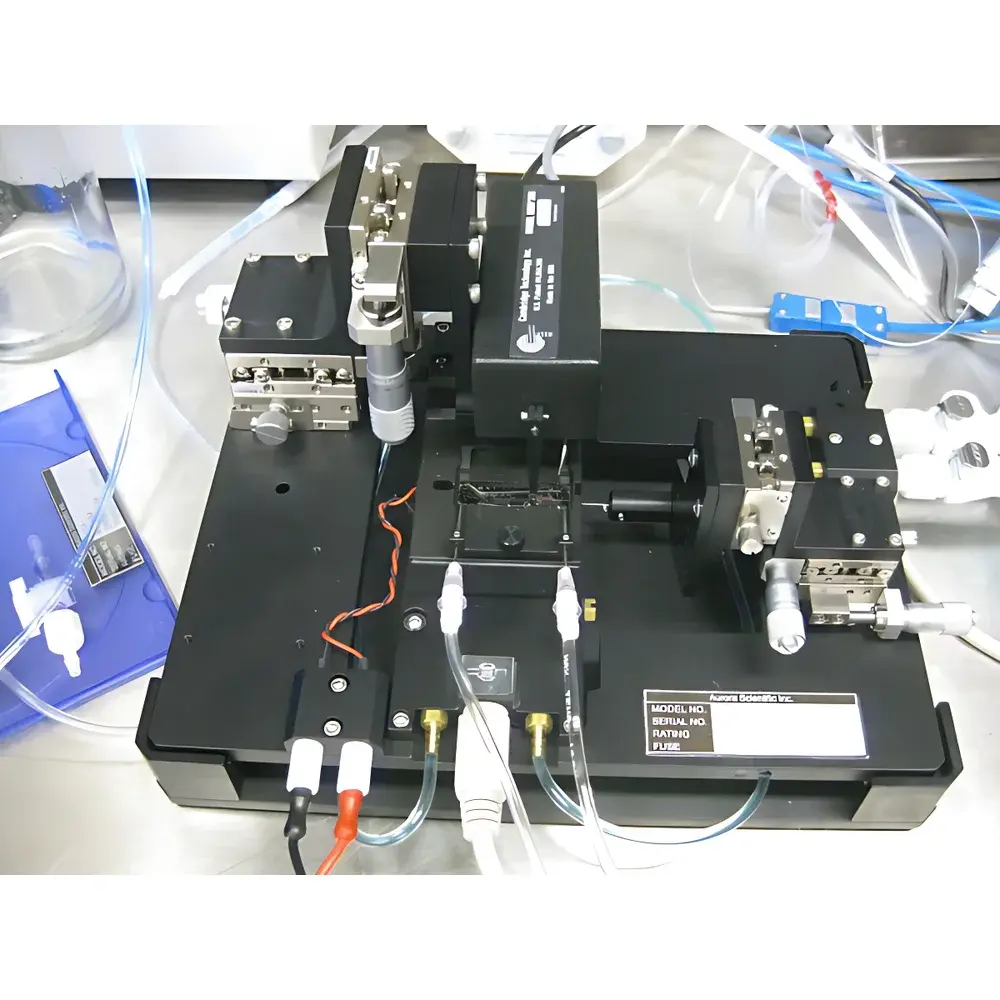
Aurora 1500A Micromechanical Tissue Testing System
| Origin | Canada |
|---|---|
| Manufacturer Type | Authorized Distributor |
| Origin Category | Imported |
| Model | 1500A |
| Price Range | USD 13,500 – 68,000 |
Overview
The Aurora 1500A Micromechanical Tissue Testing System is a precision-engineered platform designed for quantitative biomechanical characterization of intact microscale biological tissues—particularly skeletal, cardiac, and smooth muscle preparations, as well as engineered muscle constructs and vascular strips. Operating on the principles of isometric, isotonic, and work-loop protocols, the system enables real-time, high-fidelity measurement and control of force, length, velocity, and displacement under physiologically relevant conditions. Its core architecture integrates servo-controlled length actuation with nanonewton-resolution force transduction, enabling rigorous investigation of fundamental mechanical relationships—including force-length (Frank-Starling), force-velocity, power output, passive stiffness, and dynamic viscoelasticity—in specimens ranging from 0.5 mm to 5 mm in length and sub-milligram mass. The system is explicitly developed for integration into electrophysiology and live-cell imaging workflows, supporting simultaneous acquisition of mechanical, optical, and biochemical signals.
Key Features
- Modular three-configuration platform (horizontal, vertical, inverted) with full mechanical reconfigurability for diverse experimental geometries
- Integrated XYZ micrometer-stage (1 µm resolution) for precise alignment of force transducer, length controller, and dual-mode sensor relative to tissue axis
- Temperature-regulated physiological bath (±0.1 °C stability, range 4–42 °C) with gas-permeable lid and custom slit interface for low-stress tissue attachment to cantilever
- High-speed length controller (bandwidth >100 Hz, step response <5 ms) paired with low-noise, high-sensitivity force transducer (full-scale range: 0.1–10 mN; resolution: <10 nN)
- Dedicated metal base plate with standardized dovetail mounting for secure transfer between upright/inverted microscopes and vibration-isolated tables
- Real-time bidirectional control: force-clamp, length-clamp, ramp, sinusoidal, and user-defined waveform protocols via digital PID feedback
Sample Compatibility & Compliance
The 1500A accommodates native and bioengineered microtissues including isolated papillary muscles, atrial trabeculae, diaphragm strips, engineered heart tissues (EHTs), and synthetic biomimetic constructs. All wetted components are constructed from biocompatible, autoclavable stainless steel and borosilicate glass. Bath geometry conforms to ASTM F2967-22 guidelines for small-tissue mechanical testing. The system supports GLP-compliant operation through audit-trail-enabled software (see Software & Data Management), and hardware design adheres to IEC 61000-6-2/6-4 electromagnetic compatibility standards. Optional oxygenation modules enable normoxic/hypoxic perfusion studies compliant with ISO 13485–certified lab environments.
Software & Data Management
Control and acquisition are managed via Aurora TissueLab™ v4.x—a deterministic, real-time Windows-based application built on a deterministic RT kernel. The software provides preconfigured protocols aligned with AHA/ACC and NIH-supported methodologies (e.g., Langendorff-integrated pacing, twitch kinetics analysis). All data streams—including analog force/length channels, TTL-synced fluorescence inputs (e.g., GCaMP, Rhod-2), and optional sarcomere length tracking—are time-aligned with sub-millisecond precision. Raw data exports in HDF5 and MAT formats ensure interoperability with MATLAB, Python (SciPy/NumPy), and LabVIEW. Full 21 CFR Part 11 compliance is supported via electronic signatures, role-based access control, and immutable audit logs covering all protocol modifications, calibration events, and data exports.
Applications
- Cardiac contractility phenotyping in murine models of hypertrophy, failure, and genetic cardiomyopathy
- Preclinical evaluation of novel inotropes, calcium sensitizers, and metabolic modulators
- Mechanobiological assessment of iPSC-derived cardiomyocyte constructs under static/dynamic stretch
- Structure-function correlation in dystrophic or aged skeletal muscle fibers
- Validation of computational muscle models using empirically derived force-velocity and length-tension datasets
- Synchronized mechano-optical interrogation: concurrent measurement of sarcomere dynamics (via edge-detection or diffraction), intracellular Ca2+ transients, and active/passive force generation
FAQ
What tissue dimensions are optimal for reliable measurement on the 1500A?
Specimens 1–4 mm in length and 0.2–2.0 mg in mass yield highest signal-to-noise ratio and minimal edge-effect artifacts. Minimum functional gauge length is 0.5 mm.
Can the system be used with non-muscle tissues such as tendons or arterial rings?
Yes—custom clamping fixtures and extended-range transducers (0.01–100 mN) are available for connective and vascular tissues under tensile or circumferential loading.
Is third-party microscope integration supported?
The platform features universal C-mount and SM1-threaded interfaces compatible with Nikon Eclipse, Zeiss Axio Observer, and Olympus IX series microscopes—both upright and inverted configurations.
How is temperature stability maintained during long-duration experiments?
A Peltier-driven recirculating bath controller maintains setpoint within ±0.08 °C over 12+ hours, with real-time monitoring and automatic compensation for ambient drift.
Does Aurora provide validation documentation for regulatory submissions?
Yes—each system ships with IQ/OQ documentation templates, NIST-traceable calibration certificates for force/length subsystems, and software verification reports per GAMP5 Annex 11 requirements.
Related Products