
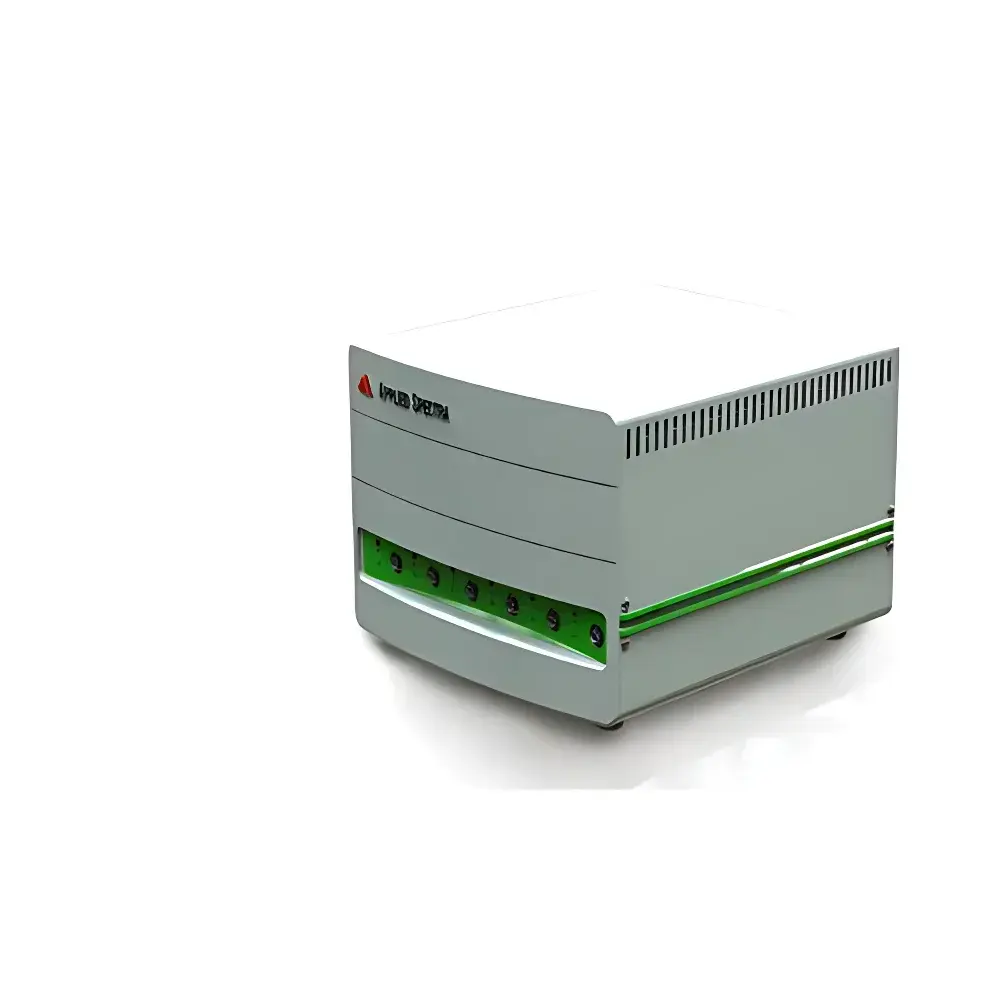
Aurora LIBS Spectrometer by Applied Spectra
| Key | Origin: USA |
|---|---|
| Manufacturer Type | Authorized Distributor |
| Origin Category | Imported |
| Model | Aurora LIBS |
| Price Range | USD 14,000 – 42,000 (FOB) |
| Instrument Type | Benchtop |
| Integration Architecture | Modular |
| Laser Pulse Energy | 200 mJ @ 1064 nm |
| Spectral Range | 190–1050 nm (UV-VIS-NIR) |
| Spectral Resolution | ≤ 0.07 nm (FWHM) |
| Gating Delay Precision | ≥ 50 ns resolution, < 1 ns jitter |
| Z-Axis Travel | 35 mm, Positioning Resolution: 0.5 µm |
| Optical Illumination | Coaxial Reflectance LED, Transmitted Light Source, Orthogonal Crosshair Targeting |
Overview
The Aurora LIBS Spectrometer is a benchtop laser-induced breakdown spectroscopy (LIBS) system engineered and manufactured in the United States by Applied Spectra, Inc. (ASI), a pioneer in quantitative elemental analysis instrumentation since 2001. Unlike rebranded or regionally assembled alternatives, the Aurora platform is fully designed, validated, and produced at ASI’s ISO 9001-certified facility in Fremont, California—ensuring traceable component sourcing, rigorous factory calibration, and full compliance with IEC 61000-6-3 EMC and IEC 60825-1 laser safety standards. At its core, the Aurora employs time-resolved, gated detection of plasma emission generated by Q-switched Nd:YAG laser ablation (1064 nm, up to 200 mJ per pulse). Its optical architecture integrates high-throughput Czerny-Turner spectrometers with back-illuminated, deep-depletion CCD/CMOS detectors, enabling simultaneous multi-channel spectral acquisition across the ultraviolet-to-near-infrared range (190–1050 nm). This design supports both qualitative fingerprinting and robust semi-quantitative to quantitative elemental analysis—particularly for heterogeneous solid samples where spatial resolution, plasma stability, and temporal gating fidelity are critical.
Key Features
- Modular multi-spectrometer configuration: Selectable 3–6 independent optical channels, each with user-defined grating and detector options to optimize resolution/sensitivity trade-offs per application.
- Precision timing control: Integrated digital delay generator synchronizes laser firing, ICCD/ICMOS gate opening, and data acquisition with ≤50 ns delay resolution and sub-nanosecond jitter—essential for suppressing continuum background and enhancing signal-to-noise ratio in early plasma decay phases.
- Automated Z-axis stage: 35 mm travel range with 0.5 µm closed-loop stepper motor positioning enables dynamic focal plane correction across topographically variable samples (e.g., mineral grains, alloys, geological sections).
- Multi-mode illumination suite: Includes coaxial LED reflectance lighting, transmitted-light base illumination, and orthogonal crosshair targeting optics—supporting precise ablation site selection and real-time sample navigation under ambient or low-light conditions.
- Laser environment flexibility: Compatible with inert gas purge (Ar, He, N₂), vacuum chambers (down to 10⁻³ mbar), and controlled atmospheric cells—enabling optimization of plasma lifetime and emission intensity for volatile element detection (e.g., H, Li, C, S).
- Embedded hardware synchronization: All subsystems—including laser, spectrometers, delay generator, and motion controller—are governed by a single FPGA-based master clock, eliminating timing drift during extended automated runs.
Sample Compatibility & Compliance
The Aurora accommodates solid samples up to 100 × 100 × 50 mm (W × L × H) on its motorized XYZ stage. It supports conductive and non-conductive materials—including silicates, metals, ceramics, polymers, and biological tissues—without mandatory conductive coating. Sample introduction adheres to ASTM E2926-22 (“Standard Guide for LIBS Analysis”) and ISO 21648:2021 (“Laser-induced breakdown spectroscopy — General requirements”). Full audit trails, electronic signatures, and instrument qualification documentation (IQ/OQ/PQ) are available upon request to support GLP, GMP, and FDA 21 CFR Part 11 compliance in regulated laboratories. Laser Class 4 operation is mitigated via interlocked enclosure, beam shutter, and visible/infrared emission monitoring per ANSI Z136.1-2022.
Software & Data Management
Control and analysis are performed via ASI’s SpectraSuite™ software—a Windows-based platform featuring real-time spectral preview, automated plasma parameter optimization (delay, width, averaging), and integrated chemometric modeling tools. The software supports partial least squares (PLS), principal component regression (PCR), and support vector machine (SVM) algorithms for multivariate calibration. All raw spectra, metadata (laser energy, gate parameters, stage coordinates), and processed results are stored in HDF5 format with embedded MIAME-compliant annotations. Export options include CSV, ASCII, and vendor-neutral JCAMP-DX for third-party spectral libraries. Remote operation via TCP/IP and scripting interfaces (Python API, LabVIEW VIs) enable integration into automated lab workflows and LIMS environments.
Applications
- Geochronology & petrology: In situ U-Pb dating of zircon and monazite; trace-element mapping in melt inclusions and fluid inclusions.
- Mineral resource assessment: Rapid quantification of major (Si, Al, Fe, Ca) and minor (REE, Y, Nb, Ta) elements in drill core, ore concentrates, and tailings.
- Forensic material analysis: Discrimination of glass, paint chips, soil, and metallurgical fragments based on elemental fingerprinting.
- Environmental monitoring: Detection of heavy metals (Pb, Cd, As, Cr) in soils, sediments, and aerosol filters at ppm-level sensitivity.
- Industrial process control: Real-time composition verification of metal alloys, battery cathode materials, and additive manufacturing powders.
FAQ
Is the Aurora LIBS system compliant with FDA 21 CFR Part 11 for electronic records and signatures?
Yes—when deployed with SpectraSuite™ in Audit Mode, the system provides full electronic signature capability, immutable audit trails, and role-based access control, meeting all technical and procedural requirements for regulated pharmaceutical and medical device QA/QC labs.
Can the Aurora be integrated into an existing automated sample handling system?
Absolutely—the platform offers native Ethernet/IP and RS-232 interfaces, plus a documented Python SDK and LabVIEW driver suite for seamless integration with robotic arms, auto-feeders, or conveyor-based inspection lines.
What spectral resolution can be achieved with the standard 3-channel configuration?
With 2400 grooves/mm gratings and 2048-pixel detectors, the typical FWHM resolution is ≤0.07 nm at 350 nm—sufficient to resolve adjacent Mn II (350.048 nm) and Fe I (350.120 nm) lines in geological matrices.
Does ASI provide method development support for new applications?
Yes—ASI’s Applications Lab offers remote and on-site method transfer services, including calibration set design, matrix-matched reference material selection, and uncertainty budgeting per ISO/IEC 17025 guidelines.
How is laser energy stability monitored during long-duration mapping runs?
An internal photodiode-based energy monitor samples every pulse and feeds real-time feedback to the laser power supply, maintaining ±1.5% pulse-to-pulse energy stability over 10,000-shot sequences.






