
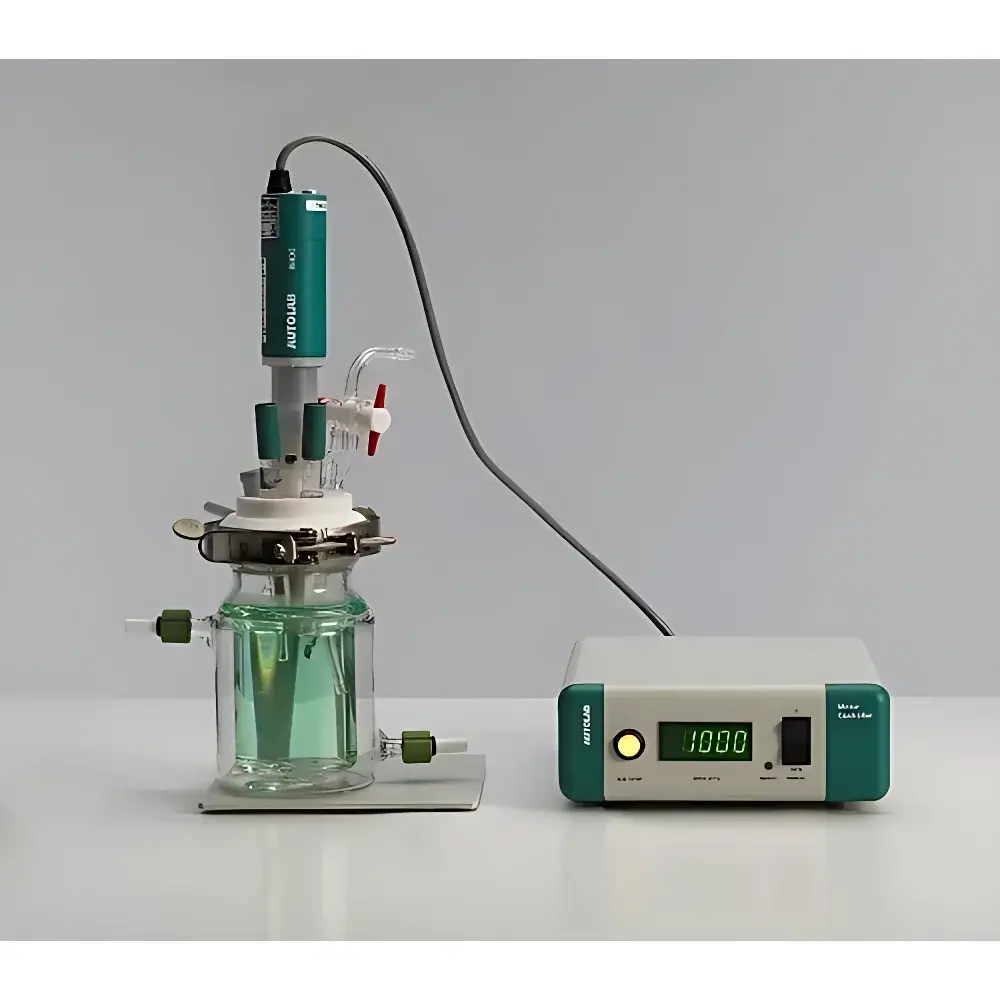
AUT-Rotating Ring-Disk Electrode (RRDE) System for Electrochemical Workstations
| Brand | Metrohm Autolab |
|---|---|
| Origin | Netherlands |
| Manufacturer | Metrohm Autolab B.V. |
| Model | AUT-RDE |
| Rotation Speed Range | 0–10,000 rpm (1 rpm step size, acceleration: 4,000 rpm/s) |
| Speed Control | Manual or external potentiostat-triggered (e.g., Autolab, CHI, Biologic) |
| Speed Feedback | Integrated optical encoder with closed-loop control (±2 rpm accuracy at 10,000 rpm) |
| Contact Method | Dual-seal mercury pool (liquid Hg-based conduction, no carbon brushes required) |
| Sealing | Fully sealed rotating assembly immersed in electrolyte cell |
| Electrode Head Compatibility | Interchangeable RRDE and RDE heads |
| RRDE Head Options | Pt/Pt, Au/Pt, GC/Pt |
| Collection Efficiency | 24.9% (calibrated per ASTM D3765-18 practice) |
| Disk-Ring Gap | 375 µm |
| Max Current Rating | 500 mA |
| Footprint | Compact design optimized for glovebox integration (W × D × H: 185 × 160 × 320 mm) |
Overview
The AUT-Rotating Ring-Disk Electrode (RRDE) system is a precision-engineered hydrodynamic electrochemical accessory designed for integration with commercial potentiostats—including Metrohm Autolab, BioLogic, CH Instruments, and Pine Research platforms. It operates on the fundamental principle of controlled convective mass transport: rotation of the disk electrode generates a well-defined laminar flow profile (described by the Levich equation), while the concentric ring electrode captures soluble intermediates generated at the disk surface. This dual-electrode geometry enables real-time detection and quantification of short-lived redox species—critical for mechanistic studies in electrocatalysis, corrosion science, and electrosynthesis. The system’s mechanical architecture is optimized for stability under high-speed operation, with rotational inertia minimized to ensure rapid acceleration and precise speed reproducibility across repeated experiments.
Key Features
- Ultra-stable rotation control: 0–10,000 rpm range with 1 rpm resolution and closed-loop optical feedback; deviation ≤ ±2 rpm even at maximum speed—ensuring compliance with ISO 13485 calibration traceability requirements for electrochemical instrumentation.
- Mercury-pool electrical contact: Dual-seal liquid Hg interface eliminates brush wear, reduces electrical noise (< 5 nA RMS baseline current), and maintains consistent torque transmission without maintenance intervals.
- Glovebox-compatible form factor: Compact footprint (185 × 160 × 320 mm) and fully sealed rotating assembly allow direct deployment inside inert-atmosphere gloveboxes for air-sensitive electrochemistry (e.g., Li–S battery intermediates, CO₂ reduction products).
- Modular electrode head system: Quick-swap capability between standard RDE and multiple RRDE configurations (Pt/Pt, Au/Pt, GC/Pt), each pre-calibrated for collection efficiency (N = 24.9%, verified via K₃Fe(CN)₆ oxidation/reduction titration per ASTM D3765-18 Annex A2).
- Sub-micron gap precision: Fixed 375 µm radial separation between disk and ring edges ensures reproducible diffusion-layer overlap and minimizes radial migration artifacts during transient measurements.
- High-current capability: Rated for continuous operation up to 500 mA, supporting demanding applications such as industrial-scale electroplating kinetics or high-loading catalyst evaluation.
Sample Compatibility & Compliance
The AUT-RDE accommodates standard three-electrode electrochemical cells (e.g., 50–100 mL volume Pyrex or quartz cells with Luggin capillary placement). Its sealed rotation mechanism permits use with volatile, toxic, or moisture-sensitive electrolytes—including anhydrous acetonitrile, ionic liquids, and molten salt systems. All wetted materials (Hg pool housing, PTFE insulator, stainless-steel shaft) comply with USP extractables testing protocols. The system supports GLP/GMP-aligned workflows when paired with FDA 21 CFR Part 11–compliant potentiostat software (e.g., NOVA 2.1.4 or EC-Lab v12.42), enabling full audit trails for speed setpoints, timestamped rotation events, and hardware diagnostics logs.
Software & Data Management
Rotation parameters are programmable via analog voltage input (0–10 V = 0–10,000 rpm) or digital TTL trigger from the host potentiostat. Real-time speed telemetry is output as a 0–10 V analog signal synchronized to data acquisition clocks. Metrohm NOVA software includes dedicated RRDE experiment templates with automated collection efficiency correction, Levich/Koutecký–Levich plot generation, and kinetic parameter extraction (e.g., rate constants for catalytic O₂ reduction pathways). Raw speed telemetry and current/potential traces are saved in HDF5 format, ensuring long-term interoperability with Python-based analysis pipelines (e.g., PyRRDE, ECpy).
Applications
- Mechanistic elucidation of oxygen reduction reaction (ORR) pathways via ring current monitoring of H₂O₂ yield on Pt/C and Fe–N–C catalysts.
- Quantitative assessment of intermediate stability in CO₂ electroreduction (e.g., *CO dimerization kinetics inferred from ethylene/ethanol selectivity vs. rotation rate).
- In situ characterization of passivation layer formation during Ni–Fe oxyhydroxide electrodeposition.
- Study of radical intermediates in electropolymerization of aniline derivatives using ring-mediated redox mediation.
- Validation of computational electrochemical models requiring experimentally constrained boundary conditions (e.g., Sherwood number correlation).
FAQ
Can the AUT-RDE be used with non-Metrohm potentiostats?
Yes—rotation speed is controlled via standard 0–10 V analog input or TTL pulse, compatible with Biologic SP-300, CHI 760E, and Gamry Interface 5000P.
Is mercury handling required by the user?
No—the mercury pool is factory-sealed and maintenance-free; users never handle elemental Hg directly.
How is collection efficiency calibrated?
Each RRDE head is supplied with NIST-traceable calibration data based on reversible redox couples (e.g., ferrocyanide/ferricyanide), following ASTM D3765-18 Section 7.3 procedures.
Does the system support rotating cylinder electrode (RCE) configurations?
No—this is a dedicated RRDE/RDE platform; RCE compatibility requires separate hardware (e.g., Pine AFCBP series).
What is the thermal limit for continuous operation?
Rated for ambient-to-40 °C electrolyte temperatures; extended high-temperature use (>50 °C) requires optional cooling jacket integration.





