
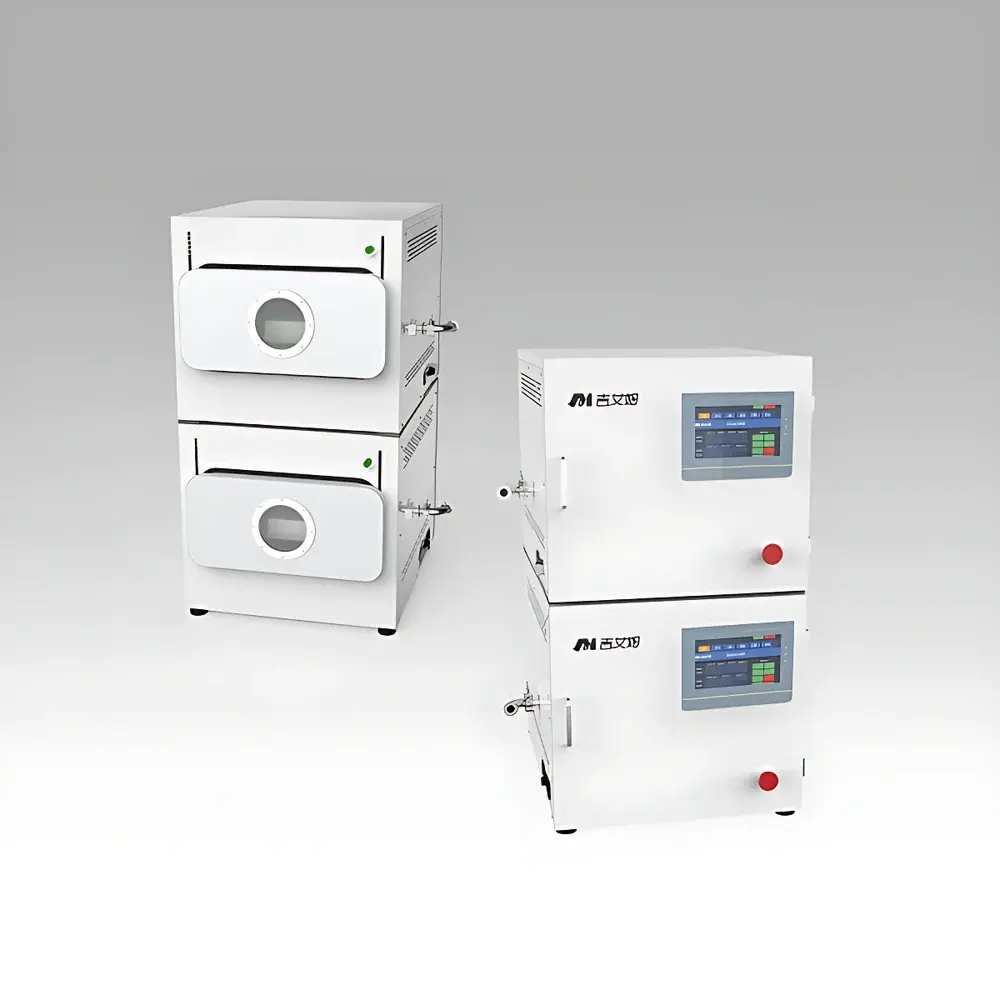
Auto C1 Fully Automated Vacuum Centrifugal Concentrator
| Brand | Ji Aim |
|---|---|
| Origin | Beijing, China |
| Manufacturer Type | Direct Manufacturer |
| Product Category | Domestic |
| Model | Auto C1 |
| Price Range | USD 28,000 – 56,000 |
| Instrument Type | Vacuum Centrifugal Concentrator |
| Temperature Range | Ambient to 70°C |
| Temperature Control Accuracy | ±2°C |
| Rotational Speed | 1500 rpm |
| Vacuum Display Range | 0.1–99.9 mbar |
| Vacuum Control | Yes |
| Heating Power | 1500 W |
| Power Supply | AC 220 V, 50/60 Hz, 10 A |
| Dimensions (W×D×H) | 657 × 518 × 465 mm |
| Lid Opening Mechanism | Vertical Lift |
| Positioning Accuracy | <1 mm |
| Rotor Configuration | Horizontal Dual-Plate Carrier (2 × 96-well Deep-Well Plates or Sample Vial Baskets) |
| Corrosion Resistance | Solvent-Compatible Materials (e.g., PTFE-coated Seals, 316 Stainless Steel Components) |
Overview
The Ji Aim Auto C1 Fully Automated Vacuum Centrifugal Concentrator is an engineered solution for high-throughput, reproducible sample concentration in analytical, pharmaceutical, and molecular biology laboratories. It integrates centrifugal force, vacuum-assisted solvent evaporation, and precisely regulated heating to accelerate the removal of volatile solvents—including ethanol, methanol, acetonitrile, and chloroform—while preserving thermolabile analytes such as nucleic acids, peptides, metabolites, and small-molecule standards. Unlike conventional benchtop concentrators, the Auto C1 employs a horizontal rotor architecture with dual 96-well deep-well plate compatibility, enabling parallel processing of up to 192 samples per run without cross-contamination. Its operational principle relies on simultaneous application of controlled rotational acceleration (up to 1500 rpm), dynamic vacuum regulation (0.1–99.9 mbar), and programmable thermal ramping (ambient to 70°C), collectively minimizing boiling point elevation and preventing bumping or foaming during evaporation.
Key Features
- Modular architecture: Independent units for main concentrator, cold trap (-50°C condensation capability), and oil-free diaphragm vacuum pump—enabling flexible configuration, serviceability, and compliance with ISO 13485 cleanroom integration requirements.
- Vertical-lift lid mechanism with integrated safety interlock and position-sensing feedback, ensuring operator safety and alignment repeatability during robotic integration.
- High-precision rotor positioning system (<1 mm positional error) with programmable A/B face switching—designed explicitly for seamless interfacing with liquid handlers and automated lab platforms compliant with SLAS/ANSI standards.
- Horizontal dual-plate rotor supports standardized 96-well deep-well plates (up to 2 mL/well) or custom vial baskets (1.5–15 mL), eliminating centrifugal imbalance risks associated with vertical rotors under variable load conditions.
- Pre-heating protocol initiation prior to vacuum application reduces overall cycle time by up to 35% compared to ambient-start protocols—validated using gravimetric endpoint detection across 20 common solvent systems.
- Full corrosion resistance: Critical wetted surfaces constructed from electropolished 316 stainless steel; seals and gaskets formulated with perfluoroelastomer (FFKM) for sustained exposure to aggressive organic solvents.
Sample Compatibility & Compliance
The Auto C1 accommodates a broad range of biological and chemical sample matrices—including aqueous buffers, acidic/basic extracts, protein digests, and LC-MS fractions—without degradation or adsorption artifacts. Its vacuum and thermal profiles are validated per ASTM E2656-22 (Standard Practice for Validation of Solvent Removal Systems) and align with USP <1058> Analytical Instrument Qualification guidelines. The system supports 21 CFR Part 11-compliant audit trails when operated via optional secure Ethernet interface, and its firmware architecture enables GLP/GMP traceability through timestamped event logs, user authentication, and parameter change history. All materials contacting samples comply with USP Class VI biocompatibility and EU Regulation (EC) No 1935/2004 for food-contact safety.
Software & Data Management
Control is executed via embedded Linux-based firmware with native Modbus TCP support (port 502), allowing direct integration into LabVantage, STARLIMS, or custom MES environments. The local HMI provides intuitive touchscreen operation with preloaded methods for DNA/RNA cleanup, peptide desalting, and metabolite enrichment. Remote access is enabled via IEEE 802.11n Wi-Fi or wired Ethernet, supporting encrypted SSH/TLS sessions. Data export options include CSV, PDF reports (with digital signatures), and real-time OPC UA streaming for SCADA-level monitoring. All method parameters—including vacuum ramp rates, temperature setpoints, spin duration, and rotor orientation—are version-controlled and exportable for regulatory submission packages.
Applications
- High-throughput nucleic acid concentration post-extraction or enzymatic reaction cleanup (e.g., library prep for NGS).
- Peptide and small-molecule drug candidate concentration prior to LC-MS/MS analysis—maintaining integrity of labile modifications (phosphorylation, glycosylation).
- Environmental residue analysis: Accelerated solvent removal from QuEChERS extracts while preserving pesticide stability.
- Biopharmaceutical QC: Final concentration of monoclonal antibody fragments and ADC intermediates under GMP-aligned process conditions.
- Academic core facility deployment: Scheduled unattended overnight runs with automatic shutdown upon vacuum stabilization or temperature deviation.
FAQ
Does the Auto C1 support integration with robotic liquid handling systems?
Yes—the A/B face-switching rotor and sub-millimeter positioning accuracy enable repeatable docking with Hamilton STAR, Tecan Freedom EVO, and Opentrons OT-2 platforms using standard gripper tooling.
Is the cold trap included as standard equipment?
The cold trap is a modular component; it is offered as a factory-configured option and may be added or omitted based on solvent volatility profile and throughput requirements.
Can vacuum level and temperature be independently programmed per step?
Yes—each method step allows discrete control of vacuum pressure (0.1 mbar resolution), temperature (0.1°C resolution), rotation speed (10 rpm increments), and dwell time, with up to 20-step sequences.
What maintenance intervals are recommended for the vacuum pump?
For typical usage (20 hrs/week), the oil-free diaphragm pump requires filter replacement every 6 months and full service inspection annually—documented in the provided PM checklist aligned with ISO/IEC 17025 preventive maintenance requirements.
Is remote firmware update capability available?
Firmware updates are delivered via signed .bin files over HTTPS; installation requires administrator credentials and triggers automatic rollback if checksum validation fails.



