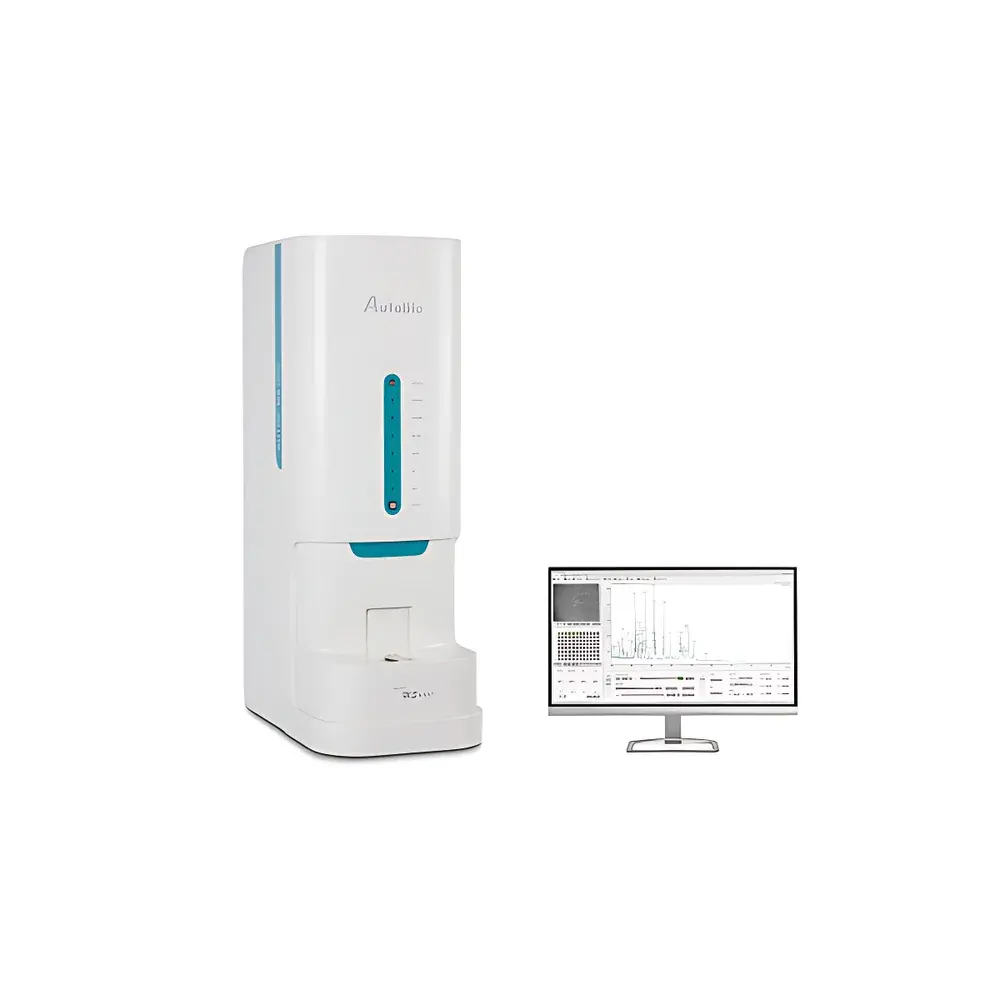
Autobio Autof MS Automated Microbial Mass Spectrometry Identification System
| Brand | Autobio |
|---|---|
| Model | Autof MS |
| Origin | Henan, China |
| Laser Lifetime | >100 million shots |
| Mass Analyzer | Titanium Alloy Linear TOF (1.05 m) |
| Vacuum System | High-Throughput Turbo-Molecular Pump |
| Identification Speed | ≤0.1 s per sample (database search) |
| Microbial Database | 5,000+ species across 1,000+ genera, including filamentous fungi, anaerobic gut bacteria, and marine isolates |
| Nucleic Acid Detection Capacity | Up to 40-plex per well |
| Regulatory Certification | NMPA-approved calibration and control materials |
| Software Compliance | Audit trail, user access control, and electronic signature support per FDA 21 CFR Part 11 requirements |
Overview
The Autobio Autof MS Automated Microbial Mass Spectrometry Identification System is a clinical-grade matrix-assisted laser desorption/ionization time-of-flight (MALDI-TOF) mass spectrometer engineered for high-throughput, reproducible microbial identification in regulated laboratory environments. Operating on the fundamental principle of peptide mass fingerprinting (PMF), the system ionizes intact ribosomal proteins from intact microorganisms—typically cultured colonies or directly processed positive blood culture broths—and measures their mass-to-charge (m/z) ratios with high mass accuracy and resolution. The resulting spectral profile is matched against a rigorously curated, continuously updated reference database using deterministic pattern-matching algorithms enhanced by proprietary artificial intelligence modules. Unlike conventional biochemical or nucleic acid–based identification methods, MALDI-TOF MS delivers species-level identification in under 5 minutes post-sample preparation, with minimal hands-on time and no requirement for organism subculturing or DNA extraction in routine workflows.
Key Features
- Titanium-alloy linear time-of-flight mass analyzer (1.05 m length) with active thermal stabilization—ensures consistent ion flight path geometry and minimizes mass drift over extended operation cycles.
- High-reliability solid-state UV laser (337 nm) rated for ≥100 million pulses, delivering stable ion yield and extended operational lifetime without recalibration.
- Integrated high-capacity turbo-molecular vacuum system enabling immediate acquisition upon target plate insertion—eliminates waiting time between sample loading and data collection.
- Dedicated signal acquisition architecture featuring low-noise analog-to-digital conversion and real-time baseline correction—enhances spectral reproducibility (CV < 2% for peak intensity across replicate runs).
- Proprietary AI-accelerated search engine performing full-spectrum matching in ≤0.1 seconds per sample, supporting concurrent analysis of up to 96 samples per batch.
- Modular dual-function platform: native MALDI-TOF microbial identification plus integrated nucleic acid detection capability (40-plex per well) via compatible cartridge-based assays—enabling parallel pathogen screening and antimicrobial resistance marker profiling.
Sample Compatibility & Compliance
The Autof MS system accepts standard 96-well stainless steel MALDI target plates and supports direct analysis of Gram-positive and Gram-negative bacteria, yeasts, molds (including dermatophytes and filamentous fungi), mycobacteria, and fastidious anaerobes following validated extraction protocols. It accommodates preprocessed positive blood culture specimens using Autobio’s NMPA-registered sample preparation kits and companion calibrators/controls. All reagents—including extraction solvents, matrix solutions, and calibration standards—are manufactured under ISO 13485-certified conditions. The instrument meets essential performance criteria outlined in CLSI MM19-A3 and EUCAST guidelines for MALDI-TOF MS–based identification. Full traceability, electronic audit trails, role-based user permissions, and 21 CFR Part 11–compliant electronic signatures are embedded in the instrument control software—supporting GLP, GMP, and CAP-accredited laboratory workflows.
Software & Data Management
Autobio’s proprietary MSControl Suite provides end-to-end workflow management—from plate layout design and automated acquisition scheduling to spectral quality assessment, database matching, and report generation. The software hosts a locally deployable, version-controlled microbial database containing over 5,000 species across 1,000+ genera, with special emphasis on clinically relevant anaerobes, environmental isolates, and taxonomically challenging filamentous fungi. Users may deploy either on-premise or cloud-hosted database instances; offline operation is fully supported without internet connectivity. Custom library expansion is enabled via standardized spectral import (mzML format) and hierarchical clustering tools. Raw data files (imzML-compliant), processing logs, and audit records are stored in immutable, timestamped archives—facilitating internal review, external inspection, and regulatory submission.
Applications
The Autof MS system serves as a core identification platform in clinical microbiology laboratories, public health reference labs (e.g., CDC, provincial CDCs), food safety testing centers, pharmaceutical QC units, and academic research facilities. Routine applications include rapid identification of bloodstream infection pathogens, antimicrobial stewardship support through timely species assignment, environmental monitoring of cleanrooms and water systems, verification of starter cultures in bioprocessing, and characterization of novel isolates in biodiversity studies. Its dual-mode architecture also supports targeted multiplex nucleic acid detection for outbreak investigation, resistance gene surveillance (e.g., carbapenemase variants), and host-response biomarker quantification when paired with compatible assay cartridges.
FAQ
Does the Autof MS system require routine mass calibration?
No—titanium alloy analyzer stability and embedded internal calibration routines ensure mass accuracy remains within ±0.3 Da over 72 hours without manual recalibration.
Can users import third-party spectral libraries?
Yes—the software supports mzML-formatted libraries from major public repositories (e.g., SIRIUS, GNPS) and allows custom annotation and hierarchical grouping.
Is remote instrument monitoring supported?
Yes—secure TLS-encrypted remote access enables real-time status viewing, log retrieval, and limited diagnostic intervention via authorized institutional IT infrastructure.
What level of technical training is required for routine operation?
Basic microbiology laboratory personnel can achieve operational proficiency after a 2-day certified training program covering sample prep, acquisition, troubleshooting, and report interpretation.
How is data integrity maintained during software updates?
All updates undergo full regression testing; legacy data formats remain readable, and versioned backups are automatically generated prior to deployment.
Related Products