
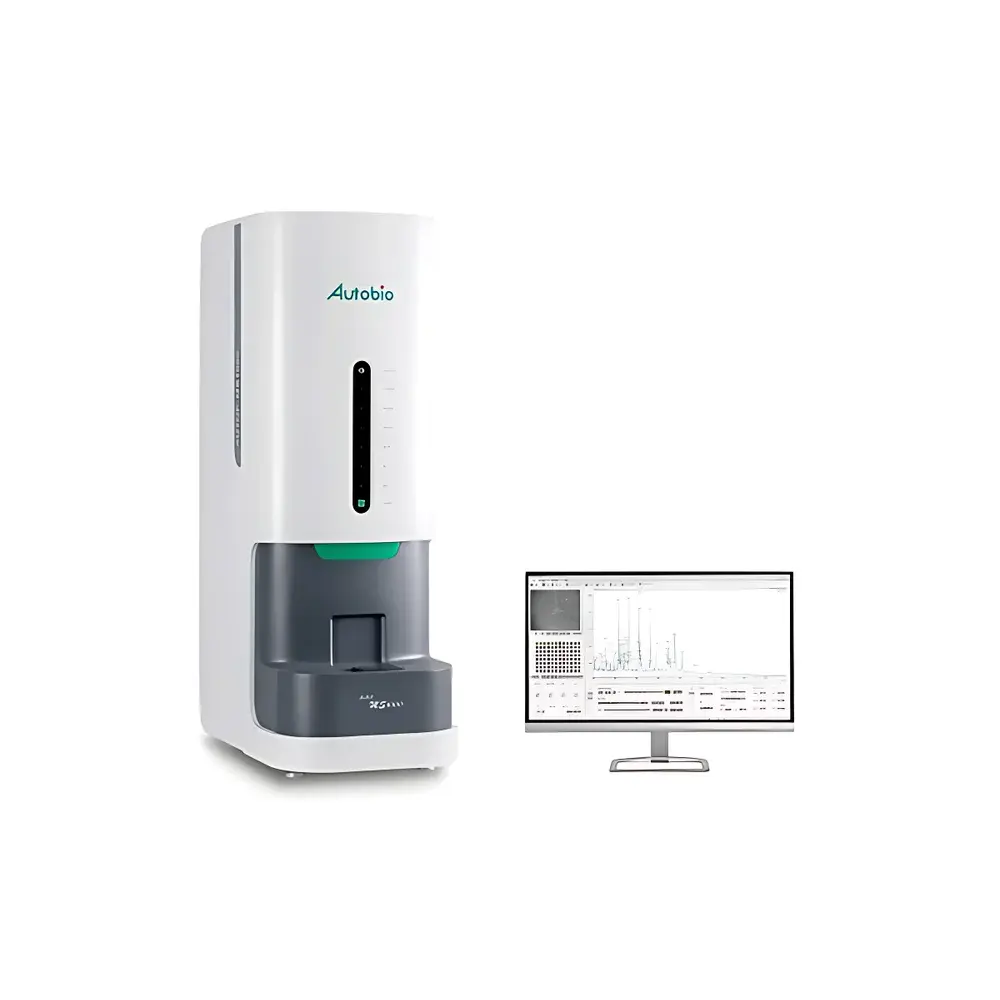
Autobio Autof ms1600 Fully Automated Nucleic Acid Mass Spectrometer
| Brand | Autobio |
|---|---|
| Origin | Henan, China |
| Manufacturer Type | Authorized Distributor |
| Regional Classification | Domestic (China) |
| Model | Autof ms1600 |
| Price Range | USD 420,000 – 560,000 |
| Instrument Type | MALDI-TOF Mass Spectrometer |
| Application Scope | Universal |
| Resolution | ≥3600 (Linear Mode) |
| Sensitivity | 50 fmol/µL (Insulin, S/N ≥ 60) |
| Mass Accuracy | <60 ppm (Internal Calibration) |
| Data Acquisition Rate | 0.5 GBit/sec |
| Stability | High Long-Term Operational Stability |
Overview
The Autobio Autof ms1600 is a fully automated matrix-assisted laser desorption/ionization time-of-flight (MALDI-TOF) mass spectrometer engineered specifically for high-throughput, quantitative nucleic acid analysis in clinical and translational research laboratories. Unlike conventional sequencing or hybridization-based platforms, the Autof ms1600 leverages the intrinsic mass difference introduced by single-base extension (SBE) chemistry following multiplex PCR amplification. Upon hybridization of allele-specific extension primers to amplified DNA templates, a single nucleotide is incorporated—altering the molecular mass of each probe by a predictable delta (e.g., +131 Da for dA, +152 Da for dC). The resulting mass-shifted products are ionized via MALDI and separated in the TOF analyzer based on their m/z ratios, enabling unambiguous detection of SNPs, indels, methylation status, and short tandem variants without fluorescent labeling or electrophoretic separation.
Key Features
- Fully integrated automation: Integrated robotic liquid handling, automatic target spotting, vacuum pumping, and laser firing sequence minimizes manual intervention and ensures walk-away operation for up to 96 samples per run.
- High-precision XY stage control: FPGA-based real-time motion control delivers sub-10 µm positional repeatability across the stainless-steel sample target, critical for consistent laser irradiation and signal reproducibility.
- Optimized vacuum architecture: Dual-stage turbo-molecular pumping system achieves operational vacuum (<5 × 10⁻⁷ mbar) within 45 seconds—eliminating wait time between sample loading and data acquisition.
- Disposable split-target consumables: Pre-assembled, single-use target plates with integrated anchor wells prevent carryover contamination and eliminate cleaning protocols—validated for >99.9% cross-contamination avoidance per CLSI EP23-A guidelines.
- Robust internal calibration strategy: On-the-fly calibrant co-spotting and dynamic recalibration during acquisition maintain mass accuracy within ±60 ppm across multi-day runs, supporting longitudinal cohort studies.
Sample Compatibility & Compliance
The Autof ms1600 accepts purified genomic DNA, whole blood lysates (with compatible extraction kits), FFPE-derived DNA, and bisulfite-converted templates. It supports input volumes from 1–10 µL and accommodates PCR amplicons ranging from 50–200 bp. The platform complies with ISO/IEC 17025:2017 requirements for testing laboratories and meets analytical validation criteria outlined in CLIA, CAP, and CNAS-accredited workflows. All firmware and software modules adhere to FDA 21 CFR Part 11-compliant audit trail functionality—including user authentication, electronic signatures, and immutable method/version logging—for regulated clinical diagnostics environments.
Software & Data Management
The proprietary Autof ms Control Suite provides an intuitive Chinese-English bilingual GUI with role-based access control (RBAC), method templating, and batch processing. Raw spectra are processed using centroiding algorithms optimized for nucleic acid adducts, followed by peak alignment, intensity normalization, and genotype calling via embedded decision-tree logic—not requiring external bioinformatics pipelines. All spectral data are stored in vendor-neutral .mzML format; metadata export supports HL7 and ASTM E1384 interoperability. Audit logs record every instrument parameter change, calibration event, and result export, satisfying GLP/GMP traceability requirements.
Applications
- Pharmacogenomic profiling: CYP2C19, CYP2D6, VKORC1, and SLCO1B1 genotyping for precision dosing guidance.
- Multiplex pathogen identification: Simultaneous detection of >40 respiratory or bloodstream pathogen targets in a single well.
- Hereditary cancer panel screening: BRCA1/2, MLH1, MSH2, and PALB2 variant classification at codon-level resolution.
- Epigenetic biomarker quantification: Quantitative assessment of CpG site methylation ratios using differential mass shifts of methylated vs. unmethylated extension products.
- Newborn and carrier screening: High-sensitivity detection of low-abundance mutant alleles in heterogeneous samples (e.g., mosaicism, chimerism).
FAQ
What sample preparation workflow is required prior to MS analysis?
Standard workflow includes DNA extraction, multiplex PCR amplification (using Autobio-certified primer sets), shrimp alkaline phosphatase (SAP) treatment, single-base extension (SBE), ethanol precipitation, and optional cation exchange purification—fully supported by Autobio’s validated reagent kits.
Is the system compatible with LIMS integration?
Yes—the Autof ms1600 supports bidirectional HL7 v2.5.1 and ASTM E1384-07 interfaces for seamless integration with major laboratory information management systems (e.g., Sunquest, Cerner, and Orchard Harvest).
How is instrument performance verified over time?
Autobio provides quarterly performance verification kits containing certified reference standards for resolution, sensitivity, mass accuracy, and peak intensity linearity—traceable to NIST SRM 2921 and ISO 13528 protocols.
Can the system be used for absolute quantification?
While primarily designed for relative allelic ratio determination, absolute quantification is achievable using isotopically labeled internal standards co-spotted with samples—validated for viral load and copy number variation assays.
What regulatory documentation is supplied with the system?
Each unit ships with full IQ/OQ/PQ documentation, CE-IVDR Class C declaration, ISO 13485:2016 certificate, and technical file summary compliant with Annex II of Regulation (EU) 2017/746.






