
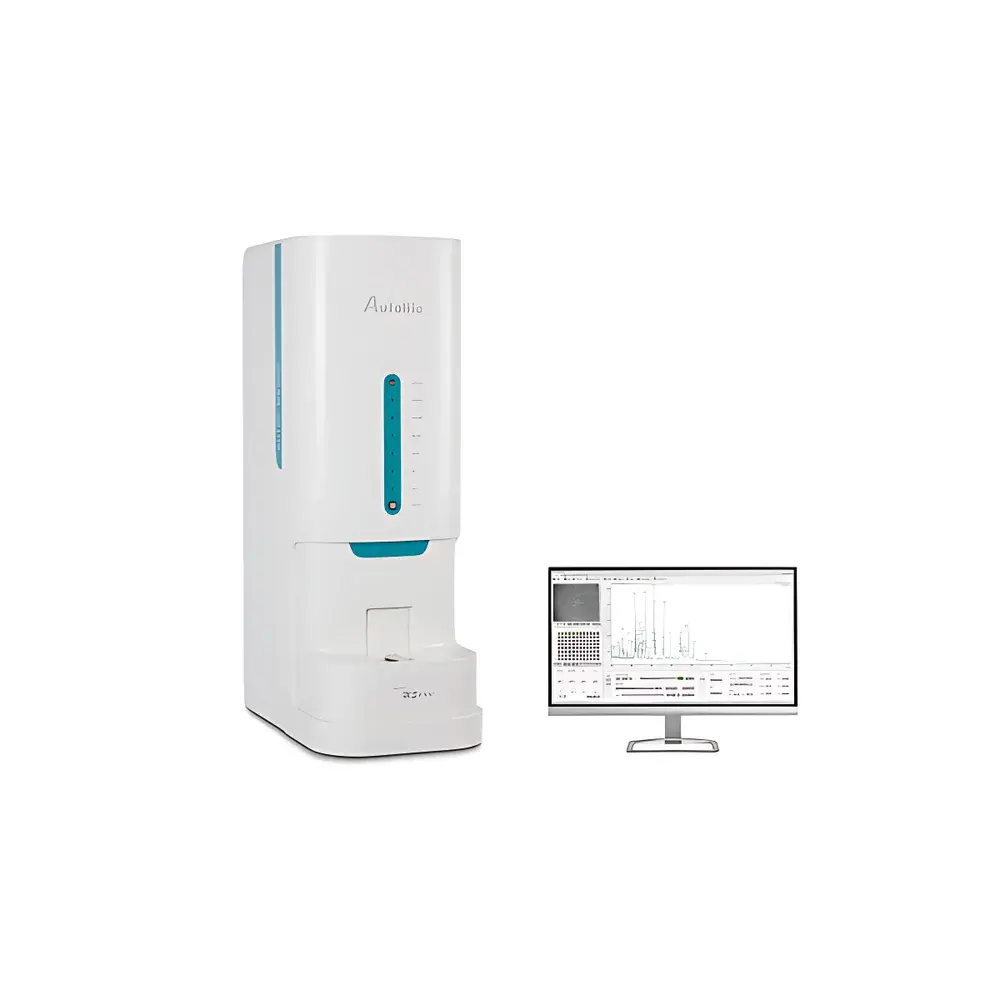
Autobio Autof ms2000 Automated Microbial Mass Spectrometry Identification System
| Brand | Autobio |
|---|---|
| Model | Autof ms2000 |
| Origin | Henan, China |
| Laser Source | Solid-state, ≥10⁹ shots lifetime, 1–1000 Hz tunable frequency |
| Ion Source Vacuum | ≤10⁻⁷ mbar |
| Ion Source Maintenance | Auto-cleaning cycle ≤10 min |
| Mass Analyzer | Titanium alloy flight tube with high thermal stability |
| Vacuum System | High-throughput turbomolecular pump |
| Signal Acquisition | High-precision FPGA-controlled real-time digitizer |
| Software Platform | AI-accelerated microbial identification engine (96 samples in <5 min) |
| Database Coverage | >1,000 genera, >5,000 species, >16,000 strains |
| Regulatory Status | CE-IVD compliant |
| Data Security | On-premise and cloud-deployable database options |
Overview
The Autobio Autof ms2000 is a fully automated matrix-assisted laser desorption/ionization time-of-flight mass spectrometry (MALDI-TOF MS) system engineered for rapid, accurate, and reproducible microbial identification in clinical microbiology, public health, food safety, and veterinary laboratories. It operates on the fundamental principle of generating characteristic peptide mass fingerprint (PMF) profiles from intact microorganisms—typically ribosomal proteins—ionized by a pulsed solid-state laser and separated according to their mass-to-charge ratio (m/z) in a linear time-of-flight analyzer. The titanium-alloy flight tube ensures minimal thermal drift during extended operation, preserving spectral fidelity across shifts and days. With vacuum maintained at ≤10⁻⁷ mbar and integrated auto-cleaning of the ion source, the system sustains consistent ion yield and signal-to-noise ratio without manual intervention or downtime. Its high-repetition-rate laser (1–1000 Hz), coupled with FPGA-based real-time stage control, enables precise, repeatable sample targeting—even across 96-well format targets—supporting both routine diagnostics and method development workflows.
Key Features
- Long-life solid-state laser with ≥10⁹ operational shots and continuously tunable pulse frequency (1–1000 Hz), enabling optimization for diverse microbial morphologies and matrix formulations.
- Innovative optical path design delivering sub-50 µm laser focus spot size, enhancing spatial resolution and minimizing cross-contamination between adjacent sample spots.
- FPGA-driven motion control system achieving ±2 µm positional accuracy for automated target navigation and reproducible laser irradiation positioning.
- Titanium-mass analyzer with passive thermal stabilization, reducing ion trajectory deviation and improving mass accuracy stability over 8-hour continuous runs.
- High-capacity turbomolecular pumping system enabling immediate acquisition upon sample introduction—no vacuum equilibration delay required.
- Integrated ion source auto-cleaning module activated via software command; full cleaning cycle completed in ≤10 minutes without disassembly or consumables.
- Onboard calibration and QC workflows using Autobio-certified reference standards, fully traceable to ISO/IEC 17025-compliant production protocols.
Sample Compatibility & Compliance
The Autof ms2000 accepts direct colony transfers from standard agar media (e.g., blood, chocolate, MacConkey), as well as processed positive blood culture broths using Autobio’s proprietary enrichment and inactivation reagents. It supports Gram-positive and Gram-negative bacteria, yeasts, molds (including filamentous fungi), mycobacteria, and anaerobes. All reagents—including extraction kits, matrix solutions, and calibrants—are manufactured under ISO 13485 quality management systems and carry NMPA Class II medical device registration. The system complies with CLSI MM19-A guidelines for MALDI-TOF MS identification and meets essential requirements of IVD Regulation (EU) 2017/746. Audit-ready electronic records—including raw spectra, processing parameters, user actions, and timestamped QC logs—support GLP and GMP environments. Data residency options ensure full compliance with regional data sovereignty mandates (e.g., China’s PIPL, EU GDPR).
Software & Data Management
The Autobio MS Suite features an intuitive, role-based interface localized in English and Chinese, with configurable access levels for analysts, supervisors, and administrators. Core algorithms employ supervised machine learning models trained on >16,000 authenticated strains, delivering species-level identification with confidence scoring aligned to CLSI thresholds. Advanced modules include: (1) Blood Culture Direct ID Module—optimized m/z range (2,000–20,000 Da) and composite scoring for polymicrobial detection; (2) Subtyping Module—leveraging strain-specific peak ratios and multivariate clustering for MRSA, carbapenem-resistant Bacteroides fragilis, Listeria monocytogenes, and Mycobacterium chimaera/intracellulare differentiation; (3) β-Lactamase Activity Assay Module—quantitative detection of hydrolyzed antibiotic fragments (e.g., ampicillin, cefotaxime, ertapenem) to infer phenotypic resistance. Local database deployment eliminates internet dependency; optional encrypted cloud sync enables multi-site library harmonization while preserving data ownership.
Applications
The Autof ms2000 serves as a primary identification platform in hospital clinical microbiology labs, CDC reference centers, food pathogen surveillance networks, and agricultural bioproduction QA/QC units. Validated use cases include: rapid turnaround identification of bloodstream isolates (<5 min/sample after colony pick); high-throughput screening of environmental Listeria isolates in food processing facilities; characterization of slow-growing mycobacteria in TB diagnostic hubs; and strain-level tracking of antimicrobial-resistant clones in outbreak investigations. Its compatibility with Autobio’s fungal extraction kits achieves >80% identification rate for dermatophytes and opportunistic molds—addressing a documented gap in conventional MALDI-TOF workflows. The system also supports research applications such as microbial community profiling, taxonomic revision studies, and biomarker discovery via spectral library expansion.
FAQ
Does the Autof ms2000 require daily instrument calibration?
No. The system performs automatic internal calibration before each batch using pre-loaded reference standards; full recalibration is recommended only after maintenance or every 30 days per CLSI MM19-A.
Can the database be updated independently of software version upgrades?
Yes. Database updates are decoupled from firmware/software releases and can be deployed locally via secure USB transfer or authenticated cloud push.
Is raw spectral data export supported in open formats?
Yes. Spectra are exportable in mzML 1.1.0 format, compatible with third-party analysis tools including OpenMS, MZmine, and Bioconductor packages.
What regulatory documentation is provided for audit readiness?
Full validation package includes IQ/OQ/PQ protocols, electronic audit trail configuration report, 21 CFR Part 11 compliance statement, and ISO 13485 certificate of conformity for all reagents and hardware components.
How is data security enforced for on-premise deployments?
All local databases operate in air-gapped mode by default; encryption-at-rest (AES-256) and role-based access control (RBAC) are enabled out-of-the-box, with optional FIPS 140-2 validated cryptographic modules.




