
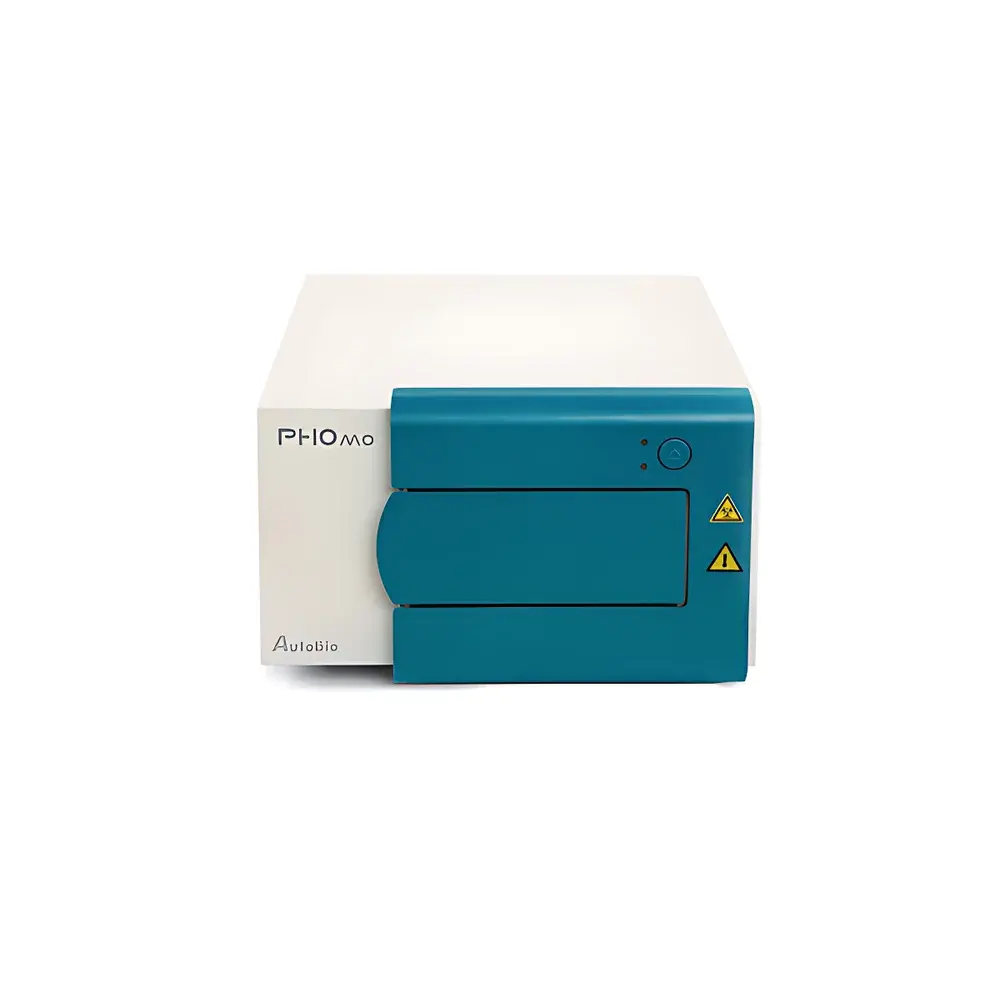
Autobio PHOMO Advanced Microplate Reader
| Brand | Autobio |
|---|---|
| Model | PHOMO |
| Origin | Henan, China |
| Instrument Type | Multifunctional Automated Microplate Reader |
| Assay Mode | Endpoint |
| Calibration Curve | Linear |
| Detector | Dual-LED Laser-Based Photodiode Array |
| Wavelength Range | 200–1000 nm |
| Absorbance Range | 0–4.5 OD |
| Absorbance Linearity | 0.000–2.000 Abs ±0.01% |
| Measurement Speed | 12 s (single wavelength), 20 s (dual wavelength), 6 s (kinetic single-wavelength) |
| Precision (CV) | <0.5% |
| Repeatability (CV) | ≤0.15% |
| Light Source | Dual-LED Cold Light Source (Lifetime ≥100,000 h) |
| Optical Architecture | RSE (Real-time Spectral Enhancement) Silicon Photodetector Platform |
| Scan Mode | Multi-point per well (up to 9 points) |
Overview
The Autobio PHOMO Advanced Microplate Reader is a CE-marked, ISO 13485–compliant automated microplate detection platform engineered for high-throughput absorbance-based assays in clinical diagnostics, pharmaceutical QC, and academic life science laboratories. It operates on the principle of spectrophotometric quantification—measuring light attenuation across 200–1000 nm wavelengths as photons pass through liquid-phase samples in standard 96- or 384-well microplates. Its core optical architecture integrates the proprietary RSE (Real-time Spectral Enhancement) silicon photodetector platform, which delivers enhanced signal-to-noise ratio and reduced spectral drift compared to conventional PMT-based systems. Unlike traditional tungsten-halogen or xenon flash sources, the PHOMO employs a dual-LED cold light source with matched emission profiles and thermal stabilization—eliminating warm-up delays, minimizing photobleaching of sensitive substrates, and ensuring >100,000 hours of stable output without lamp replacement or recalibration.
Key Features
- Dual-LED laser-coupled illumination system with spectral overlap optimization for consistent excitation across UV-Vis-NIR range (200–1000 nm)
- RSE silicon photodetector array enabling real-time baseline correction and improved dynamic range linearity (0.000–2.000 Abs ±0.01%)
- Multi-point per-well scanning (up to 9 positions) to mitigate meniscus effects and improve intra-well homogeneity assessment
- Automated endpoint assay workflow with integrated plate handling, barcode reading, and programmable incubation pause control
- Optimized kinetic measurement mode: sub-6-second single-wavelength acquisition for enzyme activity monitoring (e.g., β-galactosidase, LDH, ALP)
- CV ≤0.15% repeatability under GLP-compliant ambient conditions (22 ±2°C, 40–60% RH), validated per CLSI EP10-A3 guidelines
Sample Compatibility & Compliance
The PHOMO supports all ANSI/SBS-standard microplates—including clear, white, black, and UV-transparent polystyrene or cyclo-olefin copolymer (COC) plates—without mechanical adaptation. It is validated for use with ELISA, colorimetric enzyme assays (e.g., pNPP, TMB, ABTS), nucleic acid quantification (A260/A280), and cell viability reagents (e.g., MTT, CCK-8). The instrument meets IEC 61010-1 safety requirements and complies with electromagnetic compatibility standards EN 61326-1. Its firmware architecture supports audit trail generation, user access levels (admin/operator/visitor), and electronic signature capability—fully aligned with FDA 21 CFR Part 11 and EU Annex 11 requirements for regulated environments.
Software & Data Management
Control and analysis are executed via Autobio’s proprietary MicroPlate Manager v4.2 software, compatible with Windows 10/11 (64-bit) and supporting ODBC database export (SQL Server, MySQL). The interface enables method-driven protocol creation—including wavelength selection, reference subtraction, background correction, and linear curve fitting per plate. Raw absorbance data are stored with timestamp, operator ID, plate barcode, and environmental metadata (ambient temperature/humidity logged at start/end). All changes to analysis parameters trigger immutable audit entries; raw .mpd files retain unprocessed detector voltage traces for retrospective reprocessing.
Applications
- Clinical immunology: Quantitative IgG/IgM ELISA for infectious disease serology (HBV, HIV, SARS-CoV-2)
- Biopharmaceutical development: Host cell protein (HCP) ELISA, residual DNA quantification, and potency assay validation
- Academic research: Kinetic characterization of enzyme kinetics (Michaelis-Menten parameters), antioxidant capacity (FRAP/ORAC), and receptor-ligand binding (competitive ELISA)
- Quality control: Raw material screening (e.g., BSA purity), media component verification, and stability-indicating assays
- Toxicology: Cell cytotoxicity profiling using formazan dye reduction assays under ISO 10993-5 compliant protocols
FAQ
Does the PHOMO support wavelength scanning across its full 200–1000 nm range in a single run?
No—it uses discrete LED channels optimized for common assay wavelengths (e.g., 405, 450, 492, 620, 630, 750 nm); full-spectrum scanning requires external monochromator integration.
Is the dual-LED source calibrated traceable to NIST standards?
Yes—each production unit undergoes factory calibration against NIST-traceable neutral density filters and certified reference materials (CRM 1920a, SRM 2034), with certificate included.
Can the software generate 21 CFR Part 11–compliant reports directly?
Yes—reports include embedded digital signatures, full audit trail export (XML/CSV), and locked PDF generation with cryptographic hash verification.
What is the maximum plate format supported for kinetic measurements?
96-well plates only; 384-well kinetic mode is not implemented due to thermal uniformity constraints in high-density formats.
How often does the system require optical alignment verification?
None—solid-state LED-detector geometry is fixed at manufacture; routine verification is limited to daily photometric accuracy checks using supplied OD standards.



