
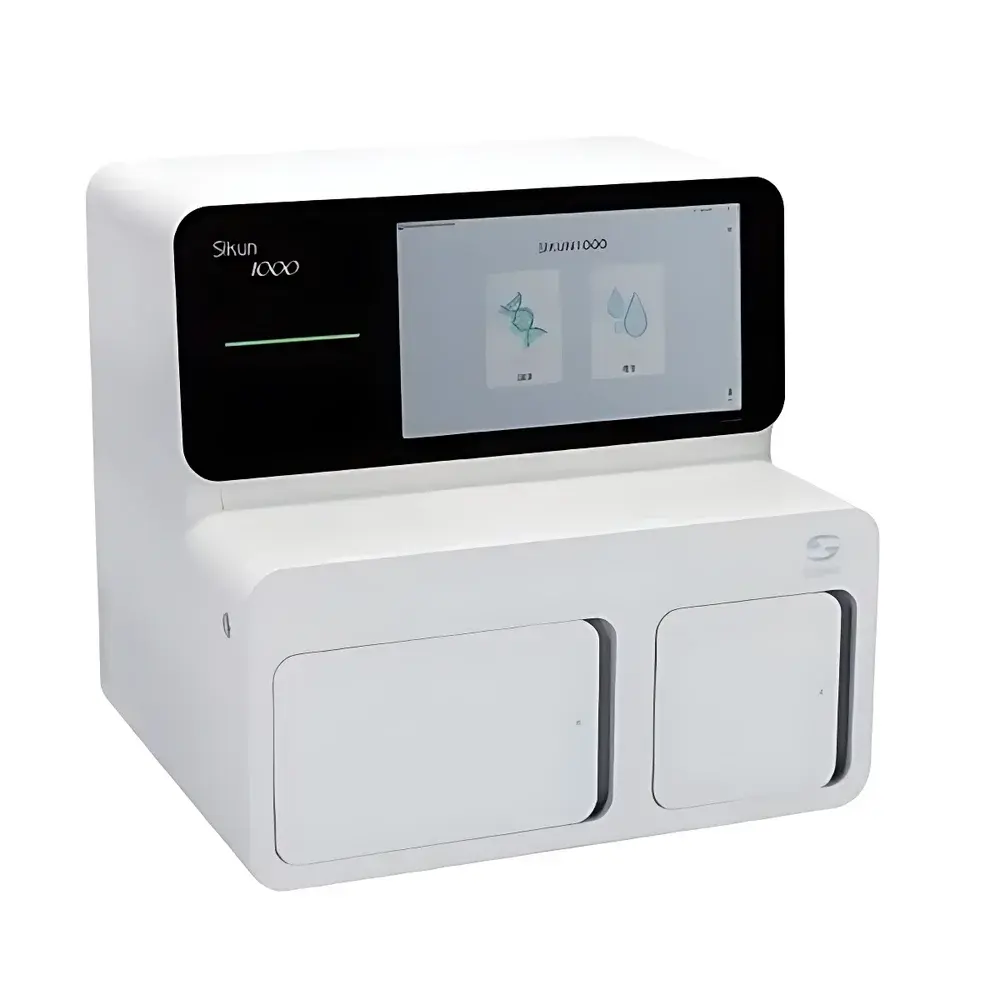
Autobio Sikun1000 Next-Generation Gene Sequencer
| Brand | Autobio |
|---|---|
| Model | Sikun1000 |
| Instrument Type | Second-Generation Sequencing Platform |
| Regulatory Status | CE-IVD & NMPA-Certified In Vitro Diagnostic Device |
| Form Factor | Benchtop Sequencer |
| Read Length | 50–300 bp |
| Throughput | 110M–330M Reads per Run |
| Data Output | 5–100 Gb per Run |
| Run Time | 3.5–24 h |
| Base Call Accuracy (Q30) | >85%–90% |
| Optical Detection Method | Fluorescence-Based Sequencing-by-Synthesis on Solid-Phase Amplified Flow Cell |
| Compliance | ISO 13485, IEC 62304, FDA 21 CFR Part 820, GLP/GMP-Aligned Data Integrity Framework |
Overview
The Autobio Sikun1000 is a CE-IVD and NMPA-certified benchtop next-generation sequencing (NGS) platform engineered for clinical and translational laboratories requiring high-fidelity, rapid-turnaround nucleic acid analysis. It employs a solid-phase clonal amplification workflow—similar to established bridge amplification principles—followed by fluorescence-based sequencing-by-synthesis (SBS) chemistry. DNA fragments are immobilized on a proprietary flow cell surface, amplified into dense clusters via isothermal amplification, and interrogated in real time using reversible terminator nucleotides labeled with spectrally distinct fluorophores. The system captures sequential optical signals across multiple imaging cycles, converting raw pixel intensity data into base calls through a validated image processing pipeline and base-calling algorithm optimized for low error propagation. Designed for reproducible performance under routine diagnostic conditions, the Sikun1000 delivers consistent Q30 scores exceeding 85–90% across diverse sample types and library preparations—meeting key analytical thresholds defined in ISO/IEC 17025 and CLIA-aligned validation protocols.
Key Features
- High-Accuracy SBS Chemistry: Engineered fluorescent nucleotides and optimized polymerase kinetics minimize phasing/pre-phasing errors, supporting >99.9% consensus accuracy in targeted panels and whole-exome applications.
- Benchtop Scalability: Two interchangeable flow cell formats—medium-throughput (110M reads) and high-throughput (330M reads)—enable flexible experimental design without hardware modification.
- Rapid Turnaround Time: Complete sequencing runs from loaded library to FASTQ output in as little as 3.5 hours, accelerating time-to-result for urgent clinical decisions including prenatal screening and oncology triage.
- Clinical-Grade Data Integrity: Built-in audit trail, electronic signatures, and role-based access control align with FDA 21 CFR Part 11 requirements for regulated environments.
- Robust Thermal & Fluidic Architecture: Precision temperature regulation (±0.1°C) and closed-loop reagent delivery ensure minimal run-to-run variability, critical for longitudinal monitoring studies.
Sample Compatibility & Compliance
The Sikun1000 accepts standard Illumina-compatible library preparations—including PCR-amplified, hybrid-capture, and amplicon-based libraries—as well as Autobio’s proprietary enrichment kits validated for reproductive genetics, oncology, and infectious disease panels. All consumables carry CE-IVD marking and comply with ISO 13485:2016 manufacturing standards. The instrument’s software and firmware are developed per IEC 62304 Class B safety requirements and support GLP/GMP-compliant workflows, including full traceability of sample metadata, reagent lot numbers, operator logs, and version-controlled analysis parameters. It meets essential requirements of the EU IVDR (Regulation (EU) 2017/746) for in vitro diagnostic devices used in human genetic testing.
Software & Data Management
The Sikun1000 operates with Autobio Sequence Analysis Suite (ASAS) v3.2—a validated, locked-down bioinformatics environment pre-installed on the onboard server. ASAS includes modules for real-time quality control (Q30 tracking, cluster density mapping, cycle-wise intensity decay), primary analysis (base calling, adapter trimming), and secondary analysis pipelines for variant calling (GATK4-compliant), CNV detection (using depth-of-coverage normalization), and HLA typing (IMGT/HLA database-integrated). Raw data export supports BAM, VCF, and FASTQ formats; all outputs are timestamped, checksummed, and stored with immutable metadata. Integration with LIMS systems is achieved via HL7 v2.5 and ASTM E1384-compliant interfaces.
Applications
- Reproductive Genetics: Non-invasive prenatal testing (NIPT), preimplantation genetic testing for aneuploidy (PGT-A) and monogenic disorders (PGT-M), copy number variation (CNV) profiling in developmental delay cohorts.
- Oncology: Tumor mutation burden (TMB) assessment, therapy-guiding hotspot panels (e.g., EGFR, BRAF, KRAS), minimal residual disease (MRD) monitoring via unique molecular identifiers (UMIs), and high-resolution HLA class I/II typing for immunotherapy eligibility.
- Infectious Disease: Metagenomic next-generation sequencing (mNGS) for unbiased pathogen detection in CSF and BAL fluid; targeted sequencing of antimicrobial resistance genes (ARGs) and virulence markers in bloodstream infections.
FAQ
Is the Sikun1000 approved for clinical diagnostic use in the United States?
No—currently cleared only for clinical use in China (NMPA Class III registration) and the European Economic Area (CE-IVD marking). U.S. regulatory submission is pending.
What library preparation kits are compatible with the Sikun1000?
Illumina TruSight, Nextera Flex, and Autobio’s proprietary SureSelect XT and OncoPanel kits—all validated under the same QC specifications referenced in ISO 20387:2018 for biobanking and diagnostics.
Does the system support dual-indexing and multiplexing?
Yes—up to 384 samples per high-throughput run using i7/i5 indexing schemes compliant with Illumina’s IDT xGen scheme.
How is data security enforced during local analysis?
All user sessions require multi-factor authentication; encrypted AES-256 storage; automatic log rotation every 90 days; and export restrictions configurable per institutional policy.
Can raw data be re-analyzed offline using third-party tools?
Yes—BCL files are accessible via secure FTP or USB 3.2 Gen 2 interface; conversion utilities for BCL-to-FASTQ are provided under a commercial redistribution license.




