
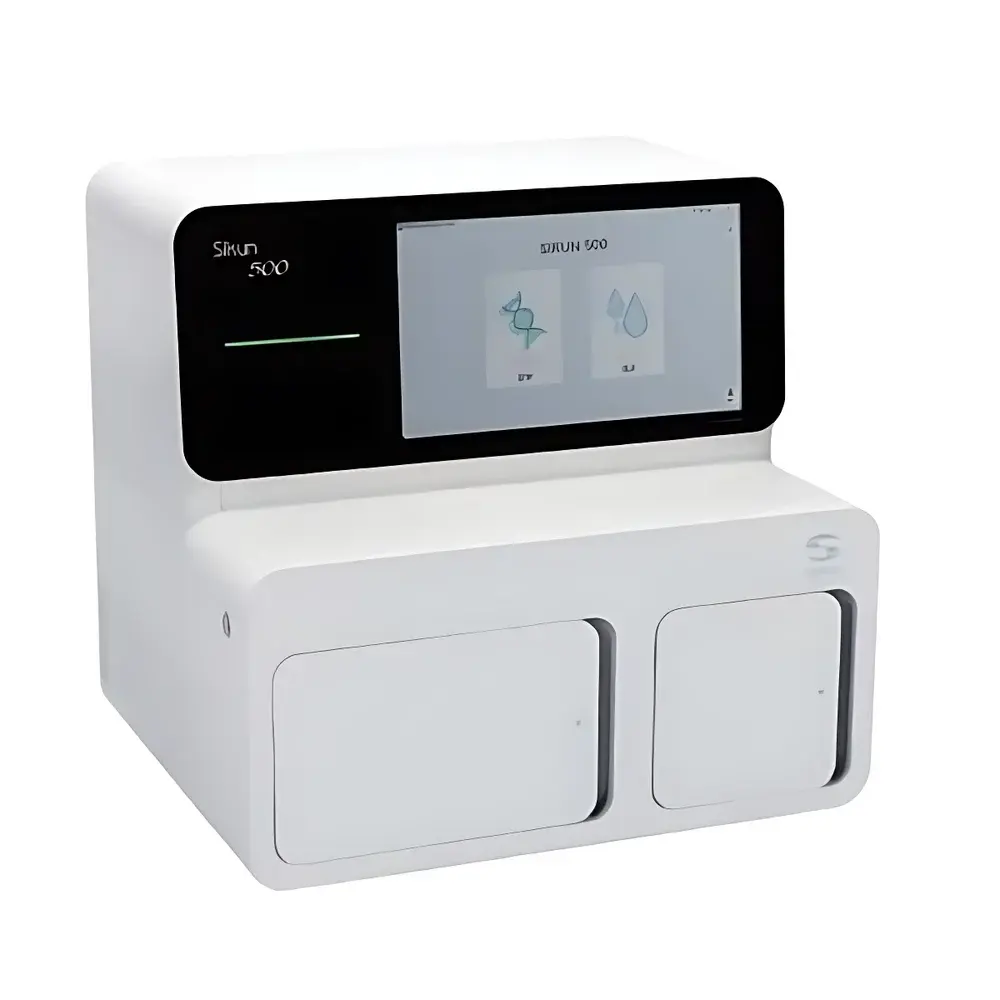
Autobio Sikun500 Next-Generation Gene Sequencer
| Brand | Autobio |
|---|---|
| Model | Sikun500 |
| Instrument Type | Second-Generation Sequencing Platform |
| Medical Device Classification | Class III (China NMPA) |
| Form Factor | Benchtop Sequencer |
| Read Length | 50–300 bp |
| Q30 Score | >85–90% |
| Sequencing Accuracy | >99.9% |
| Run Time | 3.5–24 hours |
| Throughput | 60M–170M Reads per Run |
| Data Output | 5–50 Gb per Run |
| Origin | Henan, China |
| Regulatory Status | CE-IVD compliant (pending), NMPA registered |
Overview
The Autobio Sikun500 is a benchtop next-generation sequencing (NGS) platform engineered for high-fidelity, rapid nucleic acid analysis in clinical and translational research laboratories. It employs surface-based clonal amplification (bridge PCR) coupled with reversible dye-terminator chemistry and high-resolution fluorescence imaging to enable base-by-base detection across flow cell lanes. Each sequencing cycle captures optical signals from incorporated nucleotides, which are processed through proprietary image reconstruction and base-calling algorithms optimized for low error propagation and high signal-to-noise discrimination. Designed for routine deployment in molecular diagnostics labs, the Sikun500 delivers reproducible performance under GLP-aligned operational conditions, supporting validated workflows for germline variant detection, somatic mutation profiling, and microbial identification without requiring dedicated bioinformatics infrastructure.
Key Features
- High-Accuracy Base Calling: Achieves >99.9% raw read accuracy via real-time phasing/pre-phasing correction and adaptive intensity normalization across all cycles.
- Rapid Turnaround Time: Completes full runs in as little as 3.5 hours for targeted panels (e.g., 50-bp single-read assays), enabling same-day reporting in time-sensitive clinical contexts.
- Flexible Throughput Architecture: Supports two interchangeable flow cell formats—mid-throughput (60 million reads) and high-throughput (170 million reads)—allowing scalable assay design from small gene panels to whole-exome capture libraries.
- Robust Optical Detection System: Features a cooled sCMOS sensor with sub-pixel registration and multi-wavelength excitation/emission filtering to minimize cross-talk and maximize Q30 yield (>85–90% across diverse sample types).
- Clinical-Grade Validation Framework: Pre-configured, locked firmware versions with audit-trail-enabled instrument control software compliant with ISO 13485 and aligned with FDA 21 CFR Part 11 data integrity requirements.
Sample Compatibility & Compliance
The Sikun500 accepts standard Illumina-compatible library preparations—including dual-indexed TruSeq, Nextera XT, and custom amplicon libraries—without adapter re-engineering. Input requirements range from 1–500 ng of double-stranded DNA, accommodating FFPE-derived fragments, cfDNA, and enriched microbial metagenomic libraries. All consumables (flow cells, reagent kits, indexing plates) carry NMPA registration certificates and are manufactured under ISO 13485-certified quality systems. The platform meets IEC 61010-1 safety standards and supports laboratory accreditation pathways under CAP, CLIA, and CNAS guidelines. For in vitro diagnostic use, assay-specific validation documentation (including limit-of-detection, precision, and interference studies) is provided per IVD directive Annex II requirements.
Software & Data Management
Instrument operation and primary data processing are managed through Autobio’s proprietary Sequencing Control Suite (SCS v3.2), a Windows-based application with role-based access control, electronic signature support, and embedded audit trail logging. Raw BCL files are automatically converted to FASTQ format with integrated demultiplexing; optional local alignment (BWA-MEM) and variant calling (GATK4-ready VCF export) modules are available as licensed add-ons. Data encryption at rest (AES-256) and TLS 1.3–secured remote transfer ensure compliance with HIPAA and GDPR transmission protocols. SCS integrates natively with LIMS platforms via HL7 v2.5 and RESTful API endpoints, facilitating automated result routing to EMR/EHR systems in hospital networks.
Applications
- Reproductive Genetics: Non-invasive prenatal testing (NIPT) for aneuploidy screening, preimplantation genetic testing for monogenic disorders (PGT-M), copy number variation (CNV) detection in embryos, and polygenic risk score (PRS) assessment.
- Oncology Diagnostics: Targeted tumor profiling for therapy selection (e.g., EGFR, BRAF, KRAS), minimal residual disease (MRD) monitoring via ultra-deep sequencing, HLA typing for transplant compatibility, and ctDNA-based early recurrence surveillance.
- Infectious Disease Testing: Metagenomic shotgun sequencing (mNGS) for unbiased pathogen detection in CSF and BAL fluid, targeted enrichment panels for antimicrobial resistance (AMR) gene screening, and strain-level differentiation of Mycobacterium tuberculosis or Candida auris isolates.
FAQ
Is the Sikun500 approved for clinical diagnostic use in the EU or US?
The Sikun500 holds NMPA registration for clinical use in China and carries CE-IVD marking pending final notified body assessment. It is not currently FDA-cleared for diagnostic use in the United States; however, it may be deployed in CLIA-certified labs for laboratory-developed tests (LDTs) under applicable regulatory discretion.
What bioinformatics support is included with the system?
The base package includes FASTQ generation, sample demultiplexing, and QC metrics (per-cycle Q-score distribution, cluster density, and pass-filter rate). Alignment and variant annotation require separate licensing of Autobio’s BioCloud Analysis Portal or integration with third-party pipelines via standardized BAM/VCF I/O.
Can the Sikun500 perform paired-end sequencing?
Yes—the platform supports both single-read (SR) and paired-end (PE) configurations up to 2×150 bp, with automatic run parameter switching based on selected flow cell and kit version.
How frequently must the optical system be calibrated?
Factory calibration is performed prior to shipment; field recalibration is recommended every six months or after 200 runs, using Autobio-provided reference slides and automated calibration routines within SCS.
Does the system support barcoded library pooling?
Yes—multiplexing up to 96 samples per run is supported via i7/i5 dual indexing, with built-in barcode collision detection and index hopping mitigation algorithms active during base calling.
Related Products




