
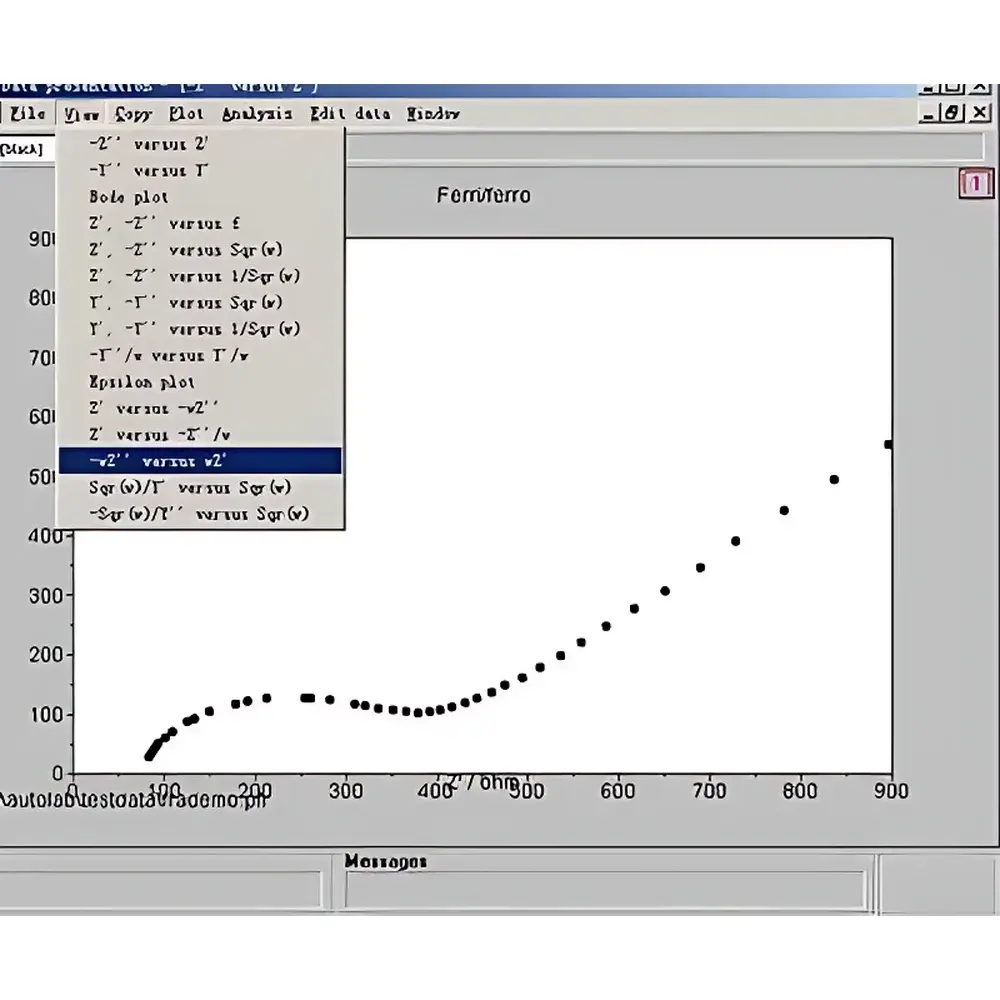
Autolab FRA Frequency Response Analysis Software for Electrochemical Impedance Spectroscopy
| Brand | Autolab |
|---|---|
| Origin | Imported (Netherlands) |
| Instrument Type | Electrochemical Impedance Spectroscopy (EIS) Control & Analysis Software |
| Frequency Range | 10 Hz – 1 MHz (single-sweep, no segmentation required) |
| Supported Measurement Modes | Potentiostatic EIS, Galvanostatic EIS, Potential Sweep EIS, Current Sweep EIS, Time-Resolved EIS |
| Data Visualization | Nyquist, Bode ( |
| Curve Fitting Engine | EQUIVCRT-based equivalent circuit modeling |
| Validation Tools | Kramers–Kronig transform consistency testing |
| Compliance | Fully compatible with Autolab PGSTAT series potentiostats/galvanostats |
Overview
The Autolab FRA Frequency Response Analysis Software is a dedicated, high-precision module designed for the acquisition, real-time processing, and advanced interpretation of electrochemical impedance spectroscopy (EIS) data. Built exclusively for integration with Autolab PGSTAT-series electrochemical workstations, FRA implements rigorous frequency-domain analysis grounded in linear system theory and small-signal perturbation principles. It enables users to characterize interfacial charge-transfer kinetics, double-layer capacitance, diffusion-controlled processes, and bulk solution resistance across a continuous frequency spectrum — from 10 Hz to 1 MHz — in a single, uninterrupted sweep. This eliminates manual segmentation, interpolation artifacts, and phase misalignment inherent in multi-range acquisitions. The software operates under controlled potentiostatic or galvanostatic conditions, ensuring compliance with fundamental assumptions of EIS linearity and stationarity. Its architecture adheres to ISO 17025-aligned data integrity protocols when deployed within validated NOVA 2.5+ environments, supporting traceable measurement chains required for R&D reproducibility and regulatory submissions.
Key Features
- Single-Sweep Broadband Acquisition: Full 10 Hz – 1 MHz frequency coverage executed in one continuous sweep, preserving phase coherence and minimizing experimental drift between segments.
- Multi-Mode Experimental Flexibility: Supports six core EIS methodologies: (1) Fixed-potential frequency scan; (2) Potential-step EIS (potential sweep with full EIS at each step); (3) Potentiostatic time-resolved EIS; (4) Fixed-current frequency scan; (5) Current-step EIS (current sweep with EIS per step); and (6) Galvanostatic time-resolved EIS — enabling dynamic process mapping under variable polarization states.
- Advanced Visualization Suite: Native rendering of Nyquist (Z″ vs. Z′), Bode magnitude/phase, Epsilon (ε′, ε″), and complex capacitance (C′, C″) plots with logarithmic scaling, adjustable axis limits, and overlay capabilities for comparative analysis.
- EQUIVCRT-Based Equivalent Circuit Modeling: Integrated circuit editor and nonlinear least-squares fitting engine using the industry-standard EQUIVCRT library — supporting Randles, transmission-line, constant-phase element (CPE), and custom topologies with parameter constraints and statistical uncertainty estimation.
- Kramers–Kronig Consistency Validation: Automated transform verification to assess data quality, detect nonlinearity, instrumental artifacts, or insufficient settling time — a critical prerequisite before physical interpretation or model fitting.
- Circle Detection Algorithm: Numerical identification of semicircular features in Nyquist plots via robust geometric fitting, facilitating rapid estimation of charge-transfer resistance (Rct) and double-layer capacitance (Cdl) without prior model assumptions.
Sample Compatibility & Compliance
FRA is engineered exclusively for use with Autolab PGSTAT-series bipotentiostats (e.g., PGSTAT302N, PGSTAT128N, and M200 modular systems). It supports all standard three-electrode configurations (working, counter, reference) and accommodates common electrochemical cells including corrosion coupons, rotating disk electrodes (RDE), microelectrodes, and solid-state battery half-cells. Data files (.mpl) are structured in ASCII-based hierarchical format compliant with ASTM E2911-21 (Standard Guide for Electrochemical Impedance Spectroscopy Data Reporting) and support metadata embedding (timestamp, instrument ID, operator, temperature, electrolyte composition). When operated under NOVA 2.5+ with enabled audit trail and electronic signature modules, FRA workflows satisfy FDA 21 CFR Part 11 requirements for electronic records and signatures in GxP-regulated laboratories.
Software & Data Management
FRA operates as a native module within the NOVA software platform (v2.5 or later), leveraging its unified instrument control layer, real-time data streaming architecture, and project-based file management. All raw and processed datasets are stored with full provenance: acquisition parameters, hardware calibration logs, user annotations, and version-stamped fit reports. Export options include CSV (for MATLAB/Python post-processing), SVG/PNG (publication-ready figures), and .mpt (Gamry-compatible binary for cross-platform validation). Batch processing scripts can be generated via NOVA’s built-in macro language to automate repetitive EIS analyses across sample sets, supporting high-throughput screening in battery material development or corrosion inhibitor evaluation.
Applications
- Characterization of electrode/electrolyte interfaces in Li-ion, Na-ion, and solid-state batteries
- Corrosion rate quantification and coating degradation monitoring on metallic substrates
- Electrocatalyst activity assessment via charge-transfer resistance and double-layer capacitance mapping
- Conductivity and ion transport analysis in polymer electrolytes and ionic liquids
- Biological interface studies including enzyme-modified electrodes and biosensor stability profiling
- Quality control of electroplating baths and passivation layers in semiconductor manufacturing
FAQ
Is FRA compatible with non-Autolab potentiostats?
No. FRA is a proprietary software module licensed exclusively for use with Autolab PGSTAT-series instruments. It does not support third-party hardware drivers or generic USB/GPIB communication protocols.
Does FRA support automated temperature compensation during EIS sweeps?
FRA itself does not acquire temperature data; however, when connected to an Autolab temperature controller (e.g., TCU100) via NOVA, real-time temperature metadata is logged and can be correlated with impedance spectra in post-analysis.
Can FRA perform distributed element modeling (e.g., transmission lines) for porous electrodes?
Yes. The EQUIVCRT engine includes predefined transmission-line elements (TL and TL0) and allows user-defined differential equations for finite-length diffusion or pore resistance-capacitance networks.
What file formats can FRA import for comparative fitting?
FRA natively imports .mpl (Autolab), .z (Solartron), and .csv (comma-separated complex impedance values) — provided column headers follow ISO-defined conventions (f, Z’, Z”).
Is Kramers–Kronig validation performed automatically or on-demand?
By default, K–K consistency checks are executed after every EIS acquisition. Results are reported as deviation metrics (real/imaginary residuals) and flagged if RMS error exceeds 2% — configurable threshold in NOVA’s advanced settings.




