
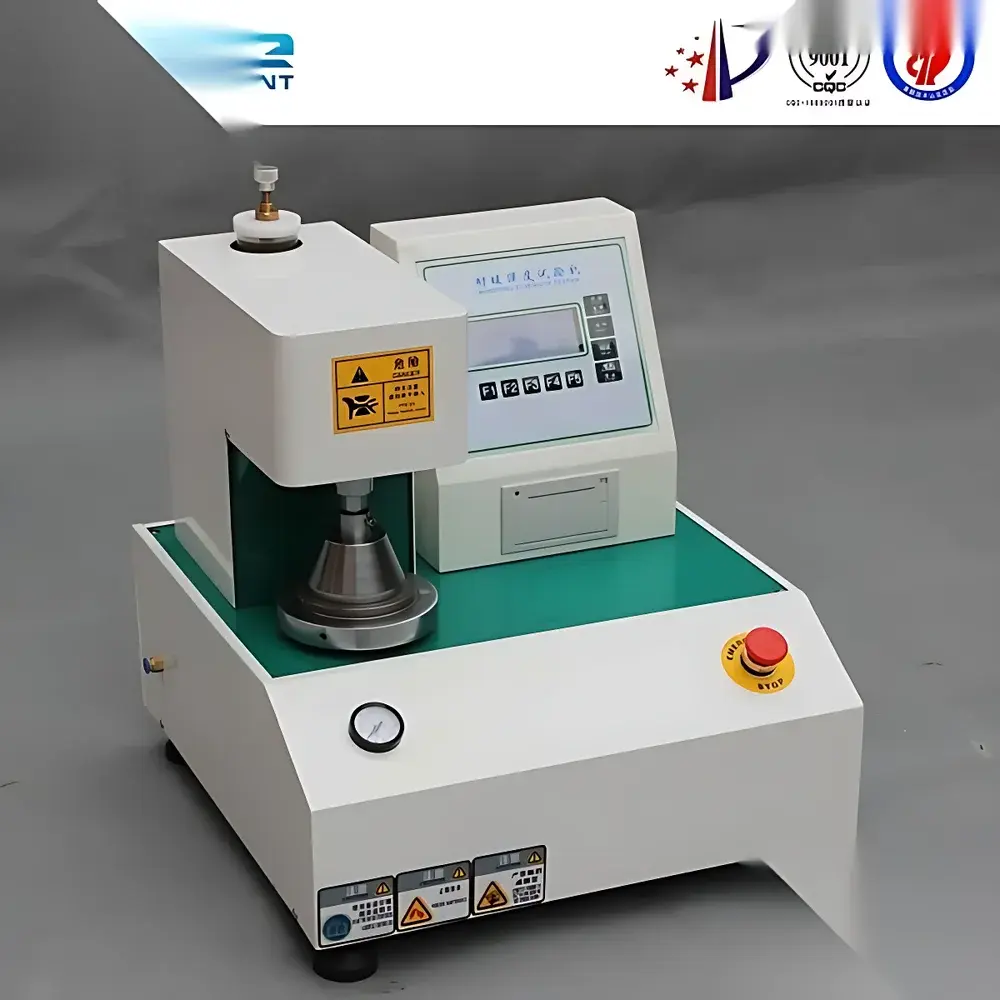
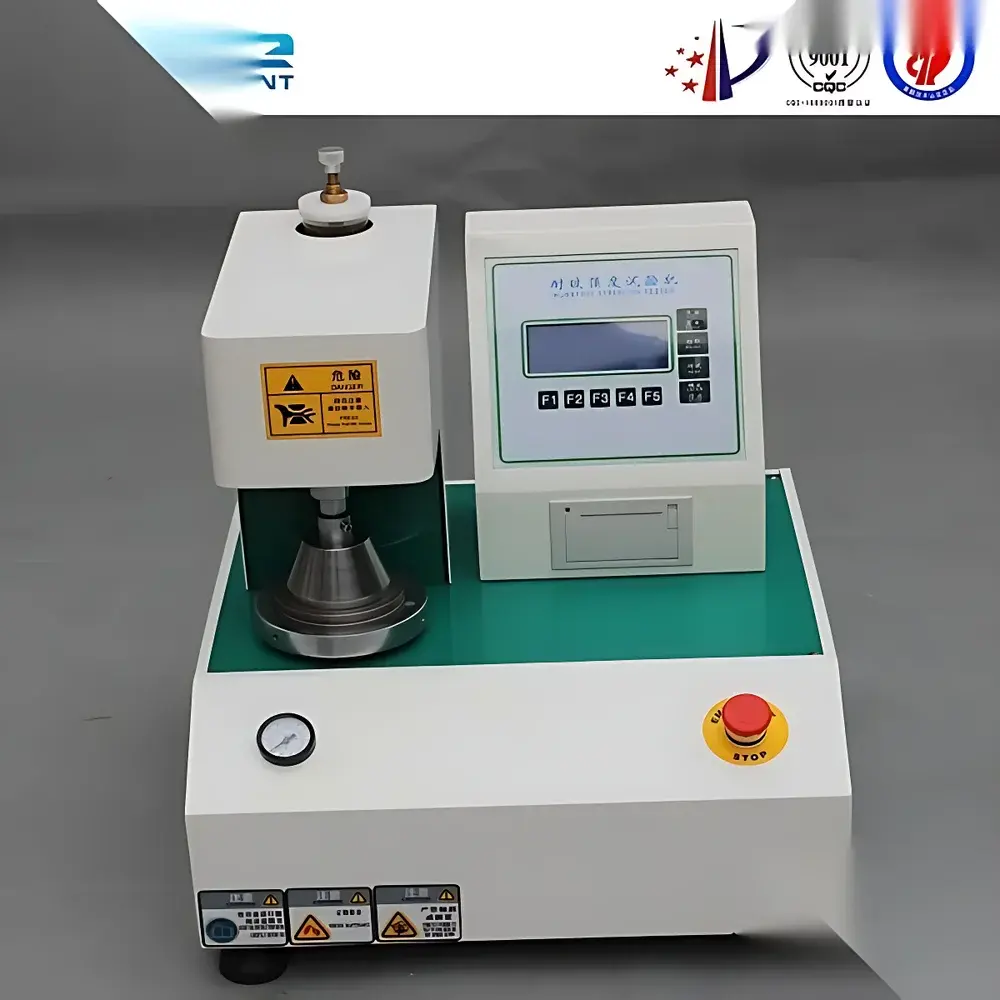
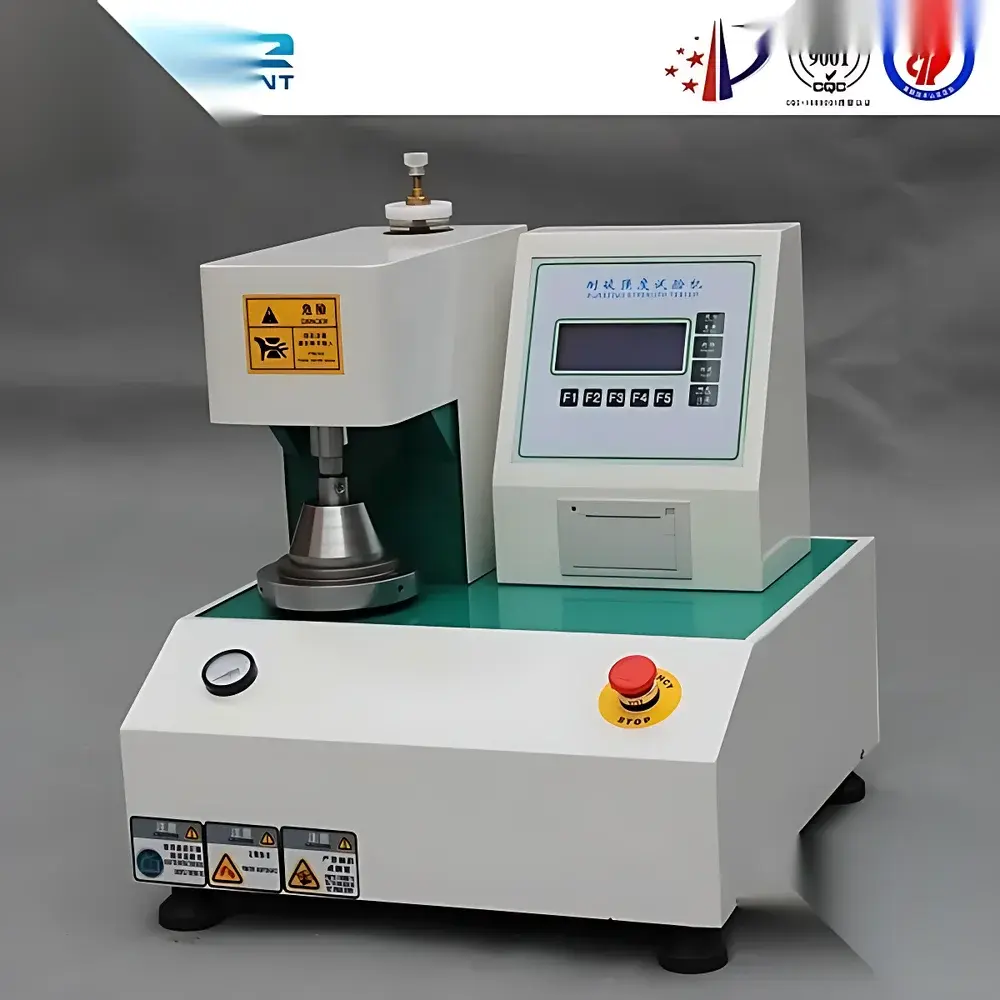
Automatic Bursting Strength Tester
| Brand | OEM |
|---|---|
| Origin | Imported |
| Manufacturer Type | Authorized Distributor |
| Price | USD 630 (FOB) |
| Standards Compliance | ISO 2759, ASTM D2210, TAPPI T403, GB/T 6545, JIS L1004/L1018/L1031, QB/T 1057 |
| Drive System | Taiwan-made AC frequency-controlled motor |
| Load Cell | U.S.-sourced explosion-proof precision load cell (±0.5% FS) |
| Actuation | Precision ball screw vertical drive |
| Pressure Medium | High-stability silicone oil (replaces glycerin-water mixture) |
| Clamping | Pneumatic sample holder with calibrated pressure gauge |
| Display & Control | Backlit LCD interface with embedded microcontroller |
| Data Storage | 50-test non-volatile memory |
| Output | Integrated thermal printer |
| Safety | Emergency stop switch, automatic return-to-home post-failure |
| Test Modes | Burst strength, constant-load hold (stack compression simulation) |
Overview
The Automatic Bursting Strength Tester is a dedicated physical property testing instrument engineered for the quantitative determination of bursting resistance in corrugated fiberboard, solid fiberboard, paperboard, synthetic leather, woven and nonwoven textiles, and other planar sheet materials. It operates on the fundamental principle of applying uniformly increasing hydraulic (silicone oil-based) pressure perpendicular to a clamped circular test area until specimen rupture occurs. The peak pressure at failure—expressed in kilopascals (kPa) or pounds per square inch (psi)—is recorded as the bursting strength. This measurement directly correlates with a package’s ability to withstand external compressive loads during storage, transport, and stacking, making it indispensable for packaging engineering, quality control laboratories, and regulatory compliance workflows across consumer goods, electronics, furniture, footwear, and food industries.
Key Features
- Full automation with single-button test initiation and auto-return-to-zero positioning post-rupture—eliminating manual reset and operator variability.
- Pneumatic sample clamping system with real-time analog pressure gauge ensures consistent, repeatable clamping force across all test cycles (compliant with ISO 2759 Section 6.2).
- Taiwan-sourced AC frequency-controlled motor coupled with high-precision ball screw actuation delivers smooth, vibration-free vertical displacement and sub-millimeter positional repeatability.
- U.S.-manufactured explosion-proof load cell (rated ±0.5% full scale) guarantees long-term stability and traceable force measurement integrity under cyclic loading conditions.
- Silicone oil hydraulic medium replaces traditional glycerin–water mixtures—preventing oxidation, corrosion, and viscosity drift over time, thereby extending service life and reducing maintenance intervals.
- Integrated thermal printer provides immediate hardcopy output of burst value, date/time stamp, test sequence ID, and pass/fail status per ASTM D2210 Annex A1 requirements.
- Embedded microcontroller with backlit LCD interface supports intuitive navigation, parameter configuration (e.g., dwell time, clamp pressure), and real-time pressure curve visualization.
- Emergency stop circuit interrupts power to all actuators and solenoids within <100 ms—meeting IEC 60204-1 machinery safety standards.
Sample Compatibility & Compliance
The tester accommodates standard circular specimens (100 mm diameter per ISO 2759 and GB/T 6545) cut from flat sheets up to 10 mm thickness. Compatible substrates include single- and multi-wall corrugated board, chipboard, kraft linerboard, coated paperboard, PU- and PVC-based synthetic leathers, canvas, denim, and technical textiles. All mechanical and software functions comply with mandatory clauses of ISO 2759:2021, ASTM D2210–22, TAPPI T403 om–23, and GB/T 6545–2008. Calibration traceability aligns with ISO/IEC 17025 requirements when performed using NIST-traceable deadweight standards. The device supports GLP-compliant audit trails when paired with optional PC-based data logging software (sold separately).
Software & Data Management
Onboard firmware stores up to 50 complete test records—including burst pressure (kPa), time-to-failure (s), peak load (N), and operator ID—in non-volatile memory with timestamp and sequential indexing. Data export is enabled via RS-232 serial interface to external PCs running Windows-compatible spreadsheet or LIMS applications. Optional software modules provide statistical process control (SPC) charting (X̄–R charts), batch reporting (per ISO 2859-1 sampling plans), and automated generation of PDF test certificates compliant with ISO 17025 clause 7.8.2. All digital records maintain immutable timestamps and user authentication logs—supporting FDA 21 CFR Part 11 readiness when configured with electronic signature protocols.
Applications
This instrument serves critical roles in packaging R&D labs evaluating board grade substitutions, QC departments validating incoming raw material specifications (e.g., linerboard tensile vs. burst correlation), and logistics teams simulating warehouse stacking profiles via controlled hold-pressure tests. It is routinely deployed by third-party certification bodies conducting ISTA 3A/3E validation, by food manufacturers verifying shelf-ready packaging integrity per SQF Code Edition 9.2 Section 5.3.2, and by footwear exporters demonstrating compliance with EU Packaging Directive 94/62/EC mechanical performance thresholds. Its robust architecture enables continuous operation in ISO 17025-accredited testing facilities performing >200 tests/day.
FAQ
What standards does this tester fully support out-of-the-box?
ISO 2759, ASTM D2210, TAPPI T403, GB/T 6545, JIS L1004/L1018/L1031, and QB/T 1057—all verified during factory calibration with certified reference materials.
Can it perform sustained-load compression tests mimicking pallet stacking?
Yes. The programmable hold mode maintains user-defined pressure for up to 999 seconds, enabling empirical evaluation of creep deformation and collapse onset per ASTM D642 Annex A3.
Is calibration documentation provided with shipment?
Each unit ships with a factory calibration certificate traceable to NIST standards, including as-found/as-left data, uncertainty budget, and technician signature.
What maintenance is required for long-term accuracy?
Annual verification of load cell linearity and silicone oil viscosity (at 23 °C per ISO 3104) is recommended; no routine recalibration is needed between verifications if operated within specified environmental limits (20–25 °C, 40–60% RH).
Does the thermal printer support barcode label generation?
No—the integrated printer outputs alphanumeric test reports only; barcode functionality requires connection to external label printers via RS-232 or USB host interface (optional accessory kit).



