
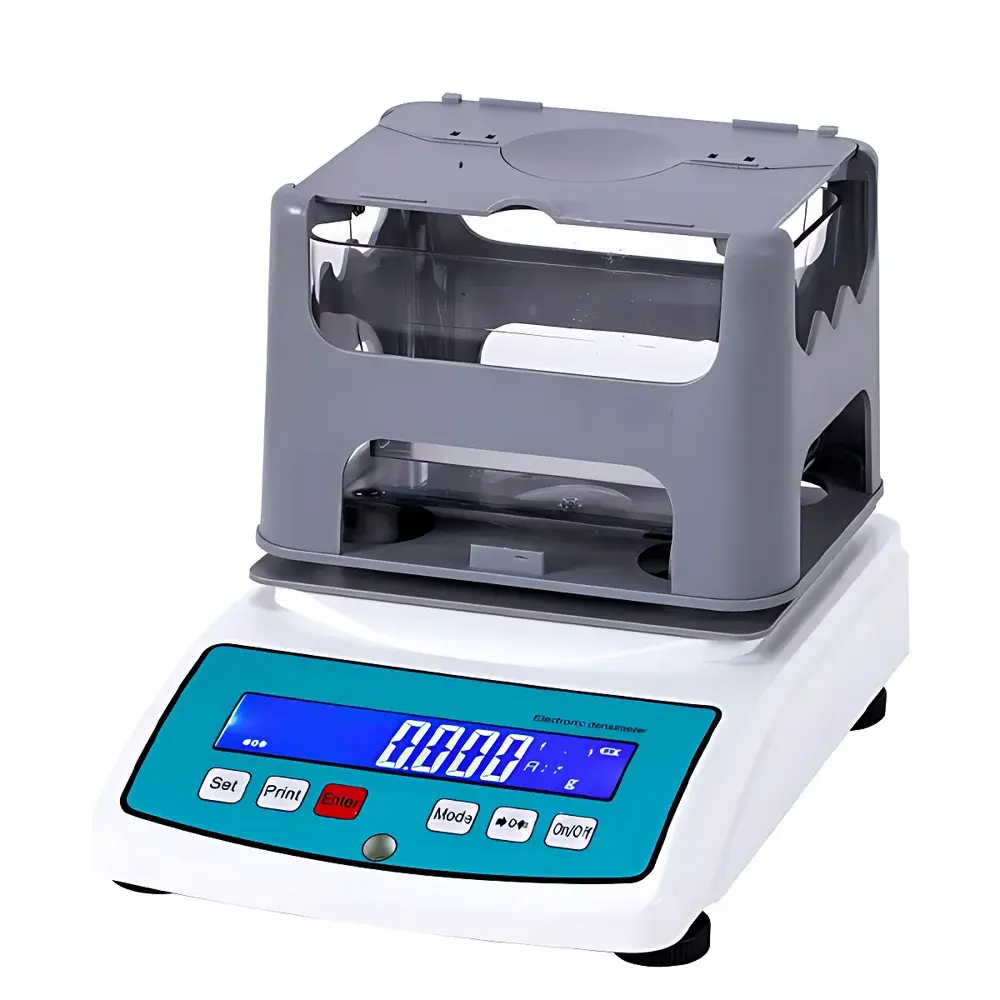
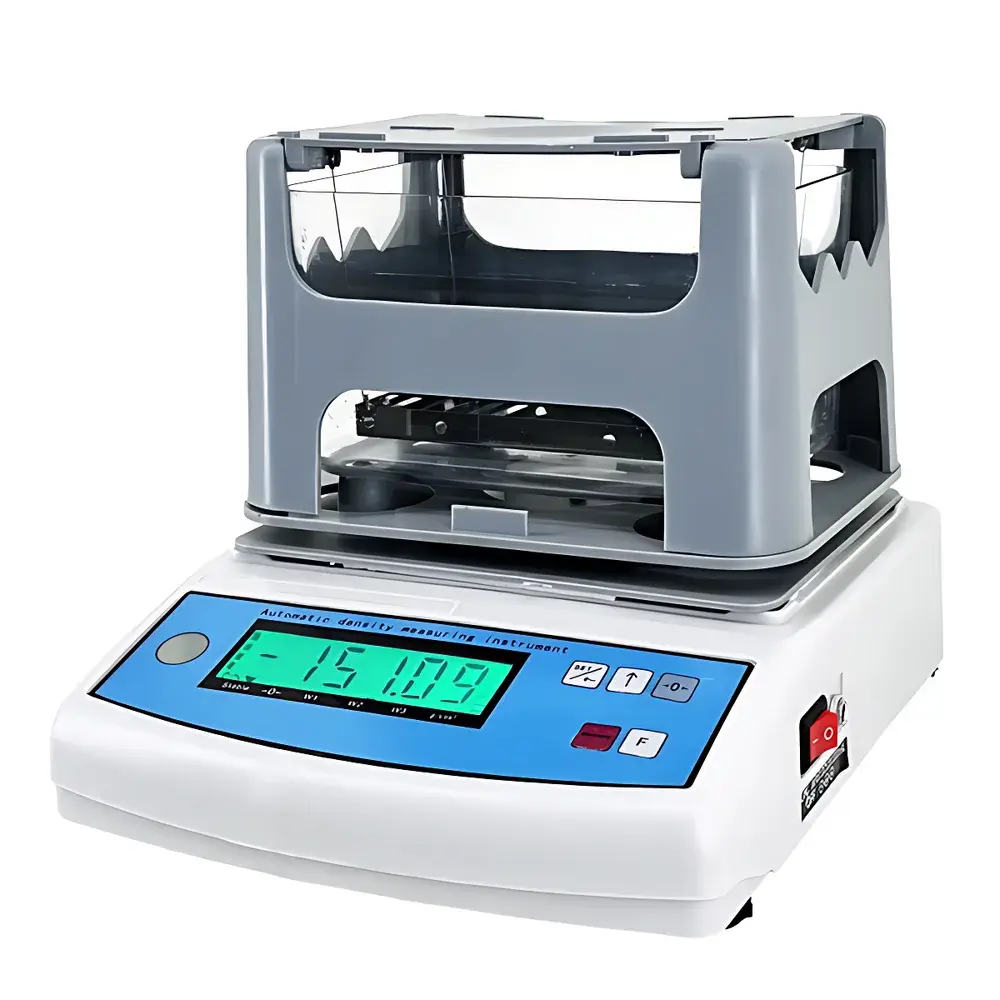
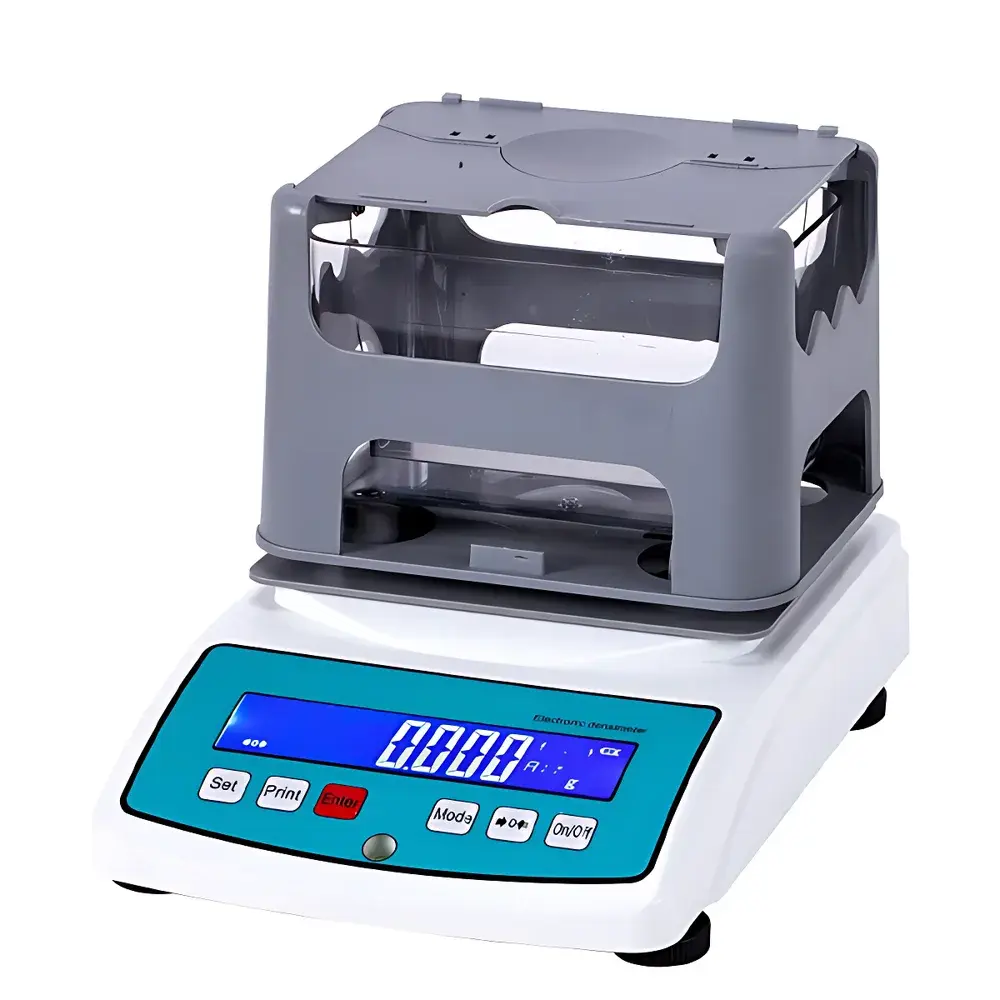
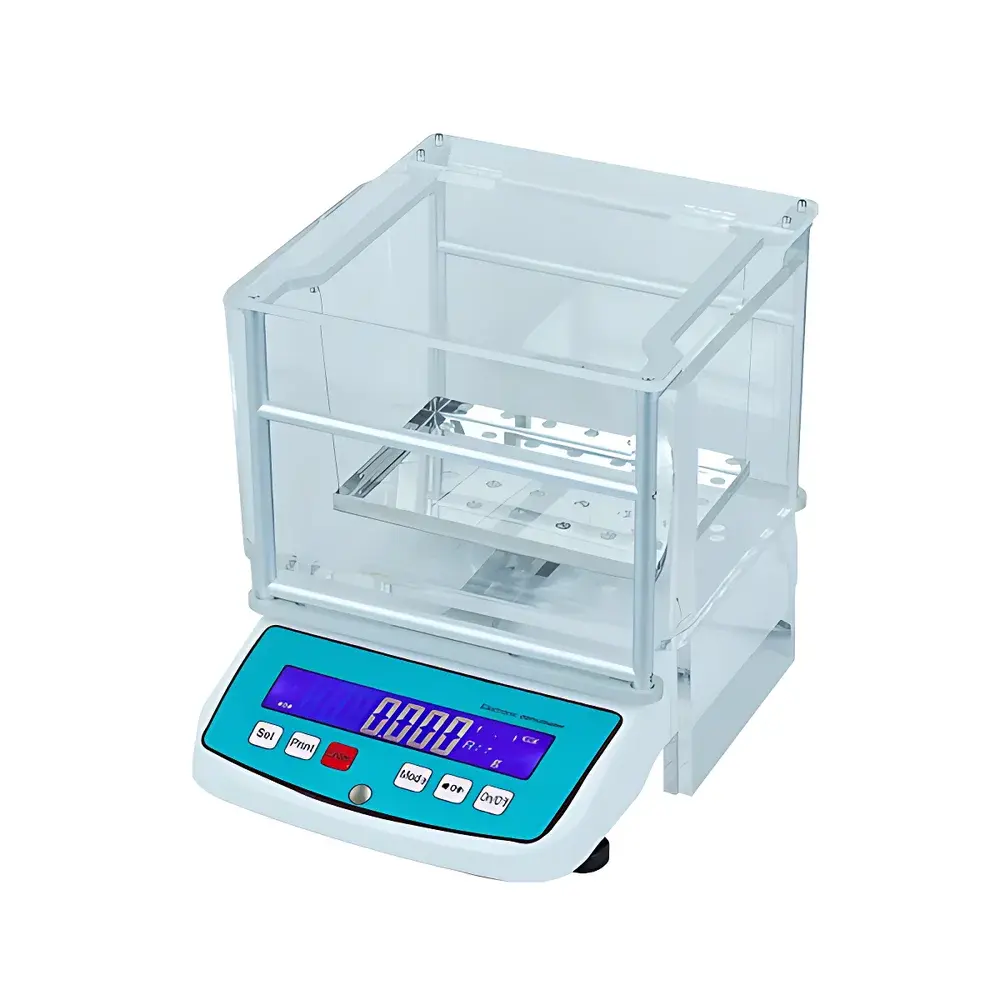
Automatic Solid Density Analyzer SDW-300S / SDW-600W / SDW-120F
| Brand | — |
|---|---|
| Origin | Beijing, China |
| Manufacturer Type | Authorized Distributor |
| Product Origin | Domestic (China) |
| Model | SDW-300S / SDW-600W / SDW-120F |
| Price | Upon Request |
| Weighing Accuracy | 0.01 g / 0.005 g / 0.005 g / 0.001 g |
| Max Capacity | 300 g / 300 g / 600 g / 120 g |
| Density Resolution | 0.001 g/cm³ / 0.001 g/cm³ / 0.001 g/cm³ / 0.0001 g/cm³ |
| Measurement Principle | Archimedean buoyancy method (hydrostatic weighing) |
| Sample Types | Solids, granules, foams, floating materials, porous bodies, thin films, and water-absorbing specimens |
| Measurement Time | ~10 seconds |
| Interface | RS-232 serial output |
| Compliance Standards | ASTM D792, ASTM D297, ISO 1183, ISO 2781, GB/T 1033, GB/T 2951, GB/T 3850, GB/T 533, JIS K6268, HG4-1468 |
Overview
The Automatic Solid Density Analyzer SDW-300S / SDW-600W / SDW-120F is a precision laboratory instrument engineered for rapid, non-destructive density determination of solid materials using the Archimedean principle of hydrostatic weighing. Unlike gravimetric moisture analyzers or infrared-based systems—despite its classification under moisture analysis instrumentation in certain regional catalogs—this device operates exclusively on buoyancy displacement methodology. It measures the mass difference of a sample in air versus immersion in a calibrated reference fluid (e.g., distilled water, ethanol, or silicone oil), enabling direct calculation of true density (g/cm³) without empirical calibration curves. Each unit integrates high-stability load cells sourced from HBM (Germany), factory-compensated for thermal drift and humidity-induced sensor offset. The system supports both non-porous and water-absorbing materials through programmable immersion time delay and surface-tension correction protocols, ensuring compliance with internationally recognized test standards including ASTM D792 (for plastics), ASTM D297 (rubber), ISO 1183 (general solids), and GB/T 1033 (Chinese national standard for plastics and rubber).
Key Features
- High-resolution density measurement down to 0.0001 g/cm³ (SDW-120F model), with weighing accuracy ranging from 0.001 g to 0.01 g across variants.
- Integrated large-volume one-piece acrylic fluid chamber designed for unrestricted placement of irregularly shaped samples—including foam blocks, wire segments, ceramic tiles, and metallic components up to 600 g.
- Dual-mode operation: automatic sequential weighing in air and liquid phase; manual override available for custom immersion protocols.
- Multi-fluid compatibility: configurable fluid density input allows use of water, alcohol, silicone oil, or other low-volatility liquids as immersion media—critical for low-density polymers (ρ < 1.0 g/cm³) or hydrophobic surfaces.
- RS-232 serial interface compliant with standard laboratory data acquisition frameworks; supports ASCII-formatted real-time output of mass, volume, and density values for traceable recordkeeping.
- Pre-installed compensation algorithms for temperature-dependent fluid density variation and surface tension effects—minimizing operator-induced error in routine QC workflows.
- No moving mechanical parts beyond the weighing pan and lift mechanism; robust architecture suitable for continuous operation in ISO/IEC 17025-accredited testing labs.
Sample Compatibility & Compliance
This analyzer accommodates diverse physical forms: solid blocks, granular powders (with optional powder kit), open-cell foams, floating specimens (via sinker-assisted measurement), thin films, and hygroscopic materials requiring pre-conditioning. It meets metrological requirements for density verification in quality control environments governed by GLP and GMP practices. Test procedures align with ASTM D792 (Standard Test Methods for Density and Specific Gravity of Plastics by Displacement), ISO 2781 (Rubber—Determination of Density), and JIS K6268 (Japanese Industrial Standard for rubber density). All models support audit-ready documentation when paired with compliant data logging software—enabling full traceability per FDA 21 CFR Part 11 where electronic records are subject to regulatory review.
Software & Data Management
While the base instrument operates via embedded firmware with front-panel LCD navigation, optional PC connectivity enables advanced data handling. Through standard RS-232 communication, users may export timestamped measurement logs—including sample ID, ambient temperature, fluid density, air mass, immersed mass, calculated volume, and final density—to CSV or Excel-compatible formats. Third-party lab information management systems (LIMS) can ingest these outputs directly via serial-to-TCP gateways. Optional printer integration supports immediate hardcopy generation of test reports containing operator ID, calibration status, and pass/fail flags against user-defined specification limits. Firmware updates maintain backward compatibility and extend support for emerging industry standards such as ISO/IEC 17025:2017 clause 7.7 on measurement uncertainty estimation.
Applications
- Quality assurance of polymer compounds (PVC, PE, PP, EVA) in extrusion and injection molding facilities.
- Density grading of sintered metal parts in powder metallurgy production lines.
- Porosity assessment of technical ceramics and refractory materials used in aerospace and energy sectors.
- Verification of alloy composition consistency in scrap metal recycling and foundry operations.
- R&D characterization of buoyancy-critical composites, including syntactic foams and lightweight structural panels.
- Teaching laboratories conducting fundamental physics experiments on buoyancy, specific gravity, and material phase behavior.
FAQ
Does this instrument measure moisture content?
No. Despite categorization within moisture analyzer listings in some regional directories, the SDW series performs only density and specific gravity measurements via hydrostatic displacement—not loss-on-drying or infrared absorption. Moisture analysis requires separate instrumentation.
Can it measure liquids or powders?
Yes—with optional accessories: a liquid density kit (including pycnometer and thermometer) and a powder density kit (featuring funnel assembly and consolidation plate) enable compliant execution of ASTM D1475 (liquid density) and ASTM D6342 (powder apparent density).
Is calibration traceable to national standards?
Yes. Each unit ships with a certificate of conformance referencing internal calibration against NIST-traceable weights (class M2 or better); external recalibration services are available through authorized service centers adhering to ISO/IEC 17025 requirements.
What environmental conditions affect measurement accuracy?
Ambient temperature fluctuations exceeding ±2°C during measurement may impact fluid density stability; recommended operating range is 15–30°C with relative humidity below 80% non-condensing. Air currents and vibration must be minimized per ISO 2781 Annex A guidelines.
How is sample surface moisture handled for water-absorbing materials?
The instrument supports delayed immersion timing and surface-drying protocols prior to air weighing; optional vacuum desiccation chamber integration further enhances repeatability for porous ceramics or wood-based composites.





