
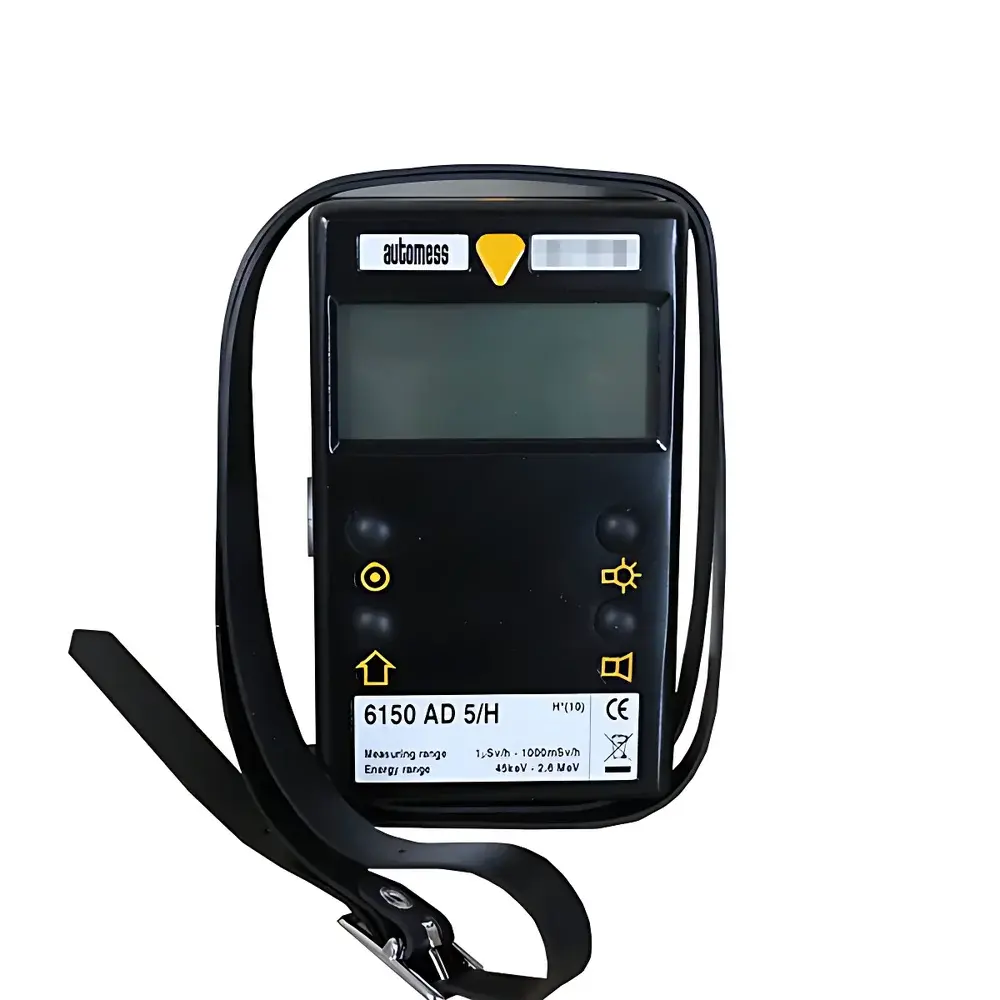
AUTOMESS 6150AD-5 Photon Dose Rate Meter
| Brand | AUTOMESS |
|---|---|
| Origin | Germany |
| Model | 6150AD-5 |
| Detection Principle | Ionization Chamber / GM Tube (Internal) + External Probe Compatibility |
| Energy Range | 45 keV – 3 MeV (γ/X-rays) |
| Dose Rate Range (Digital) | 0.1 µSv/h – 999 mSv/h |
| Dose Rate Range (Analog) | 1 µSv/h – 1000 mSv/h |
| Power Supply | IEC 6LR61 9 V battery |
| Certification | PTB-certified (Physikalisch-Technische Bundesanstalt, Germany) |
| Interface | RS232 serial port |
| Max. External Cable Length | 100 m (probe-dependent) |
| Alarm Functions | Programmable dose & dose rate thresholds |
| Data Storage | Non-volatile memory for accumulated dose |
| Auto-probe Recognition | Yes (e.g., “ext 17” display upon connection) |
Overview
The AUTOMESS 6150AD-5 is a high-performance, PTB-certified portable photon dose rate meter engineered for precise, real-time measurement of ambient gamma and X-ray radiation fields in professional radiological environments. Designed around a dual-mode detection architecture—featuring an integrated Geiger-Müller (GM) tube for general-purpose surveying and full compatibility with a wide range of external probes—the instrument delivers traceable, reproducible dose rate data across five decades of dynamic range. Its core measurement principle relies on ionization or pulse counting depending on the connected probe type, with energy response calibrated to meet IEC 60846 and DIN 6818 standards for photon dosimetry. The 6150AD-5 operates within an energy range of 45 keV to 3 MeV, making it suitable for applications involving medical radionuclides (e.g., 99mTc, 131I), industrial radiography sources (192Ir, 60Co), and environmental monitoring where accurate photon field characterization is required under varying spectral conditions.
Key Features
- Integrated GM detector with analog needle display and high-resolution digital readout (0.1 µSv/h resolution)
- Automatic external probe recognition—displays probe ID (e.g., “ext 17”) and dynamically loads appropriate calibration coefficients and unit scaling
- Dual independent alarm systems: user-programmable dose rate and accumulated dose thresholds with visual/audible alerts
- Real-time statistical metrics: simultaneous display of current value, running average, maximum value, and relative standard deviation (RSD)
- Auto-ranging circuitry ensures seamless transition between measurement scales without manual intervention
- Non-volatile memory stores accumulated dose history even after power-off; data retention exceeds 10 years
- RS232 serial interface compliant with EIA/TIA-232 specifications for direct PC connectivity and long-term trend analysis
- PTB-type approval confirms compliance with German national metrological requirements for radiation protection instrumentation
Sample Compatibility & Compliance
The 6150AD-5 supports over ten interchangeable external probes—including α/β/γ contamination monitors (6150AD-17), high-range gamma detectors (6150AD-15), low-background scintillation probes (6150AD-b), and extendable pole-mounted configurations (6150AD-t)—each providing application-specific sensitivity and energy response. All probes are powered directly by the main unit via standardized coaxial connectors, eliminating need for auxiliary batteries. The system complies with key international regulatory frameworks: ISO 4037 (X/gamma reference radiation fields), IEC 60846-1:2014 (performance requirements for installed radiation monitors), and EU Directive 2013/59/Euratom (basic safety standards for protection against ionizing radiation). For GLP/GMP-regulated laboratories, optional firmware enables audit-trail logging and user-access control compatible with FDA 21 CFR Part 11 requirements when paired with validated data acquisition software.
Software & Data Management
Raw measurement data—including time-stamped dose rate values, accumulated dose logs, probe identification codes, and alarm event timestamps—are transmitted via RS232 to host PCs running AUTOMESS’s proprietary WinDose software or third-party SCADA/HMI platforms supporting Modbus RTU protocol. WinDose provides graphical trending, report generation (PDF/CSV), and batch export for integration into LIMS or radiation safety management systems. All stored data include metadata such as probe serial number, calibration date, and operator ID—ensuring full traceability per ISO/IEC 17025:2017 clause 7.7. Firmware updates are delivered through secure USB-to-serial adapters and validated using SHA-256 checksums to maintain integrity in regulated settings.
Applications
- Radiation safety surveys in nuclear medicine departments, radiotherapy bunkers, and PET cyclotron facilities
- In-process monitoring during radiopharmaceutical synthesis and quality control testing
- Environmental surveillance around NORM/TENORM sites and decommissioning projects
- Border control and customs inspection for illicit radioactive materials
- Emergency response deployment by civil protection agencies and first responders
- Research reactor perimeter monitoring and neutron-gamma discrimination (when used with moderated probes)
- Decommissioning and waste characterization in legacy nuclear facilities
FAQ
Is the 6150AD-5 certified for use in legally regulated radiation protection programs?
Yes—it carries official PTB type approval (Z17.01.01.01-0001), fulfilling metrological requirements for personal and area dosimetry in Germany and recognized under mutual recognition agreements across EU member states.
Can the device store historical dose data without external power?
Yes—non-volatile EEPROM retains accumulated dose, alarm events, and configuration parameters for ≥10 years without battery backup.
What is the maximum cable length supported for external probes?
Up to 100 meters, depending on probe model and signal attenuation characteristics; standard options include 1.25 m, 3 m, 10 m, 20 m, 75 m, and 100 m shielded coaxial cables.
Does the instrument support dose rate averaging over configurable time windows?
Yes—users may select averaging intervals from 1 second to 60 minutes via menu-driven configuration, with real-time display of mean and standard deviation.
Are calibration certificates provided with each probe?
Each probe ships with a factory calibration certificate traceable to PTB primary standards, including energy-dependent response factors and uncertainty budgets at reference energies (e.g., 60 keV, 137 Cs, 60 Co).







