
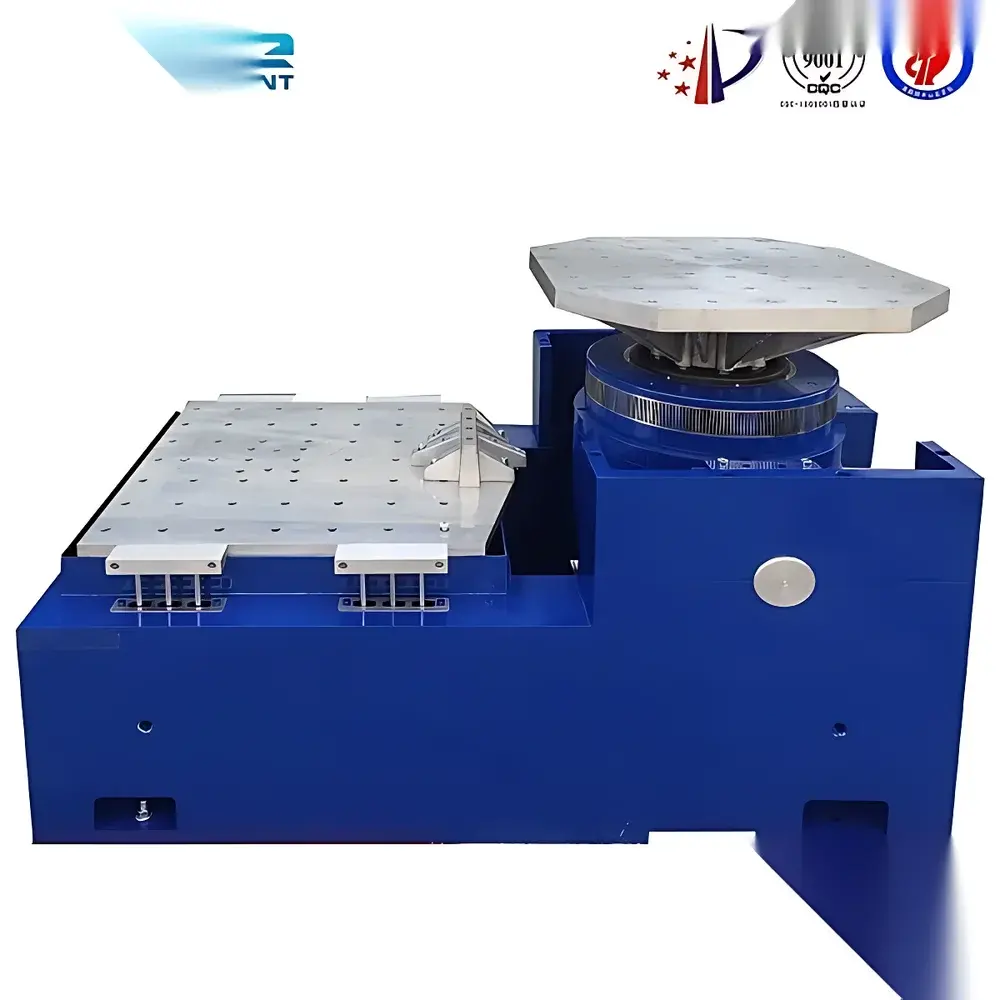
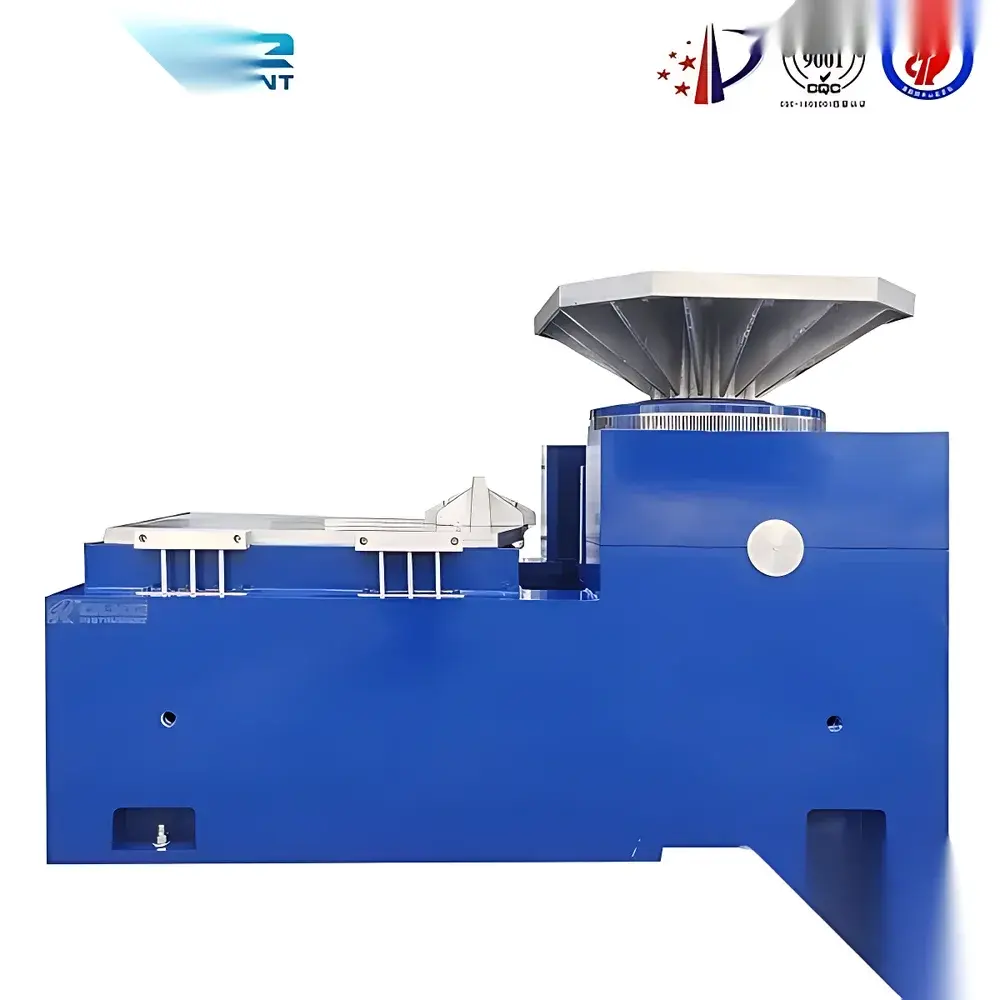
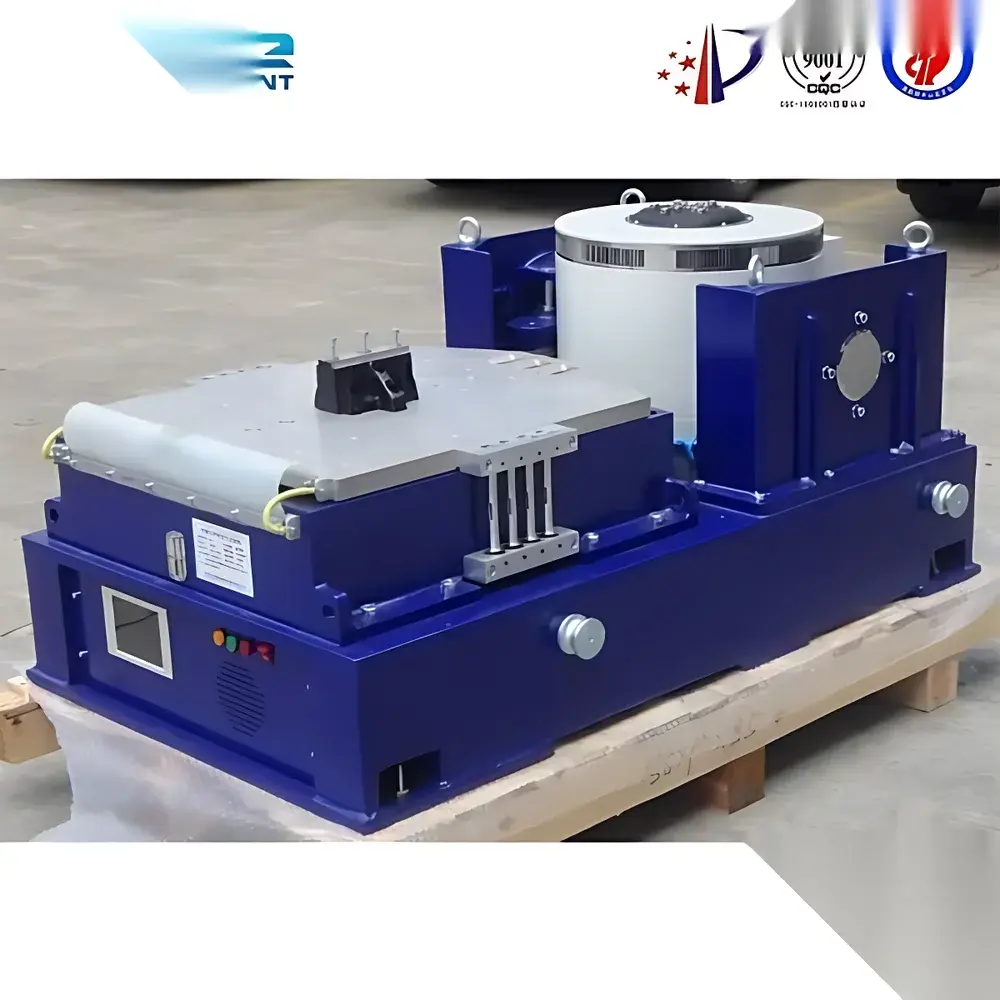
Automotive Bulb Vibration Test System – ES-3 Series Electromechanical Shaker Platform
| Brand | OEM / Custom Branding Available |
|---|---|
| Origin | Imported |
| Manufacturer Type | Authorized Distributor |
| Frequency Range | 150–300 rpm |
| Max. Load Capacity | 100 kg |
| Peak Acceleration | 20 g (calculated per ISO 5344) |
| Max. Displacement (p-p) | 25.4 mm |
| Vibration Mode | Reciprocating (Rotary Eccentric Drive) |
| Table Dimensions | 1000 × 1100 mm |
| Power Consumption | 1 HP (746 W) |
| Operating Temperature | 5–40 °C |
| Relative Humidity | ≤85% RH |
| Supply Voltage | 220 V, 50 Hz |
| Compliance | GB/T 2423.10, IEC 60068-2-6 (Fc), JJG 189–1997, GB/T 13309–1991, EN 71, ASTM D4169, ISTA 3A |
Overview
The ES-3 Automotive Bulb Vibration Test System is an electromechanical shaker platform engineered for accelerated mechanical durability assessment of automotive lighting components—including halogen, HID, LED, and adaptive driving beam (ADB) modules—under controlled sinusoidal vibration profiles. Based on rotary eccentric mass actuation, the system generates reproducible, low-frequency, high-displacement oscillatory motion to simulate real-world road-induced excitations encountered during vehicle transportation and operation. Unlike hydraulic or electromagnetic shakers optimized for broadband random testing, the ES-3 employs a robust DC-motor-driven belt-coupled mechanism with precision-machined counterweights, delivering stable amplitude and frequency control across its operational envelope (150–300 rpm, equivalent to 2.5–5 Hz). Its design prioritizes long-term repeatability, mechanical simplicity, and ease of integration into QC laboratories and Tier-1 supplier validation lines—particularly where compliance with transport simulation standards (e.g., ISTA 3A, ASTM D4169 Section 8) and regulatory environmental test protocols (GB/T 2423.10, IEC 60068-2-6) is mandatory.
Key Features
- Heavy-duty structural base fabricated from reinforced C-channel steel with integrated anti-vibration rubber mounts—eliminates need for anchoring bolts and ensures stable operation on standard laboratory flooring.
- Linear rail-based sample mounting interface enabling rapid, repeatable fixture installation and alignment; accommodates custom jigs for headlamp assemblies, bulb carriers, and socket-integrated modules.
- Digital frequency display with ±0.5 rpm resolution and analog tachometer feedback for real-time verification of rotational speed stability under load.
- DC motor speed regulation with closed-loop feedback, offering smooth acceleration/deceleration and consistent torque delivery up to 100 kg payload without speed droop.
- Configurable orientation options: vertical-only (CZ-0303), horizontal-only (SP-0303), or dual-axis (CZ-SP) configurations—all sharing identical drive architecture and calibration traceability.
- Thermal management system maintains motor winding temperature below 85 °C during continuous 8-hour duty cycles at rated load.
Sample Compatibility & Compliance
The ES-3 platform supports full-assembly testing of automotive bulbs mounted in OEM-spec sockets, reflector housings, or complete headlamp units (up to 100 kg gross weight). Fixture adaptability extends to ECE R37, SAE J2046, and GB 4599-compliant lamp geometries. All mechanical and electrical interfaces conform to GLP-aligned documentation requirements. The system’s vibration profile generation adheres to the displacement-limited sinusoidal method defined in IEC 60068-2-6 (Fc), with peak acceleration capped at 20 g (196 m/s²) and maximum peak-to-peak displacement limited to 25.4 mm—parameters validated via third-party metrology using calibrated laser Doppler vibrometry (LDV). Calibration certificates are traceable to NIM (National Institute of Metrology, China) and include uncertainty budgets per ISO/IEC 17025.
Software & Data Management
While the base ES-3 model operates via manual speed control, optional PC-integrated versions (ES-3-COM) support RS-232/USB communication for automated test sequencing, real-time waveform logging, and post-test spectral analysis. Software complies with FDA 21 CFR Part 11 requirements for electronic records and signatures, including audit trail generation, user access controls, and data integrity validation. Exported datasets conform to ASTM E1782 (Standard Practice for Data Recording in Mechanical Testing) and include timestamped metadata: frequency setpoint, actual RPM, elapsed test time, ambient temperature/humidity, and operator ID. Raw vibration data is stored in CSV and HDF5 formats for compatibility with MATLAB, Python (SciPy), and commercial CAE platforms.
Applications
- Pre-shipment validation of bulb solder joint integrity and filament shock resistance per OEM PPAP Level 3 submission requirements.
- Accelerated life testing of LED thermal interface materials (TIMs) and phosphor layer adhesion under cyclic mechanical stress.
- Verification of optical axis stability in ADB modules after exposure to simulated chassis flexure conditions.
- Root-cause analysis of intermittent open-circuit failures in halogen bulb filaments induced by resonant amplification.
- Supporting ISO 16750-3 (Mechanical loads) and SAE J1211 (Lighting system reliability) conformance testing.
FAQ
What standards does the ES-3 explicitly support for automotive bulb qualification?
The system is configured and calibrated to meet GB/T 2423.10 (China), IEC 60068-2-6 (Fc) (international), and ASTM D4169 Section 8 (transport simulation), with optional add-ons for EN 71-1 (toy safety) and UL 1574 (luminaire vibration).
Can the ES-3 perform random vibration testing?
No—the ES-3 is a fixed- or swept-sine electromechanical shaker. It does not generate broadband random spectra. For random testing per ISO 10326 or MIL-STD-810H, a servo-hydraulic or electrodynamic shaker with controller hardware (e.g., Vibration Research VR9500) is required.
Is calibration documentation provided with shipment?
Yes—each unit ships with a factory calibration report (including LDV-verified amplitude/frequency linearity, phase response, and load-dependent damping characteristics), valid for 12 months under normal operating conditions.
What maintenance intervals are recommended?
Belt tension and bearing lubrication should be verified every 500 operational hours; motor brushes require replacement after 5,000 hours. Full preventive maintenance is advised annually or after 10,000 test cycles, whichever occurs first.



