
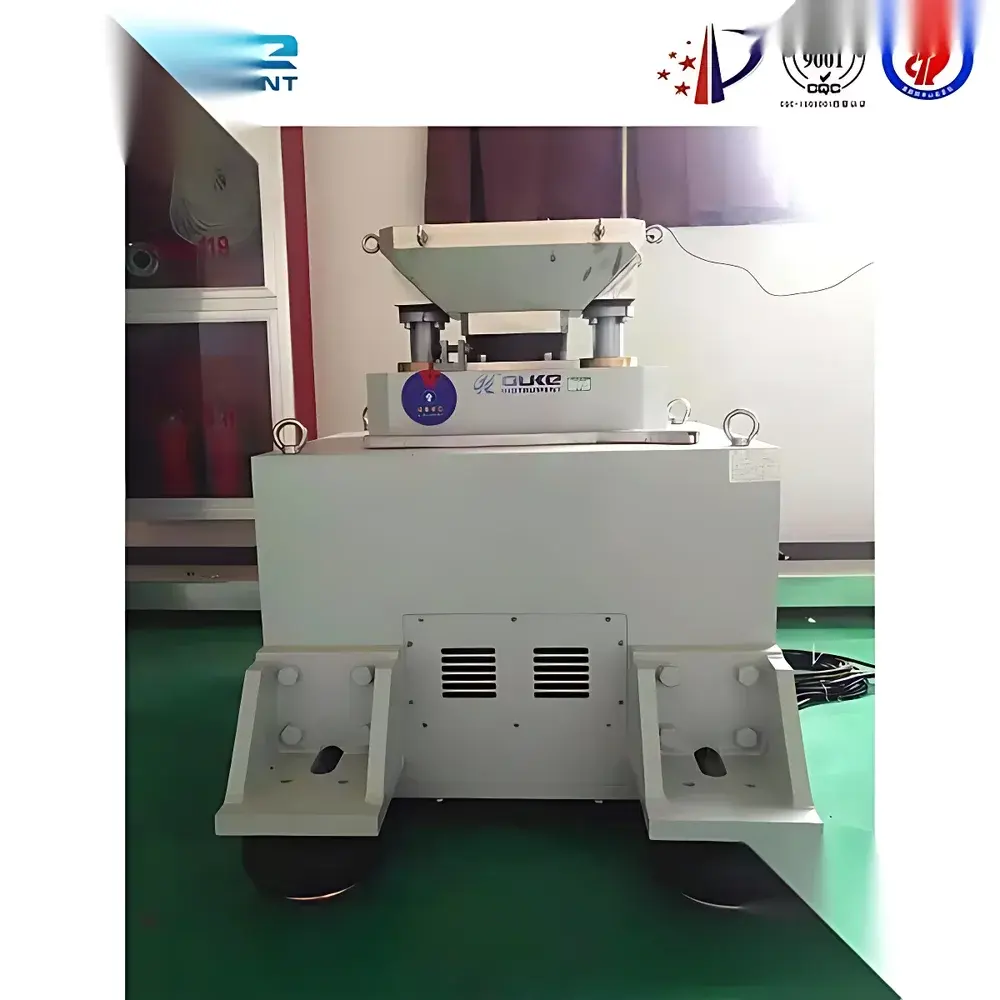
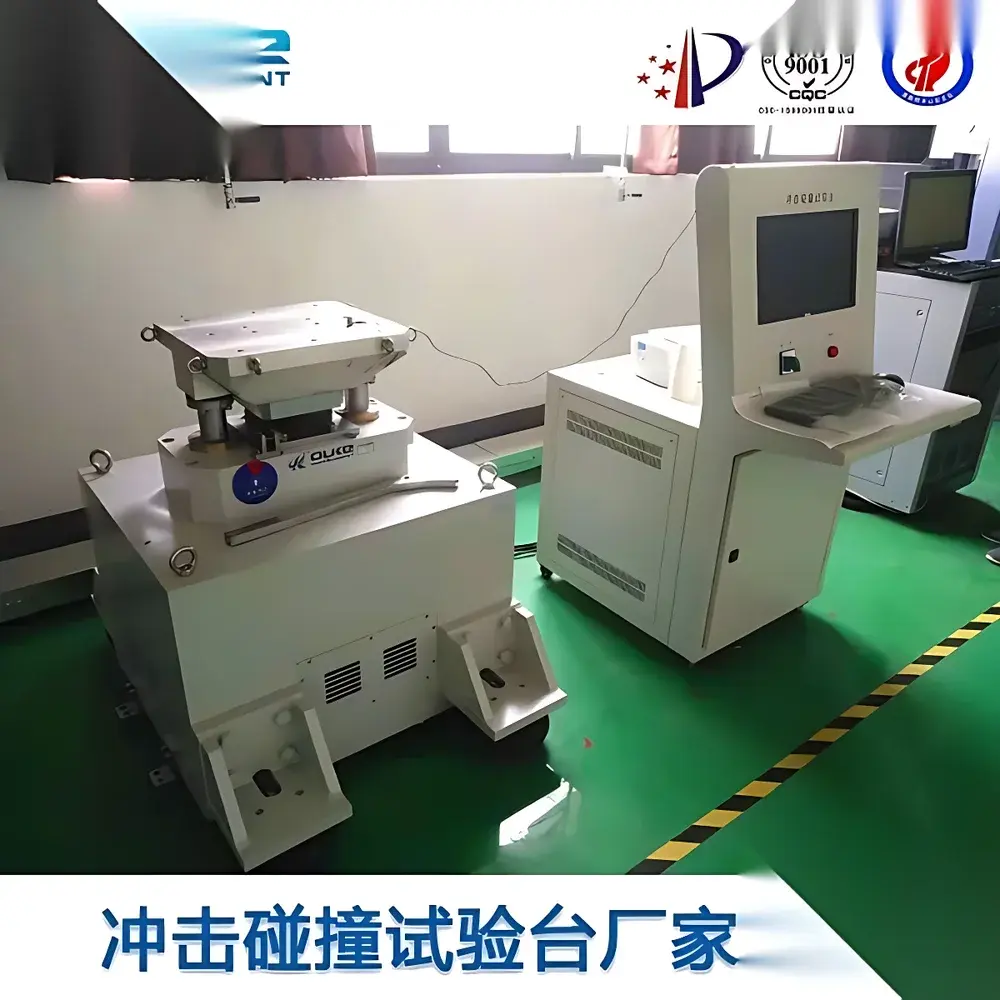
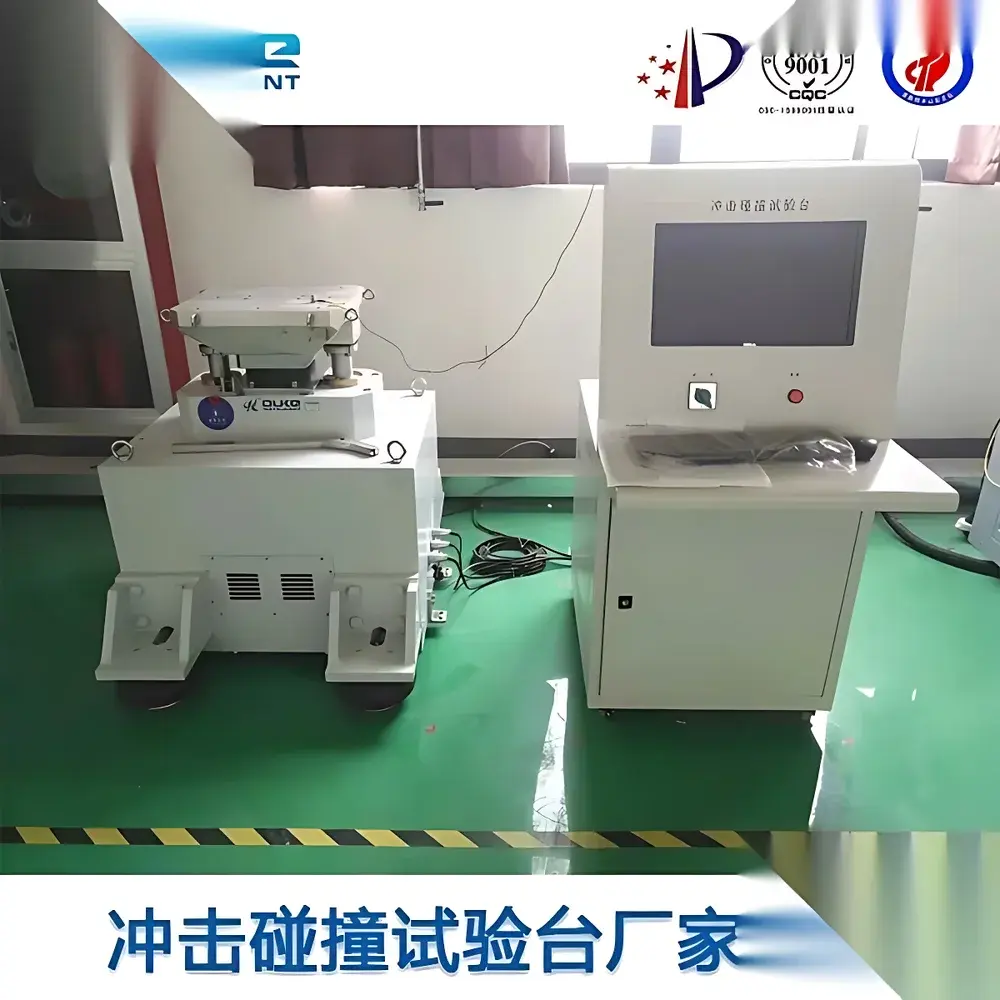
Automotive Crash Test System OKPZ-100
| Key | Brand: Other Brands |
|---|---|
| Origin | Imported |
| Max Test Load | 100 kg |
| Pulse Repetition Rate | 0–80 min⁻¹ |
| Pulse Duration | 6–180 ms |
| Peak Acceleration | 50–1000 m/s² |
| Pulse Waveform | Half-Sine |
| Table Dimensions (L×W×H) | 700 × 1200 × 900 mm |
| Work Surface | 500 × 700 mm |
| Table Mass | ~1200 kg |
| Control Unit Mass | 15 kg |
| Control Unit Dimensions (L×H×W) | 500 × 280 × 400 mm |
| Power Supply | 220 V ±10%, 50 Hz |
| Power Consumption | 1.3 kVA |
| Compliance | GB/T 2423.5, GB/T 2423.6, JB/T 9391–1999, IEC 60068-2-27, IEC 60068-2-29, JJG 498–1987 |
Overview
The Automotive Crash Test System OKPZ-100 is a precision-engineered shock test platform designed to replicate controlled mechanical impact events for reliability validation of automotive components, electronic modules, and safety-critical assemblies under standardized crash-relevant transient loading conditions. Operating on the principle of electro-mechanical drop-hammer impact generation, the system delivers repeatable half-sine acceleration pulses with programmable amplitude, duration, and repetition rate—enabling rigorous assessment of structural integrity, mounting robustness, and functional survival in post-impact scenarios. Unlike broadband vibration shakers, this system specializes in high-g, short-duration transients aligned with international shock testing protocols, making it suitable for pre-compliance verification against OEM-specific durability requirements and regulatory benchmarks such as ISO 16750-3 (Road vehicles — Environmental conditions and testing for electrical and electronic equipment — Part 3: Mechanical loads) and SAE J1211.
Key Features
- Programmable half-sine pulse generation with adjustable peak acceleration (50–1000 m/s²), pulse width (6–180 ms), and repetition frequency (0–80 impacts/min)
- Robust mechanical architecture featuring a 1200 kg base mass and rigid 500 × 700 mm aluminum test surface, minimizing resonance coupling and ensuring stable energy transfer during impact
- Dual-mode control interface supporting both manual parameter setup and automated sequence execution via embedded CC-1A shock measurement unit
- High-fidelity analog signal conditioning: differential inputs (≥500 kΩ impedance), selectable gain (×1/×10/×100), integrated IEPE constant-current excitation, and charge amplifier support for piezoelectric accelerometers
- Anti-aliasing protection combining analog filtering with 160 dB/oct digital decimation, preserving waveform fidelity up to Nyquist-limited bandwidth
- 110 dB dynamic range and >100 dB signal-to-noise ratio ensure accurate capture of low-amplitude residual vibrations following primary shock events
Sample Compatibility & Compliance
The OKPZ-100 accommodates test specimens up to 100 kg mounted directly on its horizontal work surface or via custom fixtures compatible with standard ¼”-28 or M6 threaded inserts. Its mechanical design conforms to the physical constraints and mounting requirements specified in GB/T 2423.5–2022 (equivalent to IEC 60068-2-27) for shock testing and GB/T 2423.6–2022 (IEC 60068-2-29) for bump testing. The system supports traceable calibration per JJG 498–1987 (Calibration Specification for Shock Measurement Instruments) and facilitates audit-ready documentation required under ISO/IEC 17025-accredited laboratory practices. While not a full-scale vehicle crash sled, it serves as a validated subsystem-level qualification tool for ECUs, airbag controllers, ADAS sensors, and infotainment units prior to integration into full-vehicle NCAP or FMVSS 208 test campaigns.
Software & Data Management
The embedded control software enables definition of target shock spectra via tabular input—specifying acceleration amplitude, slope (dB/octave), and cross-over frequencies across up to 100 breakpoints. Closed-loop control operates with 10 ms update latency and ±0.5 dB amplitude tolerance across 1.0–5000 Hz spectral content. Sweep modes include linear (0–6000 Hz/min) and logarithmic (0–100 octaves/min), with real-time FFT monitoring and time-domain waveform overlay. All raw acceleration traces, trigger timestamps, and pass/fail status relative to user-defined tolerance bands (per MIL-STD-810G Method 516.7 or ISO 16750-3 Annex B) are logged in IEEE-compliant binary format (.tdms) with embedded metadata including sensor ID, calibration date, and environmental ambient readings. Export options include CSV, MATLAB .mat, and universal UFF 58 formats—ensuring compatibility with third-party analysis suites such as MATLAB Signal Processing Toolbox, Python SciPy, or NI DIAdem.
Applications
- Functional survivability testing of automotive ECUs, junction boxes, and power distribution modules subjected to rear-end collision-induced inertial shocks
- Qualification of camera/lidar mounting brackets under simulated pothole-induced vertical impulses
- Validation of battery management system (BMS) response to sudden deceleration events in electric vehicle platforms
- Reliability screening of PCB-assembled components (e.g., MEMS accelerometers, gyroscopes) for shock-induced solder joint fatigue or die cracking
- Development of shock isolation mounts and damping solutions through comparative impulse response analysis
- Supporting GLP-compliant test reports for Tier-1 supplier PPAP submissions requiring documented shock exposure history
FAQ
What standards does the OKPZ-100 comply with for automotive shock testing?
The system implements hardware and software features aligned with GB/T 2423.5, IEC 60068-2-27, ISO 16750-3, and SAE J1211. Calibration traceability follows JJG 498–1987.
Can the system perform sequential multi-pulse testing with variable parameters per impact?
Yes—the control software supports script-based test sequences where each pulse may differ in amplitude, duration, and delay interval, enabling simulation of complex crash event profiles.
Is external data acquisition required, or is the CC-1A module sufficient for full waveform capture?
The integrated CC-1A shock measurement unit provides synchronized 1-channel (expandable to 2) acquisition at configurable sampling rates up to 1 MS/s, eliminating the need for external DAQ in most compliance applications.
Does the system support real-time pass/fail evaluation against a reference shock spectrum?
Yes—tolerance band comparison is performed in real time using user-defined upper/lower envelopes; results are flagged automatically and appended to the test log.
What accelerometer types are supported by the analog input stage?
Both IEPE (ICP®) and charge-output piezoelectric accelerometers are supported, with switchable constant-current excitation and dual-range charge amplification built into the signal conditioning path.



