
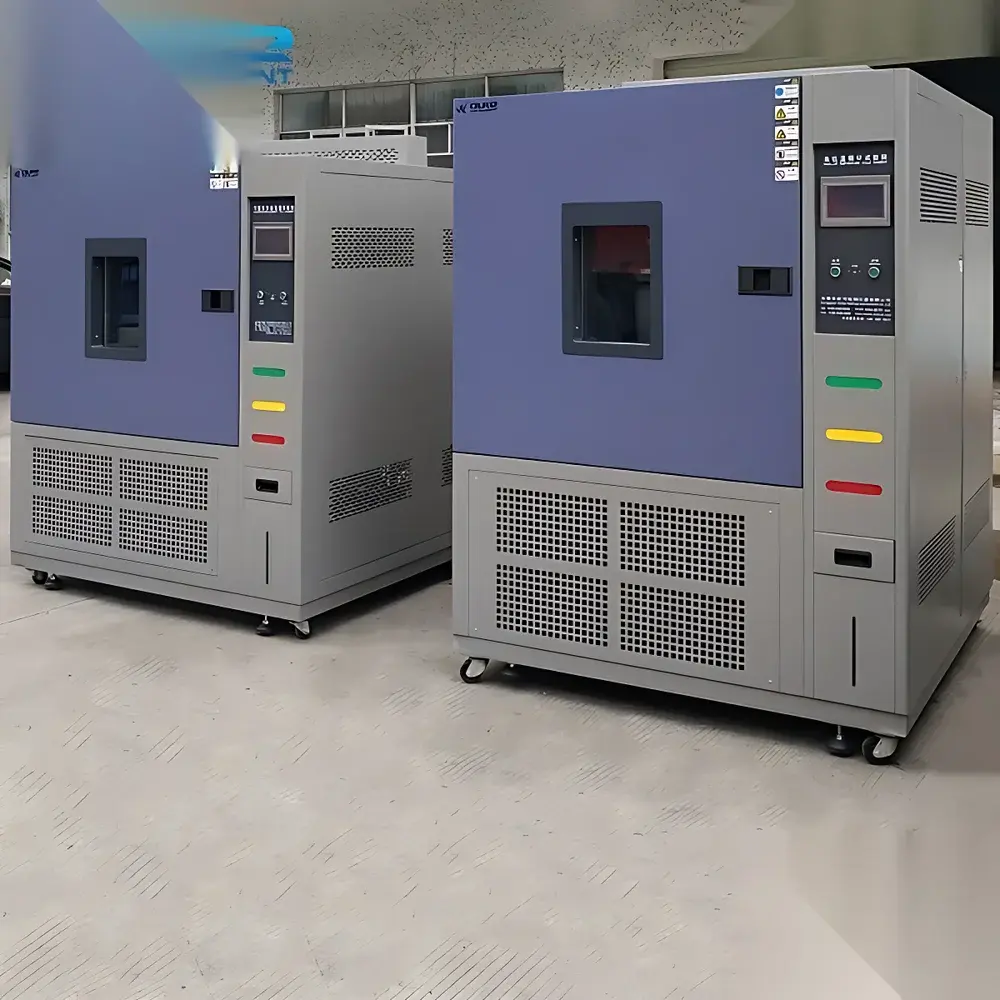
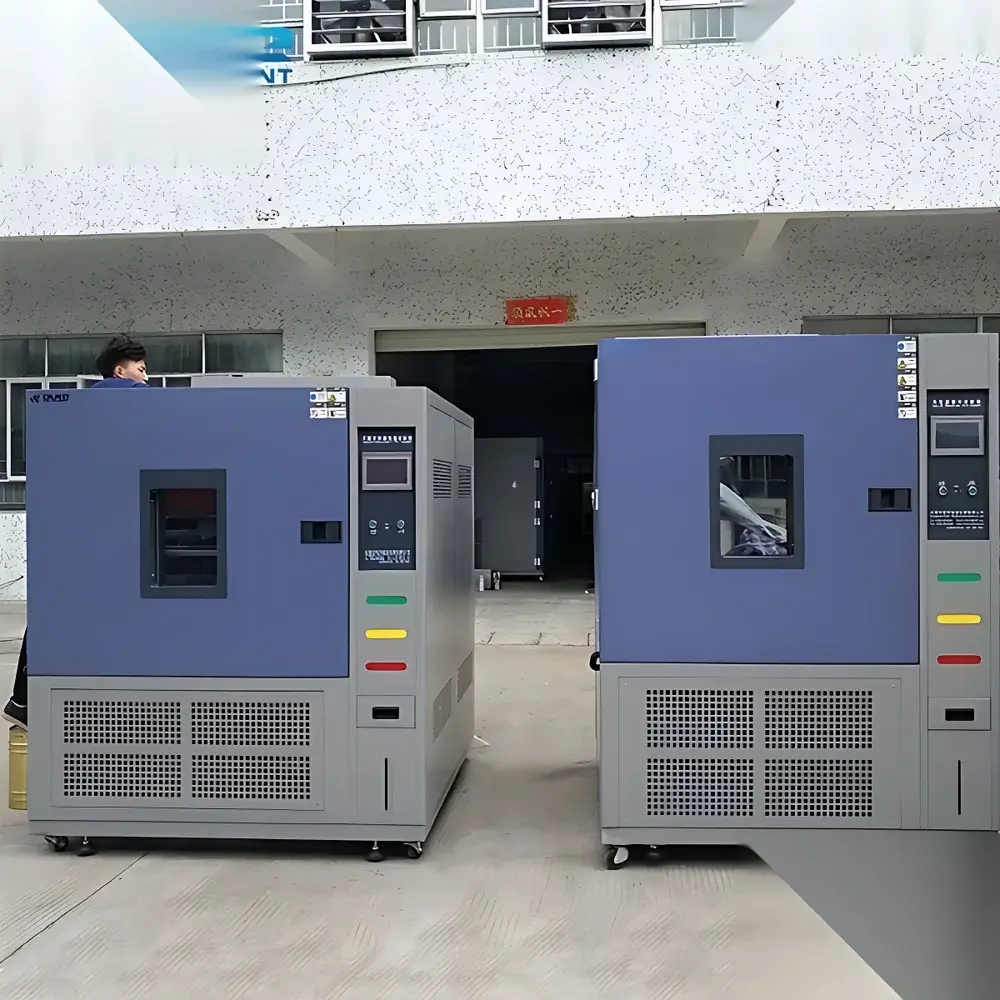
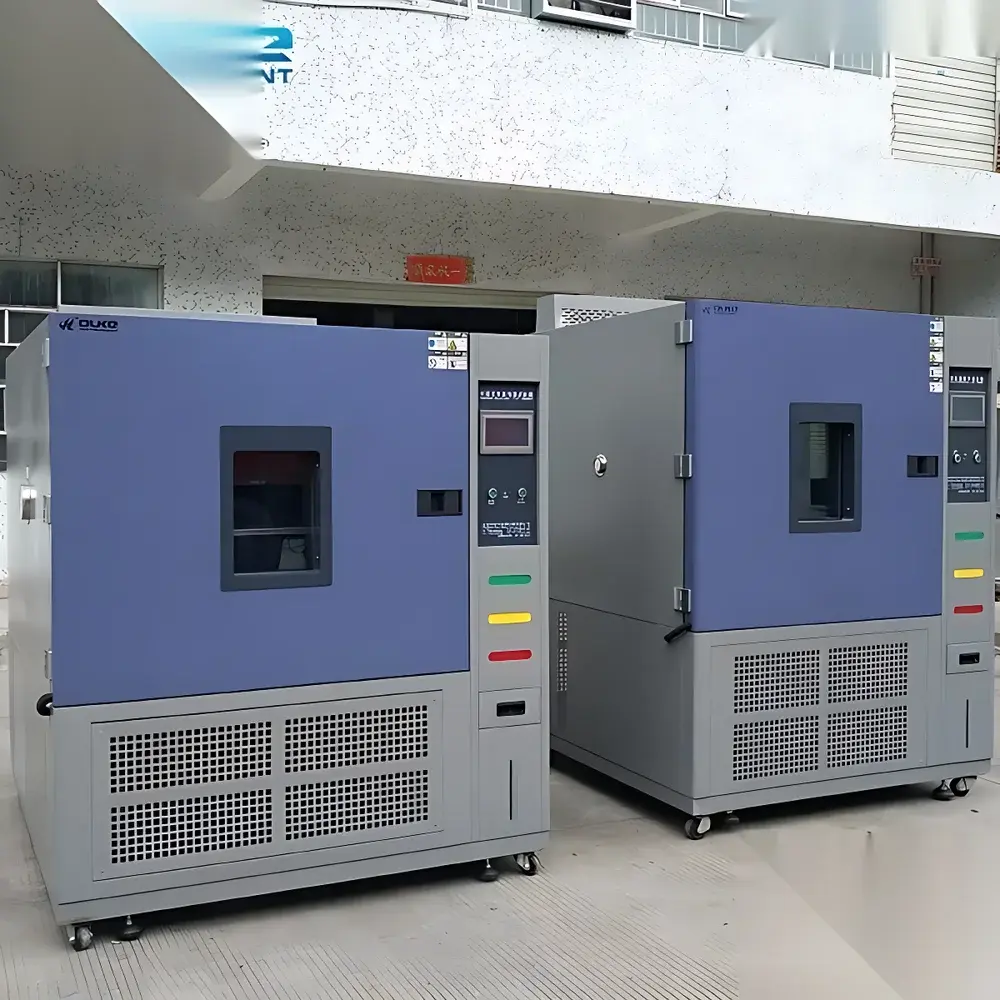
Automotive Power Supply Environmental Test Chamber – TEMI880 Controlled Temperature & Humidity Chamber
| Key | Temperature Range: −40 °C to +150 °C (optional down to −120 °C) |
|---|---|
| Humidity Range | 30–98% RH (optional 5–98% RH) |
| Temperature Resolution | 0.01 °C |
| Humidity Resolution | 0.1% RH |
| Temperature Uniformity | ±0.5 °C |
| Temperature Deviation | ≤±2 °C |
| Humidity Deviation | ≤±2.5% RH |
| Heating Rate | 2.0–3.0 °C/min |
| Cooling Rate | 0.7–1.0 °C/min |
| Control System | TEMI880 Color LCD Touchscreen Controller |
| Power Supply | 380 V ±5%, 50 Hz, 3P+N+G |
| Inner Chamber Material | SUS304 Stainless Steel |
| Compliance | GB/T 5170.2–1996, GB/T 5170.5–1996, GB 2423.1–1989, GB 2423.2–1989, GB 2423.22–1987, GB 10589–1989, GB 10592–1989, GB 11158–1989 |
Overview
The Automotive Power Supply Environmental Test Chamber is a precision-engineered temperature and humidity controlled chamber designed specifically for reliability validation of automotive-grade power electronics—including DC-DC converters, onboard chargers (OBC), battery management systems (BMS), and 12/48/800 V vehicle power modules—under dynamically simulated climatic conditions. Based on dual-refrigeration cascade cooling and PID-controlled steam humidification, the chamber delivers stable, reproducible environmental profiles across wide operational ranges. Its architecture conforms to the thermal inertia and load-dissipation requirements typical of high-power electronic assemblies, enabling realistic stress testing per ISO 16750-4 (Road vehicles — Environmental conditions and testing for electrical and electronic equipment — Part 4: Climatic loads) and SAE J1211. The system operates on a forced-air convection principle with optimized airflow distribution to minimize spatial gradients and ensure uniform exposure across DUT mounting zones.
Key Features
- Wide operational envelope: Standard temperature range of −40 °C to +150 °C; optional extension to −120 °C using liquid nitrogen-assisted cascade refrigeration
- Precise climatic control: 0.01 °C temperature resolution and 0.1% RH humidity resolution, with real-time feedback from calibrated platinum resistance (PT100) sensors and capacitive humidity transducers
- High-fidelity dynamic profiling: Programmable ramp rates of 2.0–3.0 °C/min (heating) and 0.7–1.0 °C/min (cooling), validated under no-load and standardized thermal mass loading per IEC 60068-3-5
- Robust mechanical construction: Interior chamber fabricated from electropolished SUS304 stainless steel for corrosion resistance and low outgassing; exterior housing available in either SUS304 or A3 steel with epoxy-polyester powder coating
- TEMI880 intelligent controller: 7-inch color TFT-LCD touchscreen interface supporting multi-segment ramp-soak cycles, data logging (internal SD card + USB export), alarm history, and password-protected parameter locking
- Electrical infrastructure compatibility: Configurable 380 V ±5%, 50 Hz, 3P+N+G supply (standard); optional 220 V single-phase configuration available upon request for lab-scale integration
Sample Compatibility & Compliance
This chamber accommodates automotive power units up to 600 mm × 600 mm × 600 mm (W×D×H) with dedicated cable ports (PG29 or customizable feedthroughs) and reinforced floor loading capacity (≥150 kg). It supports both static and cycling test protocols defined in GB/T 2423 (equivalent to IEC 60068), including Test A (cold), Test B (dry heat), Test N (temperature change), and Test Db (damp heat, cyclic). All performance specifications—including temperature uniformity (±0.5 °C), deviation (≤±2 °C), and humidity deviation (≤±2.5% RH)—are verified per GB/T 5170.2–1996 and GB/T 5170.5–1996 under controlled ambient conditions (25 °C ±6 °C, no load). Optional calibration certificates traceable to NIM (National Institute of Metrology, China) are available for GLP-compliant laboratories.
Software & Data Management
The TEMI880 controller provides embedded cycle programming with up to 100 user-defined profiles, each supporting 99 segments with independent ramp/soak settings. Real-time data—including chamber setpoint, actual temperature/humidity, compressor status, and alarm events—is logged at user-selectable intervals (1 s to 60 min) and stored internally (≥100,000 records) or exported via USB to CSV format for post-processing in MATLAB, Excel, or LIMS platforms. Remote monitoring and control are enabled through optional RS485 Modbus RTU or Ethernet TCP/IP interfaces, facilitating integration into centralized test management systems. Audit trail functionality meets basic requirements for regulated environments; full 21 CFR Part 11 compliance requires supplemental validation documentation and third-party electronic signature modules.
Applications
- Functional validation of automotive power supplies across extreme ambient conditions (e.g., cold cranking at −40 °C, under-hood thermal soak at +125 °C)
- Accelerated life testing (ALT) of DC-DC converters and OBCs under combined thermal-hygric stress
- Qualification testing per AEC-Q200 for passive components used in powertrain electronics
- Environmental screening of battery pack interconnects and contactors under humidity cycling
- Pre-compliance verification for ISO 16750-4, LV-124, and GMW3172 climatic test requirements
- Research-grade material stability assessment for encapsulants, conformal coatings, and PCB laminates
FAQ
What is the standard temperature and humidity range for this chamber?
The standard operating range is −40 °C to +150 °C for temperature and 30–98% RH for humidity. Extended low-temperature options down to −120 °C and extended humidity range down to 5% RH are available as factory-configured options.
Does the chamber support automated test sequencing and data export?
Yes—the TEMI880 controller enables fully programmable multi-step profiles and logs time-stamped environmental data to internal memory or USB storage in CSV format for external analysis.
Is this chamber suitable for testing high-power electronic assemblies with active thermal dissipation?
It is engineered for moderate thermal loads typical of automotive power modules (<500 W average dissipation). For higher-power DUTs, optional air-cooled or water-cooled load simulation fixtures and enhanced airflow kits are recommended to maintain chamber stability.
Are calibration and compliance documentation included?
Factory calibration reports are provided with shipment. NIM-traceable calibration certificates, installation qualification (IQ), operational qualification (OQ), and preventive maintenance plans are available as value-added services.
Can the chamber be integrated into an existing test automation framework?
Yes—RS485 (Modbus RTU) and Ethernet (TCP/IP) communication interfaces are standard, enabling seamless integration with LabVIEW, TestStand, or custom SCADA platforms via documented protocol registers.



