
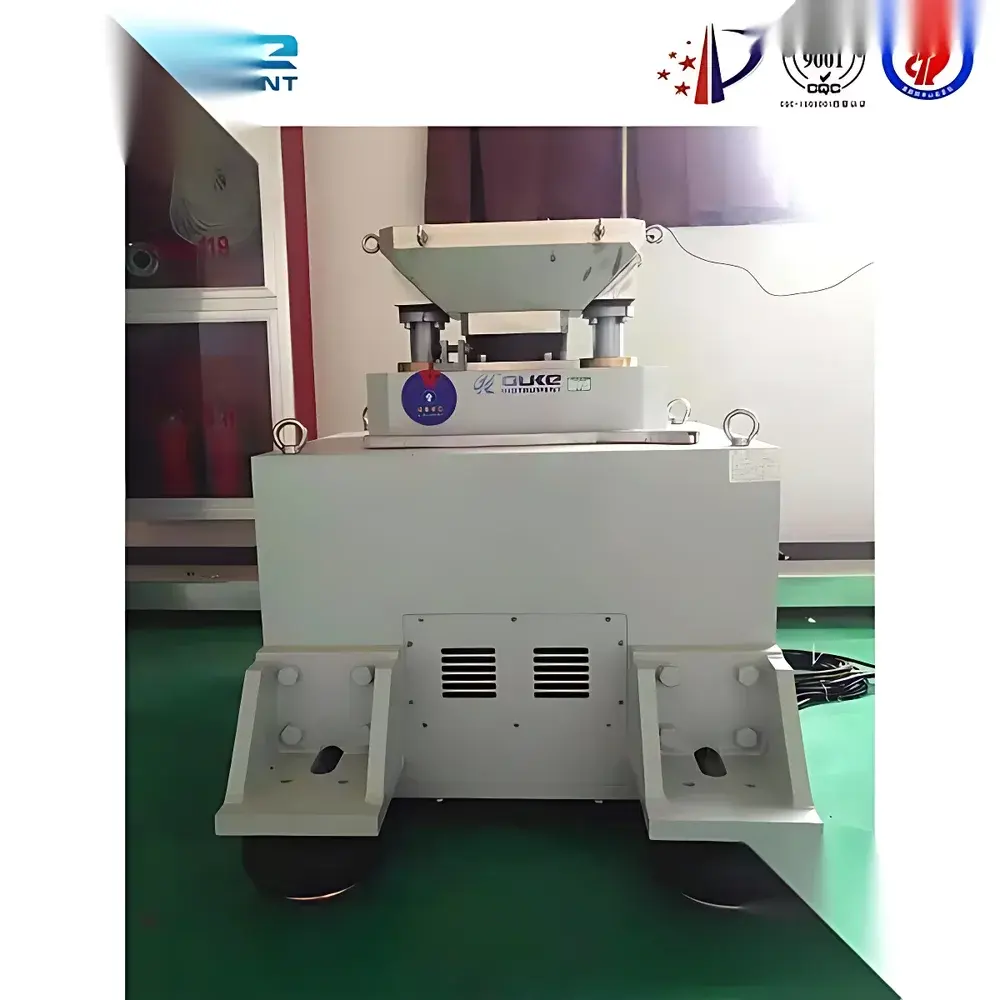
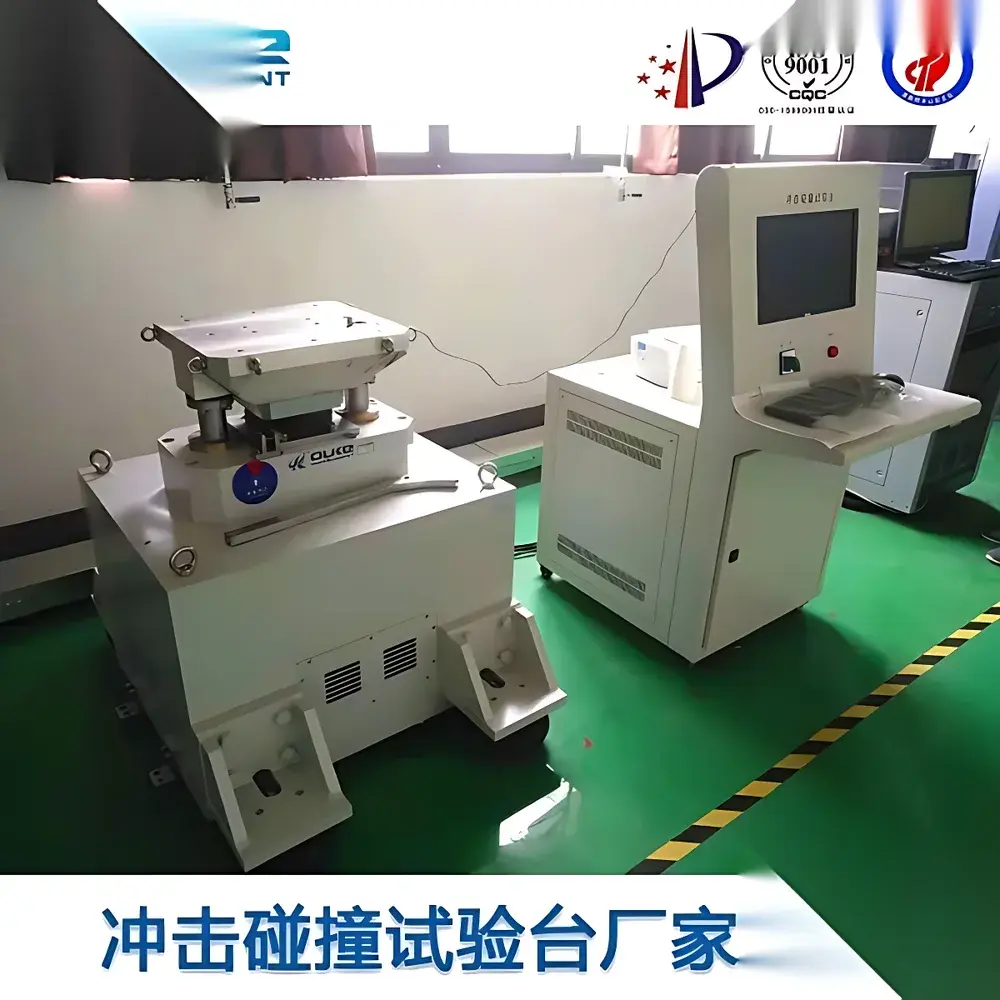
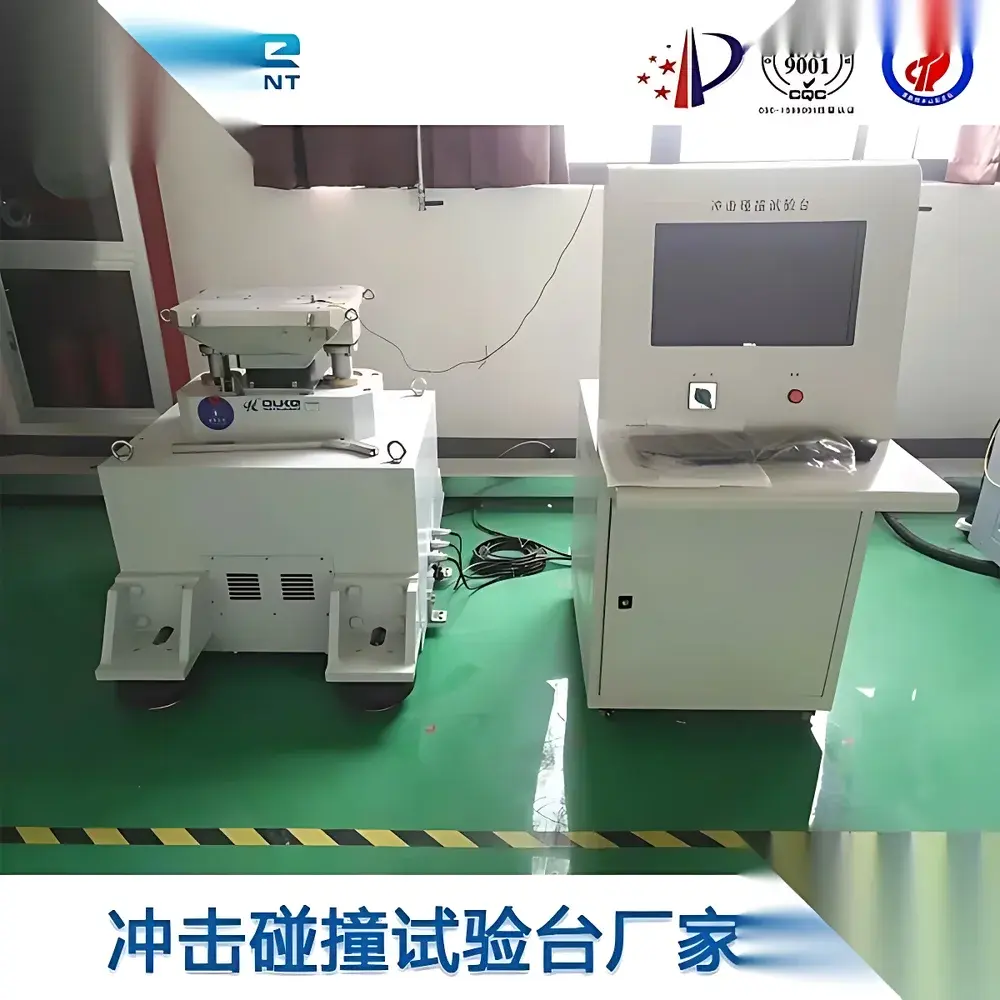
Automotive Shock and Impact Test Table
| Brand | Other Brands |
|---|---|
| Origin | Imported |
| Manufacturer Type | General Distributor |
| Price | USD 14,000 (approx.) |
Overview
The Automotive Shock and Impact Test Table is a precision-engineered electro-mechanical test system designed to simulate controlled mechanical shock environments for automotive components, subassemblies, and electronic modules. It operates on the principle of free-fall impact dynamics: a mass-driven platform is elevated by a DC motor coupled with a gear-reduction lifting mechanism and guided roller supports, then released to strike a calibrated energy-absorbing cushion—generating repeatable half-sine acceleration pulses in accordance with ISO 16750-3, SAE J1211, and GB/T 28046.3 standards. Unlike hydraulic or pneumatic shock testers, this system employs optical position feedback and closed-loop acceleration control to ensure waveform fidelity, peak amplitude stability, and pulse duration repeatability across multiple test cycles. Its rigid structural frame and high-stiffness work surface guarantee uniform acceleration distribution across the entire test plane—critical for evaluating spatially distributed responses in ECUs, airbag sensors, infotainment units, and ADAS camera housings.
Key Features
- Closed-loop acceleration control architecture with real-time optical feedback for pulse shape accuracy and peak deviation ≤ ±3% (typical)
- Dual-mode operation: programmable half-sine shock pulses and configurable impact testing per MIL-STD-810H Method 516.7
- Expandable waveform library supporting rear-peak sawtooth and trapezoidal shock profiles via firmware update
- High-rigidity aluminum-alloy test platform with modal damping treatment to minimize resonant amplification below 1 kHz
- Adjustable impact energy via cushion thickness, material composition (e.g., polyurethane, elastomeric foam), and drop height (range: 25–200 mm)
- Integrated safety interlocks, emergency stop circuitry, and mechanical overtravel limit switches compliant with ISO 13857
Sample Compatibility & Compliance
The test table accommodates samples up to 50 kg with mounting footprint ≤ 600 × 600 mm. Fixturing options include threaded inserts, T-slot rails, and vacuum chucks for non-destructive clamping. All test procedures support traceable calibration per ISO/IEC 17025-accredited protocols. The system meets electromagnetic compatibility requirements per CISPR 25 Class 3 and functional safety criteria under IEC 61508 SIL 2 for industrial test equipment. Documentation packages include test reports aligned with automotive OEM audit requirements (e.g., Ford WERS, GM World Class Manufacturing, VW 80101) and are compatible with GLP-compliant laboratory quality systems.
Software & Data Management
Control and analysis are performed via Windows-based software featuring dual-channel synchronized data acquisition (up to 100 kS/s), real-time acceleration waveform visualization, and post-test spectral analysis (FFT, shock response spectrum). Software supports export of ASCII, CSV, and UFF 58 formats for integration with MATLAB, LabVIEW, or MTS FlexTest environments. Audit trail functionality records operator ID, test parameters, calibration history, and pass/fail decisions—fully compliant with FDA 21 CFR Part 11 for regulated R&D labs. Firmware updates are delivered via secure HTTPS channel with SHA-256 signature verification.
Applications
- Qualification testing of automotive electronics per ISO 16750-3 (mechanical loads)
- Functional validation of occupant detection systems, seatbelt pretensioners, and crash sensors
- Robustness assessment of lithium-ion battery enclosures and BMS modules under transient shock loading
- Design verification of head-up display (HUD) mounts and LiDAR sensor brackets
- Supplier component release testing against OEM-specific shock specifications (e.g., Toyota TSC-10, BMW GS 95024)
- Research into shock-induced solder joint fatigue and MEMS accelerometer drift behavior
FAQ
What shock pulse shapes can the system generate natively?
The base configuration delivers half-sine pulses per ISO 16750-3; rear-peak sawtooth and trapezoidal waveforms require optional firmware activation and cushion calibration.
Is third-party calibration certification included with purchase?
A factory-as-found calibration report is provided; ISO/IEC 17025-accredited calibration services are available as an add-on option.
Can the system be integrated into an existing automated test cell?
Yes—digital I/O signals (24 VDC TTL-compatible) and Ethernet TCP/IP API enable seamless integration with PLCs and MES platforms.
What is the maximum allowable sample weight and dimensional envelope?
50 kg maximum load; recommended mounting area ≤ 600 mm × 600 mm; total height clearance above platform: 350 mm.
Does the warranty cover software updates and technical support?
One year parts-and-labor warranty applies; remote technical support and minor software updates are included throughout product lifecycle.



