
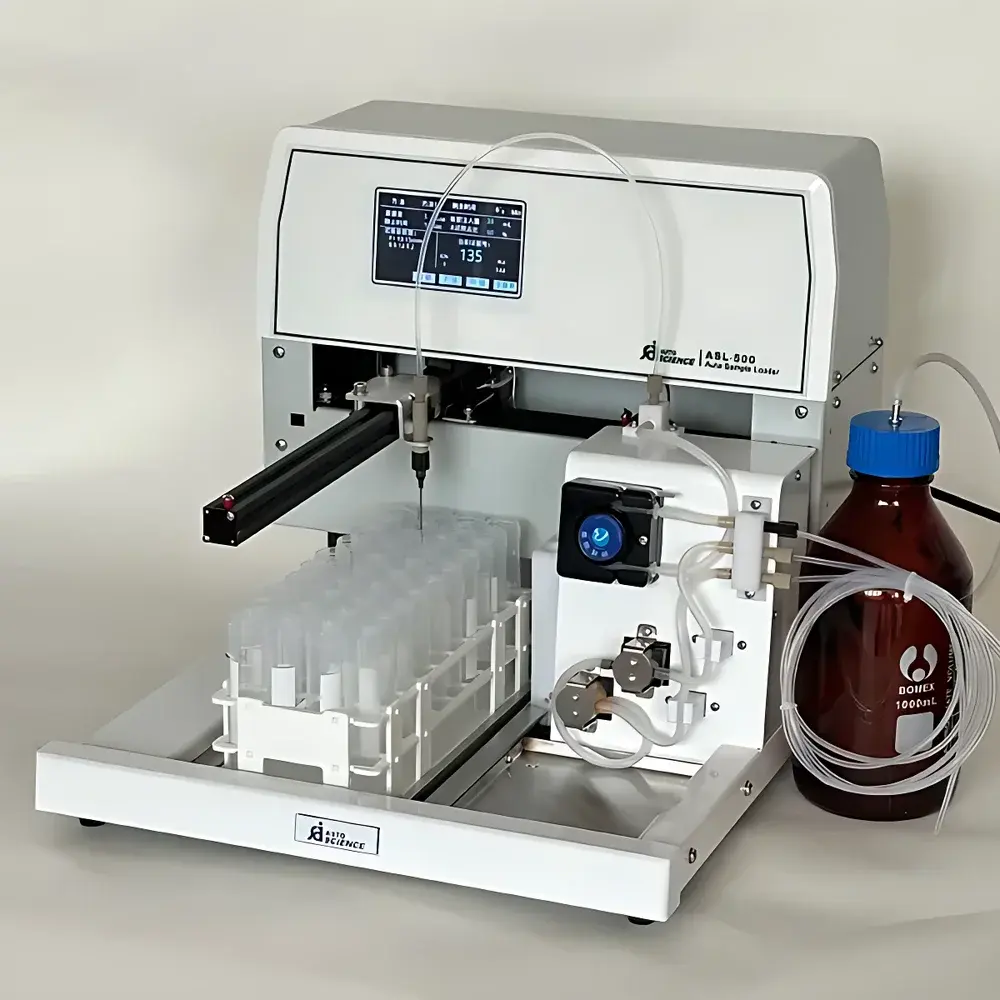
Autosampler & Fraction Collector ASL-500 by Otisence
| Brand | Otisence |
|---|---|
| Origin | Tianjin, China |
| Model | ASL-500 Autosampler & Fraction Collector |
| Instrument Type | Multifunctional Autosampler |
| Max Sample Capacity | 90 × 12.5 mm test tubes OR 96-well / 384-well microplates |
| Minimum Injection Volume | 10 µL |
| Flow Delivery Range | 10 µL to 100 mL via Peristaltic Pump |
| User Interface | 7-inch color TFT touchscreen with method storage |
| Cleaning & Drying | Automated wash-rinse-dry cycles for cuvettes, flow cells, syringe needles, and fluidic lines |
| Compliance | Designed for integration with UV-Vis spectrophotometers, protein analyzers, and kinetic assay systems |
Overview
The ASL-500 Autosampler & Fraction Collector is a laboratory-grade, multifunctional fluid handling platform engineered for unattended sample introduction and time- or volume-triggered fraction collection in analytical workflows. Unlike conventional autosamplers limited to injection-only operation, the ASL-500 integrates programmable liquid handling, on-board cleaning/drying sequences, and bidirectional compatibility with both discrete vessel formats (e.g., standard 12.5 mm test tubes) and high-density microplate formats (96-well and 384-well). Its core architecture employs a precision peristaltic pump system coupled with a motorized XYZ sample carousel and multi-position valve manifold—enabling reproducible volumetric delivery across a 10 µL–100 mL range without syringe exchange or hardware reconfiguration. The system is specifically designed for seamless integration with benchtop UV-Vis spectrophotometers, protein quantification instruments (e.g., Bradford/Lowry-compatible analyzers), and kinetic assay platforms requiring repeated cuvette or flow-cell loading without manual intervention. It does not perform chromatographic separation itself but serves as a critical front-end automation module for HPLC, SEC, or FPLC systems where fraction collection and post-run sample handling are required under GLP-aligned conditions.
Key Features
- Modular sample carrier supporting interchangeable trays: up to 90 × 12.5 mm round-bottom test tubes, or standardized 96-well/384-well microplates compliant with ANSI/SBS dimensional specifications
- Peristaltic pump with calibrated flow control enabling accurate dispensing from 10 µL to 100 mL; tubing selection optimized for aqueous, organic, and mildly corrosive solvents
- Automated maintenance sequence including multi-stage rinse (deionized water + optional solvent), air purge, and thermally assisted drying of cuvettes, flow cells, needles, and fluidic pathways
- 7-inch capacitive color touchscreen interface with intuitive icon-driven navigation; supports user-defined method templates, parameter locking, and timestamped audit logs
- Non-volatile memory stores ≥500 methods with full parameter recall—including dwell times, wash cycles, injection order, and fraction trigger logic (time-based or detector signal threshold)
- Rack-level status indicators and real-time progress visualization reduce operator dependency during overnight or unattended runs
Sample Compatibility & Compliance
The ASL-500 accommodates standard optical cuvettes (10 mm pathlength, quartz or PMMA), flow-through cells (up to 3.5 mL internal volume), and disposable pipette tips (10–1000 µL range). All wetted materials comply with USP Class VI biocompatibility requirements, and fluidic pathways are constructed from chemically resistant silicone and PTFE-lined tubing. While the unit itself is not CE-marked as an IVD device, its operational design aligns with ISO/IEC 17025 documentation practices for method validation, and data integrity features—including electronic signatures, immutable method logs, and session-based access control—support compliance with FDA 21 CFR Part 11 when deployed within validated laboratory information management systems (LIMS). It meets ASTM E2500-13 guidelines for verification of automated sample handling functions in pharmaceutical QC environments.
Software & Data Management
The embedded firmware supports export of run metadata (start/stop timestamps, error codes, executed steps) in CSV format via USB host port. Optional PC connectivity enables remote scheduling through ASCII command protocol over RS-232 or TTL-serial interfaces. Method files include checksum validation to prevent corruption during transfer. Audit trail records capture operator ID (via PIN entry), date/time stamps for all critical actions (method load, start, pause, emergency stop), and environmental parameters (ambient temperature/humidity if external sensor is interfaced). No cloud storage or proprietary software installation is required—full functionality is accessible via the onboard UI.
Applications
- High-throughput UV-Vis absorbance screening of compound libraries in drug discovery pipelines
- Automated kinetic enzyme assays requiring sequential substrate addition and timed endpoint measurements
- Fraction collection following size-exclusion chromatography (SEC) or ion-exchange purification of recombinant proteins
- Environmental water analysis workflows involving serial dilution and spiked recovery testing per EPA Method 525.3
- Food safety QA/QC protocols including mycotoxin quantification by HPLC-FLD with post-column derivatization and fraction pooling
- Method development for dissolution testing per USP , where precise timing of sampling points and temperature-controlled fraction storage are essential
FAQ
Can the ASL-500 be integrated with third-party HPLC systems?
Yes—it supports external trigger input (TTL-compatible) for synchronized fraction collection based on detector output or timer signals from any vendor’s chromatography data system.
Is calibration traceable to NIST standards?
Volumetric accuracy is verified using gravimetric methods per ISO 8655-6; certificate of conformance includes uncertainty budgets for 10 µL, 100 µL, 1 mL, and 10 mL test points.
Does it support temperature-controlled sample storage?
No—ambient-temperature operation only; however, the carousel tray is compatible with externally cooled or heated sample racks (e.g., refrigerated chillers or Peltier modules mounted adjacent to the instrument base).
What maintenance intervals are recommended?
Peristaltic pump tubing should be replaced every 6 months under continuous use; valve rotor seals require inspection every 12 months; full system performance verification is advised prior to GMP batch release activities.
Are replacement parts available globally?
Otisence maintains authorized distribution partners in North America, EU, and APAC regions; critical spares (pump heads, tubing kits, carousel motors) carry 24-month shelf life and ship with serialized traceability documentation.
Related Products






