
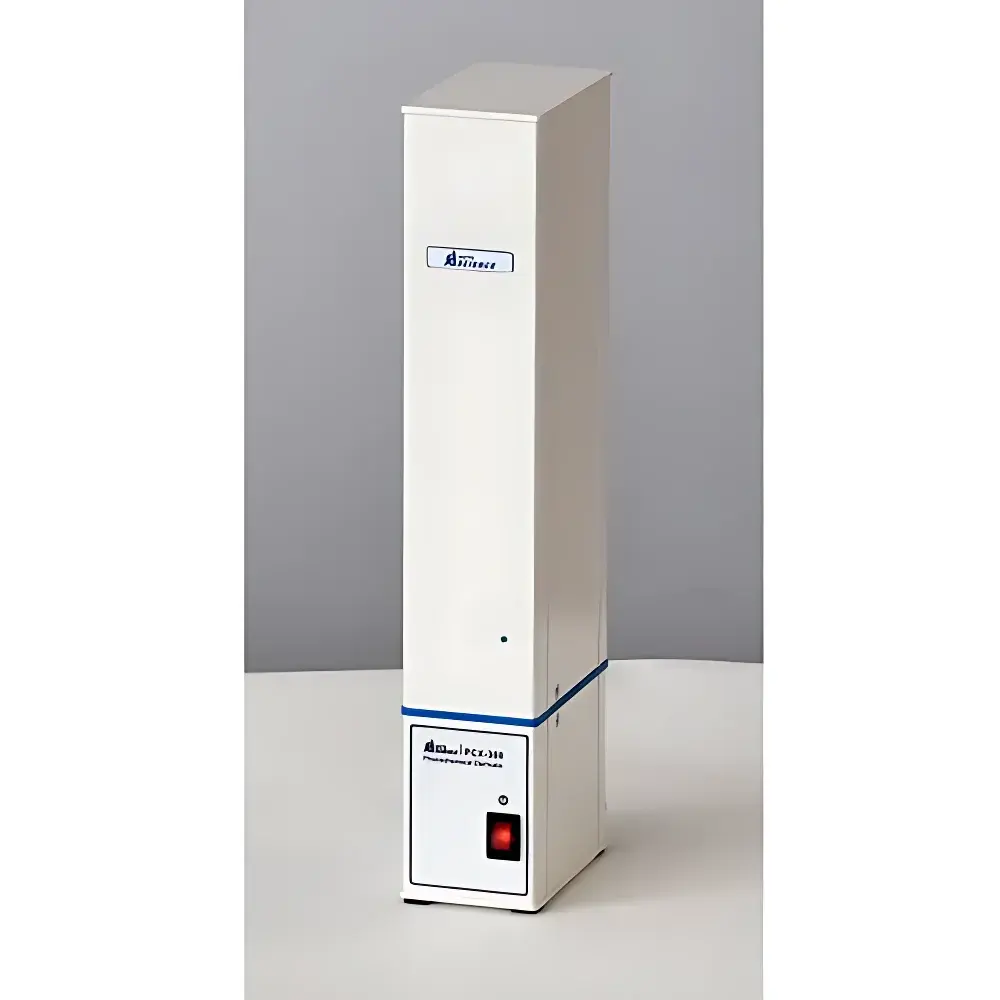
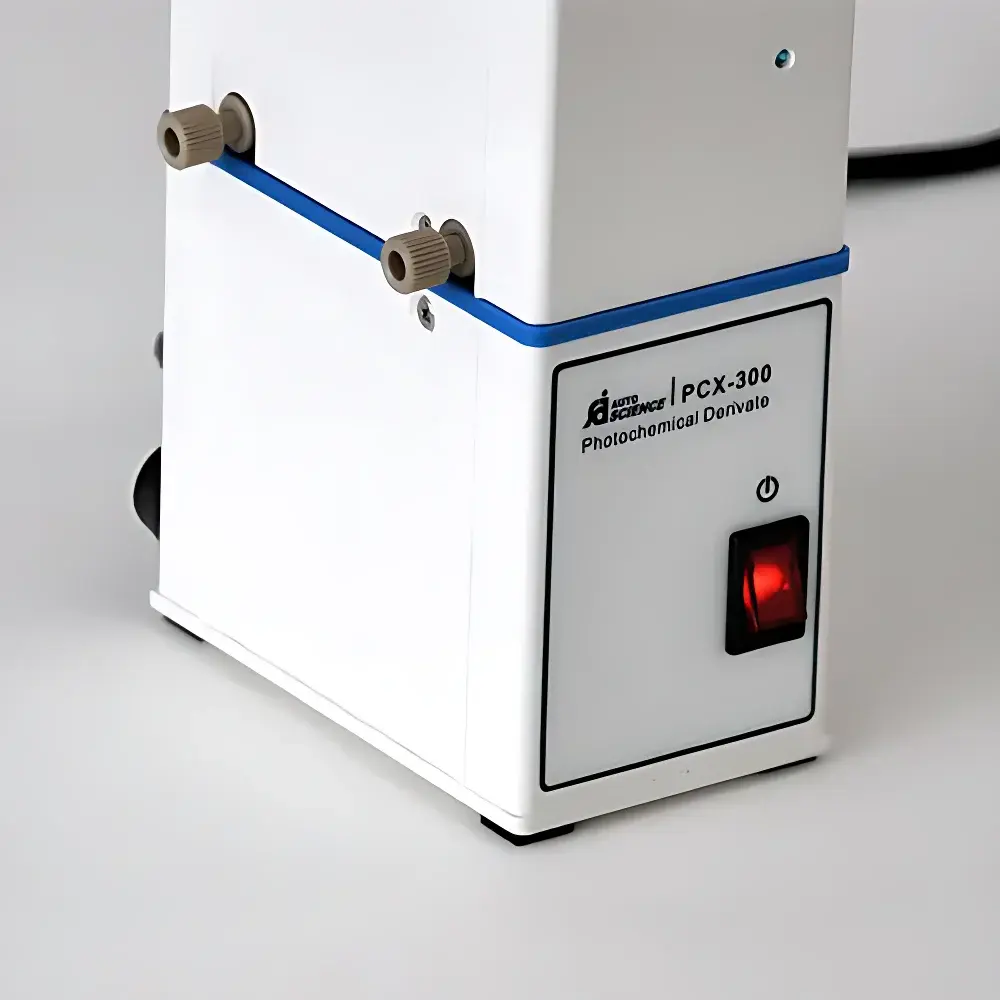
Autoscience PCX-300 Photochemical Post-Column Derivatization System
| Brand | Autoscience |
|---|---|
| Origin | Tianjin, China |
| Model | PCX-300 Photochemical Derivatizer |
| Temperature Range | 40 °C |
| Derivatization Reagent Flow Rate | 0.8–1.0 mL/min |
| Reaction Coil Material | Stainless Steel |
| UV Light Source Lifetime | ≥5000 h |
| Maximum Operating Pressure | 600 psi |
| Compliance | AOAC 2005.08, AOAC 2008.02, AOAC Aa 11-05, EU Ph. Eur. 2.8.18, Taiwan FDA Notice No. 0981800370, GB/T Standards |
Overview
The Autoscience PCX-300 Photochemical Post-Column Derivatization System is an engineered solution for enhancing the fluorescence detection sensitivity of non-native or weakly fluorescent analytes in high-performance liquid chromatography (HPLC) workflows. Unlike chemical derivatization methods requiring hazardous reagents and complex reaction quenching steps, the PCX-300 employs controlled ultraviolet (UV) irradiation to induce photochemical cleavage and structural rearrangement—specifically activating aflatoxins (B₁, B₂, G₁, G₂) and sulfonamide antibiotics (e.g., sulfadiazine, sulfapyridine, sulfamethazine, sulfadimethoxine, sulfamethoxypyridazine, sulfaquinoxaline) into highly fluorescent derivatives. This process occurs continuously and inline, immediately after chromatographic separation but prior to fluorescence detection, ensuring minimal peak broadening and maximal signal-to-noise ratio. Designed in accordance with the Chinese Pharmacopoeia (2015 Edition) monographs for aflatoxin and sulfonamide analysis, the system integrates seamlessly with standard HPLC platforms—including Agilent, Shimadzu, Waters, Hitachi, Thermo Fisher Dionex, and Ilex systems—without modification to existing detector or pump hardware.
Key Features
- Modular architecture enables rapid replacement of UV lamp modules and reaction coils—completed in under 60 seconds using only three screws.
- Extruded aluminum housing provides passive thermal management; maintains coil ambient temperature ≤40 °C during continuous operation, critical for photostability and reproducible quantum yield.
- Reaction coil fabricated from US-sourced FEP (fluorinated ethylene propylene) tubing: >95% UV transmittance at 365 nm, internal surface roughness <0.2 µm, pressure drop <0.3 MPa at 1.0 mL/min flow rate, rated burst pressure 600 psi, service life ≥5 years under routine use.
- High-stability UV-C lamp (peak emission 365 nm ±5 nm), certified lifetime ≥5000 h at nominal intensity output; lamp output monitored via integrated photodiode feedback circuitry.
- Zero-reagent operation eliminates handling of toxic bromine, iodine, or o-phthalaldehyde solutions—reducing operator exposure risk, waste disposal burden, and method validation complexity.
- No acidic or corrosive streams contact HPLC fluidic paths; preserves column integrity and extends pump seal lifetime.
- Validated performance: LODs ≤0.5 ppb for aflatoxins B₁/B₂/G₁/G₂ and ≤5 ppb for sulfonamides under pharmacopeial conditions (e.g., GB/T 5009.22–2016, USP ).
Sample Compatibility & Compliance
The PCX-300 is validated for use in regulated environments requiring audit-ready traceability and method robustness. It supports analytical procedures compliant with AOAC Official Method 2005.08 (aflatoxins in feed), AOAC 2008.02 (aflatoxins in nuts), AOAC Aa 11-05 (sulfonamides in meat), European Pharmacopoeia 2.8.18 (post-column derivatization for mycotoxins), Taiwan FDA Notice No. 0981800370, and multiple national GB/T standards for food and pharmaceutical testing. The system’s fixed-temperature operation (40 °C) and narrow-band UV source ensure consistent photoreaction kinetics across batch runs—critical for GLP and GMP-aligned laboratories performing routine QC/QA on raw materials, finished products, and environmental samples. No calibration or daily photometric verification is required; system stability is confirmed through periodic retention time and peak area RSD assessment per ISO/IEC 17025:2017 clause 7.7.
Software & Data Management
As a hardware-only derivatization module, the PCX-300 operates independently of chromatography data systems (CDS). It requires no driver installation, firmware updates, or network configuration. All operational parameters—including lamp status, cumulative irradiation time, and thermal environment—are accessible via front-panel LED indicators. For full 21 CFR Part 11 compliance, instrument use logs (start/stop timestamps, lamp hours) must be recorded manually or captured via CDS event markers. When paired with validated HPLC methods (e.g., those published in USP Analytical Instrument Qualification), the PCX-300 satisfies IQ/OQ/PQ requirements without additional software validation overhead.
Applications
Primary applications include quantitative determination of aflatoxins in cereals, nuts, spices, dairy, and infant formula; sulfonamide residues in animal-derived foods (muscle, liver, kidney, honey); and related veterinary drug metabolites in environmental water matrices. Secondary applications extend to regulatory testing for import/export certification (CIQ, CNCA), contract research organizations supporting FDA or EMA submissions, and academic labs conducting method development for LC-FLD-based multi-residue screening. The system is also employed in stability-indicating assays where oxidative degradation products require selective fluorescence enhancement without altering redox-sensitive analytes.
FAQ
Does the PCX-300 require derivatization reagents or pumps?
No. It relies solely on UV photochemistry—no reagent delivery system, mixing tees, or secondary pump is needed.
Can it be used with UHPLC systems operating above 600 bar?
Yes, provided the FEP coil is installed upstream of the detector and backpressure is managed via restrictor capillary; maximum coil inlet pressure is 600 psi (41 bar).
Is lamp intensity adjustable?
No. The UV output is fixed at optimal irradiance for pharmacopeial methods; variable intensity would compromise method transferability and regulatory acceptance.
What maintenance is required beyond lamp replacement?
None. The FEP coil is chemically inert and does not require flushing, cleaning, or passivation between runs.
How is method equivalence demonstrated versus iodine/bromine derivatization?
Published comparative studies (e.g., AOAC 2005.08 interlaboratory trials) confirm identical retention times, linear dynamic ranges (R² ≥0.999), and recovery rates (85–115%) across matrix types.
Related Products






